• Fri frakt över 249 kr
  • •
  • Snabba leveranser
  • •
  • Billiga böcker
Kundservice

Du är på sajten för privatpersoner.

Företag, bibliotek eller offentlig verksamhet?

Du handlar på classic.bokus.com, där alla dina funktioner finns intakta.
Till classic.bokus.com
Bokus logotyp. Gå till startsidan.
  • Erbjudanden
  • Student
  • Topplistor
  • Barn & ungdom
  • Bokus Play
  • E-böcker
  • Ljudböcker
  • Pocketböcker
  • Spel och pussel

Pocketfynda! Hundratals böcker för 49 kr/st →

Sidfot

Mina sidor

    Hjälp

    • Kundservice
    • Vanliga frågor och svar
    • Frakt och leverans
    • Retur vid ångerrätt
    • Reklamera vara
    • Betalning
    • Köpvillkor
    • Allmänna villkor
    • Information om webbplatsens tillgänglighet

    Om Bokus

    • Om oss
    • Pressrum
    • För studenter
    • För företag
    • För bibliotek och offentlig verksamhet
    • För leverantörer
    • Hållbarhet

    Populärt

    • Aktuella erbjudanden
    • Presentkort
    • Studentlitteratur
    • Nya böcker
    • Topplistor
    • Signerade böcker
    • Engelska böcker

    Inspiration

    • Boktips
    • BookTok
    • Barnbokskaraktärer
    • Populära författare
    Logotyp för Bokus
    Följ oss på Facebook (extern länk)Följ oss på Instagram (extern länk)Följ oss på YouTube (extern länk)Följ oss på TikTok (extern länk)
    bokus @ CookiesAnpassa cookiesIntegritetspolicyKöpvillkor
    Till Citymail hemsida (extern länk)Till Budbee hemsida (extern länk)Till Postnord hemsida (extern länk)Till Schenker hemsida (extern länk)Till Early Bird hemsida (extern länk)Till Walleys hemsida (extern länk)
    1. Naturvetenskap och teknik
    2. Geovetenskap
    3. Miljövetenskap och miljöpolitik

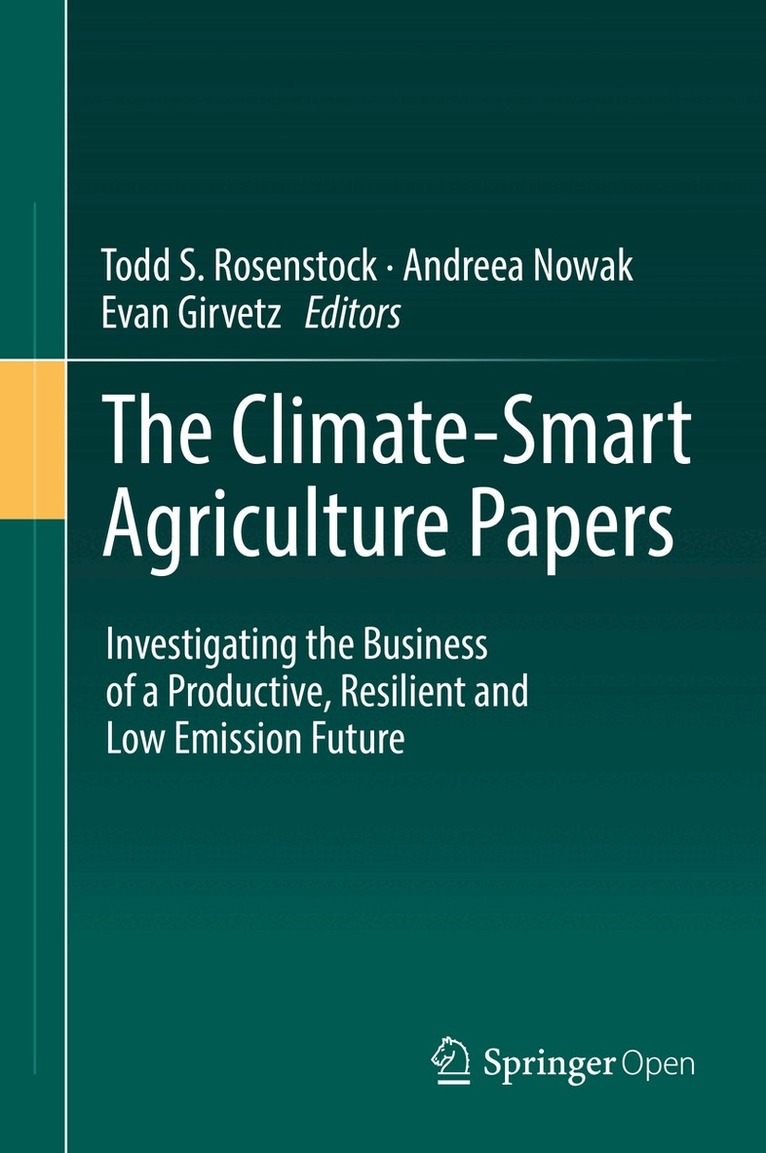
    Climate-Smart Agriculture Papers

    Investigating the Business of a Productive, Resilient and Low Emission Future

    AvTodd S. Rosenstock,Andreea Nowak

    Inbunden, Engelska, 2018

    542 kr

    Beställningsvara. Skickas inom 10-15 vardagar. Fri frakt över 249 kr.

    Beskrivning

    This book is open access under a CC BY 4.0 license.This volume shares new data relating to Climate-Smart Agriculture (CSA), with emphasis on experiences in Eastern and Southern Africa. The book is a collection of research by authors from over 30 institutions, spanning the public and private sectors, with specific knowledge on agricultural development in the region discussed. The material is assembled to answer key questions on the following five topic areas: (1) Climate impacts: What are the most significant current and near future climate risks undermining smallholder livelihoods? (2) Varieties: How can climate-smart varieties be delivered quickly and cost-effectively to smallholders? (3) Farm management: What are key lessons on the contributions from soil and water management to climate risk reduction and how should interventions be prioritized?  (4) Value chains: How can climate risks to supply and value chains be reduced? and (5) Scaling up: How can most promising climate risks reduction strategies be quickly scaled up and what are critical success factors? Readers who will be interested in this book include students, policy makers, and researchers studying climate change impacts on agriculture and agricultural sustainability.

    Produktinformation

    • Utgivningsdatum:2018-12-06
    • Mått:155 x 235 x 24 mm
    • Vikt:664 g
    • Format:Inbunden
    • Språk:Engelska
    • Antal sidor:321
    • Upplaga:18001
    • Förlag:Springer International Publishing AG
    • ISBN:9783319927978

    Utforska kategorier

    • Miljövetenskap och miljöpolitik inom Naturvetenskap och teknik
    • Lantbruksteknik inom Naturvetenskap och teknik
    • Agronomi inom Naturvetenskap och teknik

    Mer om författaren

    Todd Rosenstock is a Scientist  with the World Agroforestry Centre (ICRAF) in Kinshasa, Democratic Repbulic of Congo where he uses observational and manipulative experiments, data synthesis and modeling techniques to understand the synergies and tradeoffs among food production, society and the environment. Methods development for monitoring social and environmental change and climate-smart agricultural are central themes of his current research portfolio. Dr. Rosenstock is particularly interested in integrative, multidisciplinary science that can be applied to emerging issues in development and thus works with partners including: farmers, civil society, international NGOs, national governements and intergovernmental institutions. He is trained in agroecology (PhD, UC Davis), International Agricultural Development (MS, UC Davis), and horticulture (BS, University of Georgia, Athens). Andreea Nowak is a research scientist with the World Agroforestry Centre (ICRAF). Over the past six years, she has coordinated and carried out stakeholder-driven research on climate-smart agriculture (CSA) across Africa, Latin America and South Asia. Andreea has been working with governments and development partners in setting up participatory tools and analytical frameworks for prioritization, scaling, monitoring, and evaluation of national CSA investments. She contributed to the development of the ICRAF-CCAFS CSA Monitoring, Reporting and Verification Profiles and co-led the development of the CIAT-CCAFS CSA Country Profiles and CSA Prioritization Framework. Andreea holds an MSc degree in international development and project management, specializing in natural resource management (Lund University, Sweden) and a BA in political science  (University of Bucharest, Romania).Dr. Evan Girvetz is a Senior Scientist at the International Center for Tropical Agriculture (CIAT), team lead for the CIAT Decision and Policy Analysis Research Area in Africa, and an affiliate assistant professor at the University of Washington School of Environmental and Forest Sciences. His research spans climate-smart agriculture (CSA), sustainable agricultural intensification, ecosystem services, environmental decision support, and water resources management.  Dr. Girvetz works on these issues globally through innovative partnerships with the World Bank, African Development Bank, USAID, African Union, government agencies, NGOs, and the private sector. He sits on the steering committees of the Africa CSA Alliance and the World Overview of Conservation Approaches and Technologies, led the development of the Climate Wizard climate change analysis tool, and contributed to the development of the CSA 101 Website. Dr. Girvetz earned a PhD from the University of California, Davis, and is widely published and his research has been featured in top media outlets including the San Francisco Chronicle, Seattle Times and New Scientist magazine.

    Innehållsförteckning

    • Chapter 1-An introduction to the climate-smart agriculture papers.- Chapter 2-Future climate projections in Africa: where are we headed?.-  Chapter 3-Climate change and infectious livestock diseases: the case of rift valley fever and tick-borne diseases.- Chapter 4-Large scale crop suitability assessment under future climate using the ecocrop model: the case of six provinces in Angola’sPlanalto region.- Chapter 5-Understanding the role of soils and management on crops in the face of climate uncertainty in Zimbabwe: a sensitivity analysis.- Chapter 6-Role and challenges of the private seed sector in developing and disseminating climate-smart crop varieties in Eastern and Southern Africa.- Chapter 7-Fast-tracking the development and dissemination of a drought-tolerant maize variety in Ethiopia in response to the risks of climate change.- Chapter 8-Access to early generation seed: obstacles for delivery of climate-smart varieties.- Chapter 9-Climate change and seed systems of roots, tubers and bananas: the cases of potato in Kenya and sweet potato in Mozambique.- Chapter 10-Delivering perennial new and orphan crops for resilient and nutritious farming systems.- Chapter 11-Generating farm-validated variety recommendations for climate adaptation.- Chapter 12-What is the evidence base for climate-smart agriculture in East and Southern Africa? a systematic map.- Chapter 13-Understanding the multidimensionality of climate-smartness: examples from agroforestry in Tanzania.- Chapter 14-A participatory approach to assessing the climate-smartness of agricultural interventions: the Lushoto case.- Chapter 15-Household welfare effects of stress: tolerant varieties in Northern Uganda.- Chapter 16-Considering religion and tradition in climate smart agriculture: insights from Namibia.- Chapter 17-The role of farmers’ entrepreneurial orientation on agricultural innovations in Ugandan multi-stakeholder platforms.- Chapter 18-Shea butter: a pro-poor, pro-female route to increased income.- Chapter 19-One size does not fit all: private-sector perspectives on climate change, agriculture and adaptation.- Chapter 20-Climate-smart agricultural value chains: risks and perspectives.- Chapter 21-Nutrition-sensitive value chain development in a changing climate.- Chapter 22-Realising ambitious targets and metrics for private-sector action on climate risks.- Chapter 23-The role of learning alliances for creating an enabling climate-change policy environment in East Africa.- Chapter 24-Farmer-to-farmer extension: a low-cost approach for promoting climate-smart agriculture.- Chapter 25-Innovative partnerships to scale up climate-smart agriculture for smallholder farmers in Southern Africa.- Chapter 26-Rural finance to support climate change adaptation: experiences, lessons and policy perspectives.