• Fri frakt över 249 kr
  • •
  • Snabba leveranser
  • •
  • Billiga böcker
Kundservice

Du är på sajten för privatpersoner.

Företag, bibliotek eller offentlig verksamhet?

Du handlar på classic.bokus.com, där alla dina funktioner finns intakta.
Till classic.bokus.com
Bokus logotyp. Gå till startsidan.
  • Erbjudanden
  • Student
  • Topplistor
  • Barn & ungdom
  • Bokus Play
  • E-böcker
  • Ljudböcker
  • Pocketböcker
  • Spel och pussel

Pocketfynda! Hundratals böcker för 49 kr/st →

Sidfot

Mina sidor

    Hjälp

    • Kundservice
    • Vanliga frågor och svar
    • Frakt och leverans
    • Retur vid ångerrätt
    • Reklamera vara
    • Betalning
    • Köpvillkor
    • Allmänna villkor
    • Information om webbplatsens tillgänglighet

    Om Bokus

    • Om oss
    • Pressrum
    • För studenter
    • För företag
    • För bibliotek och offentlig verksamhet
    • För leverantörer
    • Hållbarhet

    Populärt

    • Aktuella erbjudanden
    • Presentkort
    • Studentlitteratur
    • Nya böcker
    • Topplistor
    • Signerade böcker
    • Engelska böcker

    Inspiration

    • Boktips
    • BookTok
    • Barnbokskaraktärer
    • Populära författare
    Logotyp för Bokus
    Följ oss på Facebook (extern länk)Följ oss på Instagram (extern länk)Följ oss på YouTube (extern länk)Följ oss på TikTok (extern länk)
    bokus @ CookiesAnpassa cookiesIntegritetspolicyKöpvillkor
    Till Citymail hemsida (extern länk)Till Budbee hemsida (extern länk)Till Postnord hemsida (extern länk)Till Schenker hemsida (extern länk)Till Early Bird hemsida (extern länk)Till Walleys hemsida (extern länk)
    1. Samhälle och politik
    2. Samhälle och kultur
    3. Kultur och medier
    4. Referensverk och tvärvetenskap

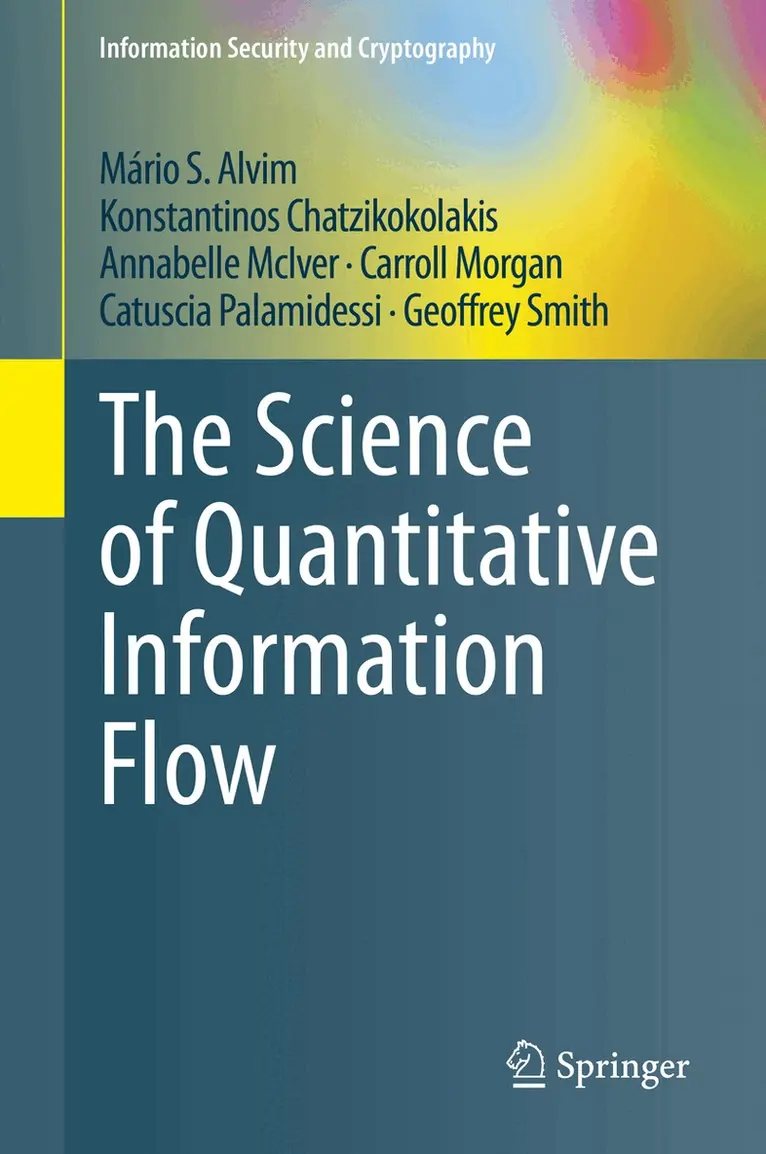
    Science of Quantitative Information Flow

    AvMário S. Alvim,Konstantinos Chatzikokolakis

    Inbunden, Engelska, 2020

    Del i serien Information Security and Cryptography

    650 kr

    Beställningsvara. Skickas inom 10-15 vardagar. Fri frakt över 249 kr.

    Beskrivning

    This book presents a comprehensive mathematical theory that explains precisely what information flow is, how it can be assessed quantitatively – so bringing precise meaning to the intuition that certain information leaks are small enough to be tolerated – and how systems can be constructed that achieve rigorous, quantitative information-flow guarantees in those terms. It addresses the fundamental challenge that functional and practical requirements frequently conflict with the goal of preserving confidentiality, making perfect security unattainable.Topics include: a systematic presentation of how unwanted information flow, i.e., "leaks", can be quantified in operationally significant ways and then bounded, both with respect to estimated benefit for an attacking adversary and by comparisons between alternative implementations; a detailed study of capacity, refinement, and Dalenius leakage, supporting robust leakage assessments; a unification of information-theoretic channels and information-leaking sequential programs within the same framework; and a collection of case studies, showing how the theory can be applied to interesting realistic scenarios.The text is unified, self-contained and comprehensive, accessible to students and researchers with some knowledge of discrete probability and undergraduate mathematics, and contains exercises to facilitate its use as a course textbook.

    Produktinformation

    • Utgivningsdatum:2020-09-23
    • Mått:155 x 235 x 33 mm
    • Vikt:922 g
    • Format:Inbunden
    • Språk:Engelska
    • Serie:Information Security and Cryptography
    • Antal sidor:478
    • Förlag:Springer International Publishing AG
    • ISBN:9783319961293

    Utforska kategorier

    • Referensverk och tvärvetenskap inom Samhälle och politik
    • Matematisk statistik inom Naturvetenskap och teknik
    • Programmeringsböcker inom Data och IT

    Mer om författaren

    Mário S. Alvim is assistant professor in the Computer Science Department of the Universidade Federal de Minas Gerais in Belo Horizonte. His current research interests include formal methods for security and pri­vacy, as well as applications of quantitative information flow to fields beyond security. Kostas Chatzikokolakis is associate professor at the University of Athens. He works on security and pri­vacy, in particular quantitative information flow, location privacy, and differential privacy. Annabelle McIver is professor in the Dept. of Computing at Macquarie University in Sydney. She works on mathematical techniques for the verification of probabilistic systems. Carroll Morgan is professor in the School of Engineering and Computer Science at the University of New South Wales, and is affiliated with the Trustworthy Systems Group of CSIRO’s Data61. His current interests are quantitative information flow, program derivation (including security), and proved correctness of multi­core operating-system kernels. Catuscia Palamidessi is director of research at Inria Saclay. She is the leader of COMÈTE, a research team in the Inria and École Polytechnique shared lab. Her main research interests are quantitative information flow, privacy, and concurrency theory. Geoffrey Smith is professor in the School of Computing and Information Sciences of Florida International University in Miami. His current research interests include quantitative information flow and its applications to cryptography.

    Innehållsförteckning

    • Part I, Motivation.- Introduction.- Part II, Secrets and How to Measure Them.- Modeling Secrets.- On g-Vulnerability.- Part III, Channels and Information Leakage.- Channels.- Posterior Vulnerability and Leakage.- Robustness.- Capacity.- Composition of Channels.- Refinement.- The Dalenius Perspective.- Axiomatics.- The Geometry of Hypers, Gains, and Losses.- Part IV, Information Leakage in Sequential Programs.- Quantitative Information Flow in Sequential Computer Programs.- Hidden-Markov Modeling of QIF in Programs.- Program Algebra for QIF.- Iteration and Non-termination.- A Demonic Lattice of Information.- Part V, Applications.- The Crowds Protocol.- Timing Attacks on Blinded and Bucketed Cryptography.- Defense Against Side Channels.- Multi-party Computation: The Three Judges Protocol.- Voting Systems.- Differential Privacy.- Glossary and Index.