• Fri frakt över 249 kr
  • •
  • Snabba leveranser
  • •
  • Billiga böcker
Kundservice

Du är på sajten för privatpersoner.

Företag, bibliotek eller offentlig verksamhet?

Du handlar på classic.bokus.com, där alla dina funktioner finns intakta.
Till classic.bokus.com
Bokus logotyp. Gå till startsidan.
  • Erbjudanden
  • Nyheter
  • Student
  • Topplistor
  • Barn & ungdom
  • Bokus Play
  • E-böcker
  • Pocketböcker
  • Spel & pussel

10% rabatt på allt med kod: NYSTART10 →

Sidfot

Mina sidor

    Hjälp

    • Kundservice
    • Vanliga frågor och svar
    • Frakt och leverans
    • Retur vid ångerrätt
    • Reklamera vara
    • Betalning
    • Köpvillkor
    • Allmänna villkor
    • Information om webbplatsens tillgänglighet

    Om Bokus

    • Om oss
    • Pressrum
    • För studenter
    • För företag
    • För bibliotek och offentlig verksamhet
    • För leverantörer
    • Hållbarhet

    Populärt

    • Aktuella erbjudanden
    • Presentkort
    • Studentlitteratur
    • Nya böcker
    • Topplistor
    • Signerade böcker
    • Engelska böcker

    Inspiration

    • Boktips
    • BookTok
    • Populära bokserier
    • Barnbokskaraktärer
    • Populära författare
    Logotyp för Bokus
    Följ oss på Facebook (extern länk)Följ oss på Instagram (extern länk)Följ oss på YouTube (extern länk)Följ oss på TikTok (extern länk)
    bokus @ CookiesAnpassa cookiesIntegritetspolicyKöpvillkor
    Till Citymail hemsida (extern länk)Till Budbee hemsida (extern länk)Till Postnord hemsida (extern länk)Till Schenker hemsida (extern länk)Till Early Bird hemsida (extern länk)Till Walleys hemsida (extern länk)
    1. Naturvetenskap och teknik
    2. Teknik och industri
    3. Elektronik och kommunikationer

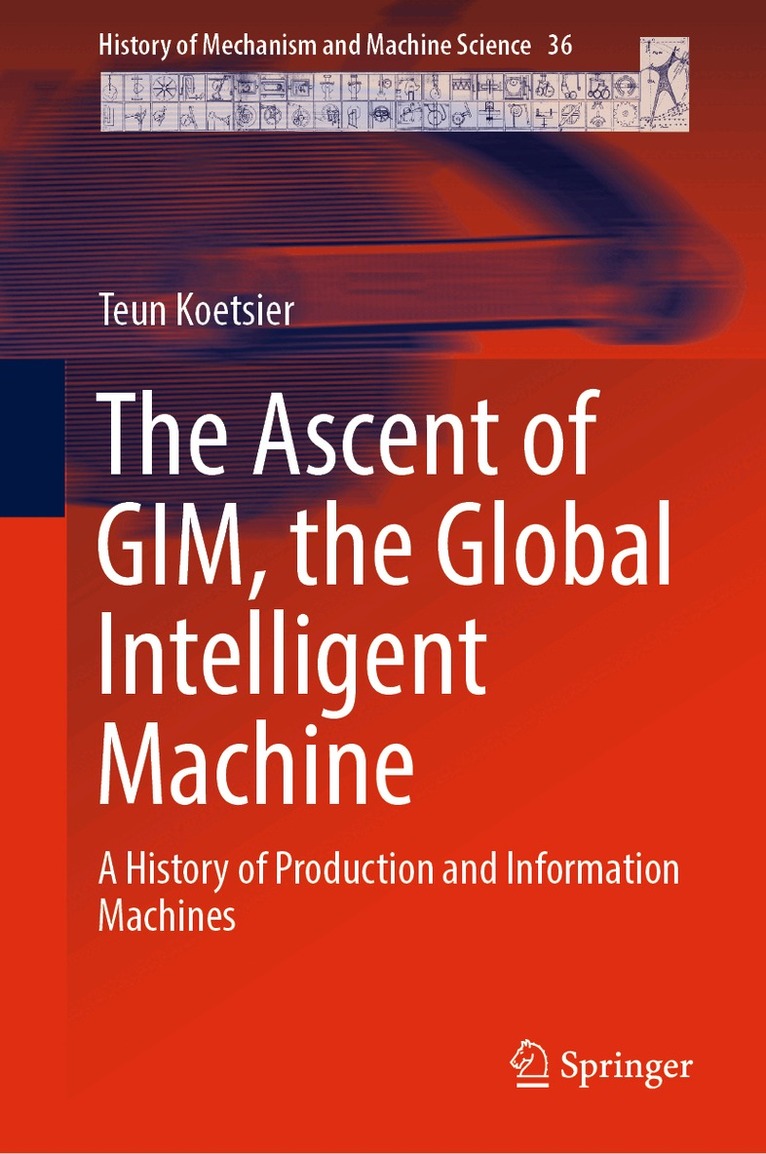
    Ascent of GIM, the Global Intelligent Machine

    A History of Production and Information Machines

    AvTeun Koetsier

    Inbunden, Engelska, 2018

    Del 36 i serien History of Mechanism and Machine Science

    1 086 kr

    Beställningsvara. Skickas inom 10-15 vardagar. Fri frakt över 249 kr.

    Fler format och utgåvor

    E-bok

    1 413 kr

    Beskrivning

    In  the concluding chapters of this book the author introduces GIM, the Global Intelligent Machine. GIM is a huge global hybrid machine, a combination of production machinery, information machinery and mechanized networks.  In the future it may very well encompass all machinery on the globe. The author discusses the development of machines from the Stone Age until the present and pays particular attention to the rise of the science of machines and the development of the relationship between science and technology. The first production and information tools were invented in the Stone Age. In the Agricultural empires tools and machinery became more complex. During and after the Industrial Revolution the pace of innovation accelerated. In the 20th century the mechanization of production, information processing and networks became increasingly sophisticated. GIM is the culmination of this development.GIM is no science fiction. GIM exists and is growing and getting smarter and smarter. Individuals and institutions are trying to control parts of this giant global robot. By looking at its history and by putting GIM in the context of the current developments, this book seeks to reach a fuller understanding of this phenomenon.

    Produktinformation

    • Utgivningsdatum:2018-12-01
    • Mått:155 x 235 x 28 mm
    • Vikt:720 g
    • Format:Inbunden
    • Språk:Engelska
    • Serie:History of Mechanism and Machine Science
    • Antal sidor:364
    • Förlag:Springer International Publishing AG
    • ISBN:9783319965468

    Utforska kategorier

    • Elektronik och kommunikationer inom Naturvetenskap och teknik
    • Teknik: allmänt inom Naturvetenskap och teknik
    • Artificiell intelligens inom Data och IT

    Recensioner i media

    “The book presents an ambitious, clearly written, and well-organized history of technology from before the emergence of Homo sapiens until the development of the Internet of Things in the twenty-first century. … The concept of GIM is the book’s most important contribution to the big history of technology. … Koetsier’s The Ascent of GIM is a useful contribution to the growing literature on the big history of technology.” (Dustin Abnet, Isis, Vol. 113 (4), December, 2022)

    Innehållsförteckning

    • Preface.- 1 Introduction.- The Global Intelligent Machine.- Cultural evolution.- Production technology and information technology.- 2 The Rise of Homo Sapiens.- Animals using production tools.- Monkeys and apes using production tools.- Information tools in the animal world: clues, signs and signals.- Communicating honey bees.- Communication among monkeys and apes.- From the hairpin ancestor to Homo sapiens.- Olduwan technology.- The adze makers of Langda.- Language as an information tool.- The control of fire.- The Stone Age Revolution.- Information tools.- Whistle languages.- Talking drums.- The Ishango bone.- Orientation in space, maps in the Pacific.- 3 Tools in the Early Agricultural Empires.- Economic surplus.- Agriculture.- The wheel.- Monumental architecture.- Complete writing.- Towards the alphabet.- Mathematics.- Sundials and water clocks.- 4 The Axial Age and the Birth of Western Science.- The Axial Age.- The rise of abstract symbolic thought in China and India.- Oral versus written thought.- Aristotle’s Logic, a New Information Tool.- Knowledge-how versus knowledge-that.- Deductive science.- The birth of the theory of machines.- The wedge and the pulleys.- Archimedes.- The invention of the screw.- Heron’s Mechanics.- Combinations of simple machines.- Difficulties in understanding the wedge and the inclined plane.- 5 Machines in Classical Antiquity.- The invention of artillery.- Production machines in Vitruvius’ Ten Books on Architecture.- The Phaistos disc.- The abacus.- Water clocks and sundials.- The Armillary Sphere.- The anaphoric clock.- The astrolabe.- The mystery of the Antikythera mechanism.- The front dial.- The upper back dial.- The pin and slot mechanism.- The hodometer.- Automata.- 6 The Middle Ages.- Marco Polo.- Textile machines.- Military technology.- Metal technology.- Movable type printing.- The hodometer and Su Sung’s clock.- Automata.- Chinese influence in the West.- The Golden Age of Islamic Science.- Islamic culture, the information machines of the three Banu Musa.- Al-Jazari’s production machines.- Al-Muradi.- The rise of the West.- Jordanus.- The Vision of Ramon Llull.- The invention of the printing press.- Llull’s influence.- A new information machine: the mechanical clock.- 7 The Renaissance and the Scientific Revolution.- The impact of the printing press.- Da Vinci and the others.- Parachute, tank and machine gun.- Da Vinci as an engineer.- Da Vinci’s fame.- Theaters of machines.- Exterior ballistics.- Del Monte and simple machines.- Galilei and simple machines.- The Archimedean screw pump.- Astronomy.- Galilei’s Discorsi.- A remarkable Flemish engineer: Simon Stevin.- There is more.- The dream of a mathesis universalis.- Calculators.- Scepticism.- 8 The First Wave of Industrial Revolution: Cotton Textiles and Pig Iron.- The background.- The role of the Scientific Revolution.- A macroeconomic view of the Industrial Revolution.- The Malthusian trap.- The escape.- One or more Industrial Revolutions?.- Innovation and long waves.- The Control Revolution.- Textile industry.- Steam engines.- Safety valve and governor.- Robert Stirling.- Printing.- A changing world.- The clockmakers and the art of the transformation of motion.- Watt’s parallelogram.- Babbage’s machines.- 9 The Second Wave of Industrial Revolution: Railroads and Steel.- Globalization.- The Railroads.- Stephenson’s valve gear.- Corliss Engines.- Problems of control.- Organizational charts: the birth of a new information tool.- Office technology.- Kinematics and the birth of scientific technology.- The energetic approach.- Sadi Carnot and the Carnot machine.- Thermodynamics is born.- The application of thermodynamics to the design of actual machines.- 10 More Scientific Technology.- Electrical engineering.- Ballistics.- Iron in architecture.- Scientific management.- Control rooms.- Sales.- Calculators.- Statistical machines.- Scientific calculators.- Kelvin’s tide predictors.- Differential analyzers.- 11 Electronic Brains.- The fourth wave and the first programmable computers.- Turing machines: What can be computed in principle?.- Code breaking.- The mechanization of the mind.- Early computers in the USA.- Real Time Computing.- Software.- The computer becomes personal.- The fifth wave and the World Wide Web.- Smartphones and more.- 12 Towards the Global Intelligent Machine.- Early hybrid machines.- Karel Čapek.- An early parallel robot.- Analogue computer-controlled machines.- From analogue to numerical control.- Cybernetics.- An early serial robot.- Robotics.- The Stewart platform.- Field and service robots.- Artificial intelligence.- The Internet of Things.- The Global Intelligent Machine.- On the way to GIM.- GIM is growing fast.- Industry 4.0.- 13 Epilogue.- Hindsight.- A Brave New World?.- The battleground.- Cybercrime.- Unemployment.- Security, Privacy and fake news.- 14 Literature.- Index.