• Fri frakt över 249 kr
  • •
  • Snabba leveranser
  • •
  • Billiga böcker
Kundservice

Du är på sajten för privatpersoner.

Företag, bibliotek eller offentlig verksamhet?

Du handlar på classic.bokus.com, där alla dina funktioner finns intakta.
Till classic.bokus.com
Bokus logotyp. Gå till startsidan.
  • Erbjudanden
  • Nyheter
  • Student
  • Topplistor
  • Barn & ungdom
  • Bokus Play
  • E-böcker
  • Pocketböcker
  • Spel & pussel

10% rabatt på allt med kod NYSTART10 →

Sidfot

Mina sidor

    Hjälp

    • Kundservice
    • Vanliga frågor och svar
    • Frakt och leverans
    • Retur vid ångerrätt
    • Reklamera vara
    • Betalning
    • Köpvillkor
    • Allmänna villkor
    • Information om webbplatsens tillgänglighet

    Om Bokus

    • Om oss
    • Pressrum
    • För studenter
    • För företag
    • För bibliotek och offentlig verksamhet
    • För leverantörer
    • Hållbarhet

    Populärt

    • Aktuella erbjudanden
    • Presentkort
    • Studentlitteratur
    • Nya böcker
    • Topplistor
    • Signerade böcker
    • Engelska böcker

    Inspiration

    • Boktips
    • BookTok
    • Populära bokserier
    • Barnbokskaraktärer
    • Populära författare
    Logotyp för Bokus
    Följ oss på Facebook (extern länk)Följ oss på Instagram (extern länk)Följ oss på YouTube (extern länk)Följ oss på TikTok (extern länk)
    bokus @ CookiesAnpassa cookiesIntegritetspolicyKöpvillkor
    Till Citymail hemsida (extern länk)Till Budbee hemsida (extern länk)Till Postnord hemsida (extern länk)Till Schenker hemsida (extern länk)Till Early Bird hemsida (extern länk)Till Walleys hemsida (extern länk)
    1. Naturvetenskap och teknik
    2. Teknik och industri
    3. Teknik: allmänt

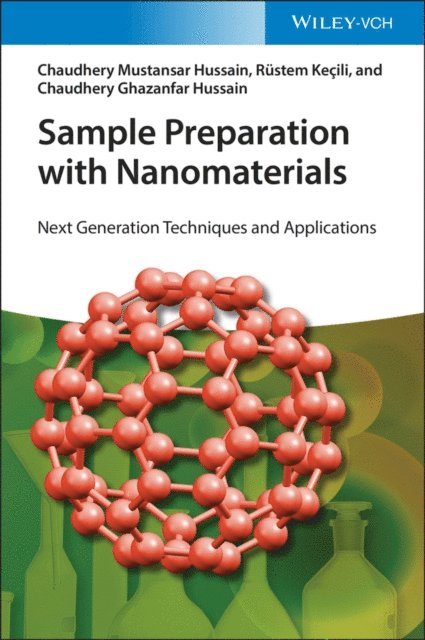
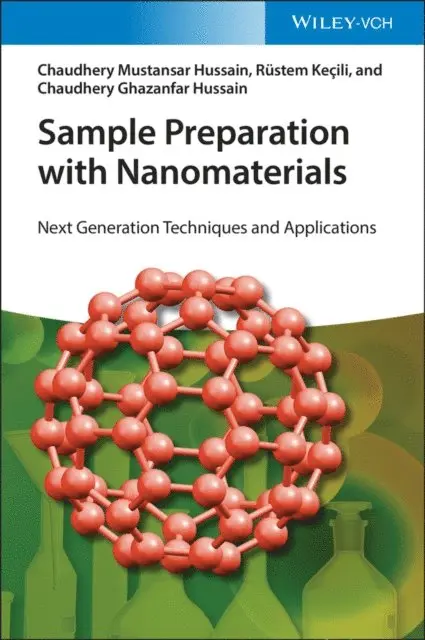
    Sample Preparation with Nanomaterials

    Next Generation Techniques and Applications

    AvChaudhery Mustansar Hussain,Rustem Kecili

    Inbunden, Engelska, 2021

    1 741 kr

    Beställningsvara. Skickas inom 5-8 vardagar. Fri frakt över 249 kr.

    Beskrivning

    Discover this timely, comprehensive, and up-to-date exploration of crucial aspects of the use of nanomaterials in analytical chemistry  Sample Preparation with Nanomaterials: Next Generation Techniques for Sample Preparation delivers insightful and complete overview of recent progress in the use of nanomaterials in sample preparation. The book begins with an overview of special features of nanomaterials and their applications in analytical sciences. Important types of nanomaterials, like carbon nanotubes and magnetic particles, are reviewed and biological sample preparation and lab-on-a-chip systems are presented.  The distinguished author places special emphasis on approaches that tend to green and reduce the cost of sample treatment processes. He also discusses the legal, economical, and toxicity aspects of nanomaterial samples. This book includes extensive reference material, like a complete list of manufacturers, that makes it invaluable for professionals in analytical chemistry.  Sample Preparation with Nanomaterials offers considerations of the economic aspects of nanomaterials, as well as the assessment of their toxicity and risk. Readers will also benefit from the inclusion of:   A thorough introduction to nanomaterials in the analytical sciences and special properties of nanomaterials for sample preparation An exploration of the mechanism of adsorption and desorption on nanomaterials, including carbon nanomaterials used as adsorbents Discussions of membrane applications of nanomaterials, surface enhanced raman spectroscopy, and the use of nanomaterials for biological sample preparation A treatment of magnetic nanomaterials, lab-on-a-chip nanomaterials, and toxicity and risk assessment of nanomaterials Perfect for analytical chemists, materials scientists, and process engineers, Sample Preparation with Nanomaterials: Next Generation Techniques for Sample Preparation will also earn a place in the libraries of analytical laboratories, universities, and companies who conduct research into nanomaterials and seek a one-stop resource for sample preparation.

    Produktinformation

    • Utgivningsdatum:2021-04-27
    • Mått:170 x 244 x 15 mm
    • Vikt:510 g
    • Format:Inbunden
    • Språk:Engelska
    • Antal sidor:304
    • Förlag:Wiley-VCH Verlag GmbH
    • ISBN:9783527338177

    Utforska kategorier

    • Teknik: allmänt inom Naturvetenskap och teknik
    • Tillverkningsteknik inom Naturvetenskap och teknik

    Mer om författaren

    Chaudhery Mustansar Hussain, PhD, is an Adjunct Professor and Director of Labs in the Department of Chemistry & Environmental Sciences at the New Jersey Institute of Technology (NJIT), Newark, New Jersey, USA. His research is focused on nanotechnology, analytical chemistry, advanced technologies & materials, environmental management, and various industries. Dr. Hussain is the author of numerous papers in peer-reviewed journals as well as prolific author and editor of several (around 50 books) scientific monographs and handbooks in his research areas.Rüstem Keçili is currently an Associate Professor at the Yunus Emre Vocational School of Health Services, Anadolu University, Turkey. He worked as a researcher at MIP Technologies AB, Sweden, and was a visiting researcher at the University of Manchester, UK. His professional background covers nanomaterials, molecularly imprinted polymers and chromatography.Chaudhery Ghazanfar Hussain is a Research Scholar in Computer Science and Technology at the Department of Education, Punjab, Pakistan. His key areas of research are Data Science, Computer Networks, Environmental Modeling, nanomaterials and Industrial development. He is author of monographs on software technology. He is a true IT professional and affiliated with several companies.

    Recensioner i media

    "... an excellent contribution in the field of sample preparation, showing the interesting possibilities offered by nanomaterials as analytical tools. It combines basic scientific principles of NMs with practical aspects, and provides examples of analytical applications. Overall, it presents a good resource on sample preparation alternatives for analytical purposes involving NMs." —Ángel Ríos, Analytical and Bioanalytical Chemistry, https://doi.org/10.1007/s00216-021-03759-w

    Innehållsförteckning

    • 1 Nanomaterials (NMs) in Analytical Sciences 11.1 Introduction 1 1.2 Types of NMs 21.2.1 Graphene 21.2.2 Carbon Nanotubes (CNTs) 31.2.3 Fullerenes (FULs) 41.2.4 Inorganic Nanoparticles 61.2.4.1 Gold and Silver Nanoparticles 61.2.4.2 Titanium Nanoparticles 71.2.4.3 Silica Nanoparticles 71.2.5 Magnetic Nanoparticles 71.3 Applications of NMs 81.3.1 NMs in Separation Processes 81.3.2 NMs in Biomedical Applications 81.3.3 NMs in Sensor Platforms 121.4 Conclusions 16References 192 Special Properties of Nanomaterials (NMs) for Sample Preparation 272.1 Introduction 272.2 Mechanical Properties of NMs 282.2.1 Hardness and Strength 282.2.2 Ductility 302.2.3 Applications of Mechanical Properties 322.3 Thermal Properties of NMs 332.4 Electrical Properties of NMs 352.5 Optical Properties of NMs 362.6 Magnetic Properties of NMs 372.7 Adsorption Properties of NMs 382.8 Conclusions 39References 403 Adsorption Mechanism on Nanomaterials (NMs) 473.1 Introduction 473.2 Adsorption Process 483.2.1 Adsorption Isotherms 483.2.1.1 Langmuir Isotherm 503.2.1.2 Freundlich Isotherm 503.2.1.3 Temkin Isotherm 503.2.1.4 Dubinin–Radushkevich Model 513.2.1.5 Harkins–Jura and Halsey Isotherms 513.2.1.6 Redlich–Peterson Isotherm 513.2.1.7 BET (Brunauer, Emmett, and Teller) Isotherm 523.2.2 Adsorption Kinetics and Thermodynamics 523.2.2.1 Pseudo-first-order Kinetics 523.2.2.2 Pseudo-second-order Kinetics 533.2.2.3 Intraparticle Diffusion Model 533.2.2.4 Thermodynamic Study 533.2.3 Adsorption Process on Nanoparticles 543.2.3.1 Silver Nanoparticles 543.2.3.2 Gold Nanoparticles 553.2.3.3 Zinc Oxide Nanoparticles 563.2.3.4 Magnetic Fe3O4 Nanoparticles 563.2.4 Adsorption Process on Carbon Nanomaterials 583.2.4.1 Activated Carbon 583.2.4.2 Carbon Nanotubes (CNTs) 593.2.4.3 Graphene Oxide (GO) 603.3 Conclusions and Future Perspective 63References 634 Carbon Nanomaterials (CNMs) as Adsorbents for Sample Preparation 714.1 Introduction 714.2 Carbon Nanomaterials (CNMs) 724.2.1 Carbon Nanotubes (CNTs) 724.2.2 Graphene 734.2.3 Fullerenes (FULs) 754.3 Adsorption on CNMs 764.4 Applications of CNMs 774.4.1 Extraction and Separation Applications 774.4.2 Chromatographic Applications 804.4.2.1 Chromatographic Stationary Phases Having CNTs 814.4.2.2 Chromatographic Stationary Phases Having FULs 834.5 Conclusions 84References 845 Membrane Applications of Nanomaterials (NMs) 935.1 Introduction 935.2 Traditional Membranes 935.3 Carbon Nanomaterial-based Membranes 945.3.1 Graphene-based Membranes 945.3.2 Carbon Nanotube-based Membranes 975.3.3 Fullerene-based Membranes 1005.4 Nanoparticle-based Membranes 1015.5 Molecularly Imprinted Polymer (MIP)-based Membranes 1025.6 Conclusions 105References 1086 Surface-Enhanced Raman Spectroscopy (SERS) with Nanomaterials (NMs) 1176.1 Introduction 1176.2 Theory of SERS 1186.3 SERS Mechanisms 1186.3.1 Electromagnetic Enhancement 1196.3.2 Chemical Enhancement 1206.4 Determination of SERS Enhancement Factor 1216.5 Selection Rules 1216.5.1 Image Field Model 1216.5.2 Electromagnetic Field Model 1226.6 Fabrications of SERS Substrates 1236.6.1 Template-assisted Fabrication 1246.6.2 Hybrid Fabrication 1246.6.3 Fabrication by Using Colloids 1246.6.4 Direct Deposition 1256.7 Applications of SERS 1256.7.1 SERS-Based Separation Applications 1256.7.2 SERS-Based Sensor Applications 1266.7.2.1 Environmental Analysis 1266.7.2.2 Forensic Analysis 1296.7.2.3 Biological Applications 1316.8 Conclusions 133References 1337 Nanomaterials (NMs) for Biological Sample Preparations 1477.1 Introduction 1477.2 The Use of NMs in Diagnostic Platforms 1487.2.1 The Optimization of NMs in Diagnostic Platforms 1487.2.2 Biofunctionalization of NMs in Diagnostic Platforms 1497.3 NMs-based Lab-on-a-chip (LOC) Platforms 1507.3.1 Paper-based LOC Platforms 1527.3.2 Centrifugal LOC Platforms 1527.3.3 Droplet-based LOC Platforms 1527.3.4 Digital LOC Platforms 1527.3.5 Surface AcousticWave-based LOC Platforms 1527.3.6 LOC Platforms for Biological Applications 1537.4 Biomedical Applications of NMs 1557.5 Sensor Applications of NMs 1577.6 Conclusions 162References 1628 Magnetic Nanomaterials for Sample Preparation 1738.1 Introduction 1738.2 Synthesis of Magnetic Nanoparticles 1748.2.1 Thermal Decomposition Technique 1748.2.2 Coprecipitation Technique 1758.2.3 Sol–Gel Synthesis 1758.2.4 Hydrothermal Synthesis 1768.2.5 Microemulsion-Based Synthesis 1768.2.6 Flow Injection Synthesis 1768.2.7 Aerosol/Vapor-Phase-Based Synthesis 1768.3 Solid-Phase Extraction (SPE) 1778.4 Magnetic Solid-Phase Extraction (MSPE) 1778.4.1 MSPE for Environmental Samples 1788.4.2 MSPE for Food and Beverage Samples 1838.4.3 MSPE for Biological Samples 1858.5 Conclusions and Future Trends 186References 1879 Lab-on-a-Chip with Nanomaterials (NMs) 1959.1 Introduction 1959.2 Lab-on-a-Chip (LOC) Concept 1969.2.1 Paper-based LOC Systems 1989.2.2 Centrifugal LOC Systems 1989.2.3 Droplet-Based LOC Systems 1989.2.4 Digital LOC Systems 1999.2.5 Surface AcousticWave-Based LOC Systems 1999.3 NM-Based LOC Platforms 1999.3.1 NM-Based Transducers 1999.3.1.1 Electrochemical Detection Systems 1999.3.1.2 Optical Detection Systems 2029.3.1.3 Other Detection Techniques 2059.3.2 Nanoparticles as Labels in Microfluidics 2069.3.3 NMs for Process Improvement 2089.4 Conclusions and Future Perspectives 209References 21010 Toxicity and Risk Assessment of Nanomaterials 21910.1 Introduction 21910.2 Hazard Assessment of Nanomaterials 22010.2.1 Dermal Toxicity of Nanomaterials 22010.2.2 Inhalational Toxicity of Nanomater;;als 22110.2.3 Carcinogenicity and Genotoxicity of Nanomaterials 22310.2.4 Neurotoxicity of Nanomaterials 22610.3 Toxicity Mechanism of Nanomaterials 22710.4 The Traditional Risk Assessment Paradigm 22910.5 Strategies for Improving Specific Risk Assessment 23010.5.1 Combining Life Cycle Methodology with the Risk Assessment Approach 23010.5.2 The Support of Risk-Based Classification Systems 23110.6 Conclusions 232References 23211 Economic Aspects of Nanomaterials (NMs) for Sample Preparation 24111.1 Introduction 24111.2 Toxicity Concerns of NMs 24211.3 Global Market for NM-Based Products 24311.4 Conclusions 245References 24612 Legal Aspects of Nanomaterials (NMs) for Sample Preparation 25112.1 Introduction 25112.2 Safety Issues of NMs 25112.3 Regulatory Aspects of NMs 25212.3.1 Ethical Concerns in the Environmental Effects of NMs 25312.3.2 Ethical Concerns in Occupational Health and Safety ofWorkers 25412.3.3 Ethical Concerns of NMs in Food 25512.3.4 Ethical Concerns of NMs in Drugs, Cosmetics, and Human Health 25512.4 Conclusions 256References 25713 Monitoring of Nanomaterials (NMs) in the Environment 26113.1 Introduction 26113.2 Toxicity and Safety Concerns of NMs 26213.3 Main Sources and Transport Routes of Nanopollutants 26413.4 Requirements of Analytical Approaches 26613.5 Sampling of NMs in Environmental Samples 26613.6 Separation of NMs in Environmental Samples 26713.7 Detection Techniques for the Characterization of NMs 26813.8 Conclusions 270References 27014 Future Prospect of Sampling 27514.1 Introduction 27514.2 Sampling 27614.3 Sample Preparation 27614.4 Green Chemistry 27814.5 Miniaturization of Analytical Systems 28014.5.1 Miniaturization of Separation Techniques 28114.5.2 Lab-on-a-Valve (LOV) as a Powerful Tool to Meet Green Chemical Principles 28314.6 Conclusions 283References 284Index 289