• Fri frakt över 249 kr
  • •
  • Snabba leveranser
  • •
  • Billiga böcker
Kundservice

Du är på sajten för privatpersoner.

Företag, bibliotek eller offentlig verksamhet?

Du handlar på classic.bokus.com, där alla dina funktioner finns intakta.
Till classic.bokus.com
Bokus logotyp. Gå till startsidan.
  • Erbjudanden
  • Nyheter
  • Student
  • Topplistor
  • Barn & ungdom
  • Bokus Play
  • E-böcker
  • Pocketböcker
  • Spel & pussel

10% rabatt på allt med kod NYSTART10 →

Sidfot

Mina sidor

    Hjälp

    • Kundservice
    • Vanliga frågor och svar
    • Frakt och leverans
    • Retur vid ångerrätt
    • Reklamera vara
    • Betalning
    • Köpvillkor
    • Allmänna villkor
    • Information om webbplatsens tillgänglighet

    Om Bokus

    • Om oss
    • Pressrum
    • För studenter
    • För företag
    • För bibliotek och offentlig verksamhet
    • För leverantörer
    • Hållbarhet

    Populärt

    • Aktuella erbjudanden
    • Presentkort
    • Studentlitteratur
    • Nya böcker
    • Topplistor
    • Signerade böcker
    • Engelska böcker

    Inspiration

    • Boktips
    • BookTok
    • Populära bokserier
    • Barnbokskaraktärer
    • Populära författare
    Logotyp för Bokus
    Följ oss på Facebook (extern länk)Följ oss på Instagram (extern länk)Följ oss på YouTube (extern länk)Följ oss på TikTok (extern länk)
    bokus @ CookiesAnpassa cookiesIntegritetspolicyKöpvillkor
    Till Citymail hemsida (extern länk)Till Budbee hemsida (extern länk)Till Postnord hemsida (extern länk)Till Schenker hemsida (extern länk)Till Early Bird hemsida (extern länk)Till Walleys hemsida (extern länk)
    1. Naturvetenskap och teknik
    2. Teknik och industri
    3. Elektronik och kommunikationer

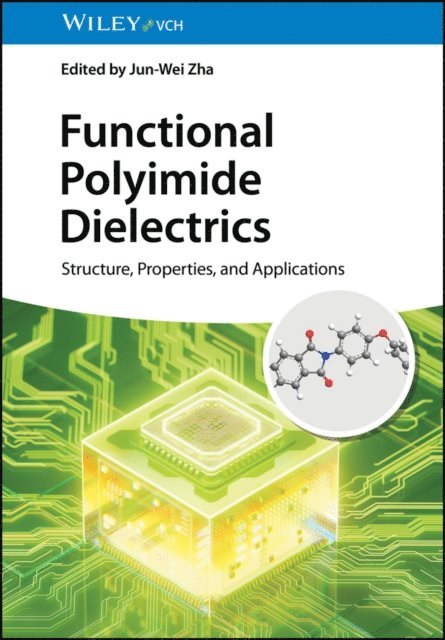
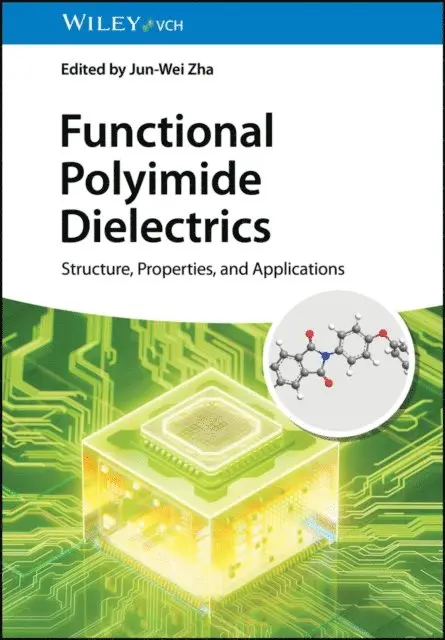
    Functional Polyimide Dielectrics

    Structure, Properties, and Applications

    AvJun-Wei Zha,Jun-Wei Zha

    Inbunden, Engelska, 2025

    1 630 kr

    Beställningsvara. Skickas inom 5-8 vardagar. Fri frakt över 249 kr.

    Beskrivning

    An of-the-moment discussion of the most cutting-edge research in the field of polyimide dielectrics In Functional Polyimide Dielectrics: Structure, Properties, and Applications, distinguished researcher Dr. Jun-Wei Zha delivers an up-to-date and authoritative discussion of the latest advancements in the application of polyimide dielectrics (PIDs) in electrical and electronic equipment. Readers will find coverage of the application of PIDs in aerospace, high-temperature energy storage capacitors, corona-resistant motors, new energy power equipment, packaging, and more. The book serves as a valuable reference for improving the performance and expanding the application of existing PIDs, as well as designing and developing new PIDs. It also provides a current overview of research and frontier applications that will prove useful to students and researchers from multiple disciplines. Functional Polyimide Dielectrics also contains: A thorough introduction to the different types of polyimide dielectrics, including their synthesis, composites & blends, processing-property relationships, processing strategies and technologies, properties and applicationsComprehensive explorations of a wide range of PID applications in a variety of special applications, like energy storage, insulation, thermal conductivity, intelligence, and morePractical discussions of the environmental aspects of the technology, as well as life cycle assessment sustainable alternative possibilitiesComplete treatments of smart polyimide dielectricsPerfect for materials scientists, electronics engineers, polymer chemists, physicists, and mechanical engineers, Functional Polyimide Dielectrics: Structure, Properties, and Applications will also benefit professionals, engineers, and scientists working in the chemical industry.
    Produktinformation

    • Utgivningsdatum:2025-04-23
    • Mått:170 x 244 x 15 mm
    • Vikt:680 g
    • Format:Inbunden
    • Språk:Engelska
    • Antal sidor:304
    • Förlag:Wiley-VCH Verlag GmbH
    • ISBN:9783527354337

    Utforska kategorier

    • Elektronik och kommunikationer inom Naturvetenskap och teknik
    • Maskinteknik och material inom Naturvetenskap och teknik
    • Tillverkningsteknik inom Naturvetenskap och teknik

    Mer om författaren

    Jun-Wei Zha, PhD, is Professor at the University of Science and Technology Beijing, China. He was previously selected as a Hong Kong Scholar. He is currently the IET Fellow, IEEE Senior Member, member of IEEE/DEIS Technical Committee on Nanodielectrics and CIGRE WG D1-73 etc. He won the first prize of Natural Science of the Ministry of Education in 2019, the first prize of Natural Science of Beijing Science and Technology Award in 2022 and Young Scientist Award of Chinese Society for Composite Materials in 2021.

    Innehållsförteckning

    • 1 Overview of Polyimide Dielectrics 1Mengyu Xiao and Jun-Wei Zha1.1 Introduction 11.2 Structure Design of Polyimide 11.3 Fabrication of Polyimide 41.4 Applications of Polyimide 41.4.1 Capacitive Energy Storage 41.4.2 Electronic Devices 51.4.3 Electrical Engineering 61.4.4 Medical Materials 61.4.5 Environmental Protection 61.5 Summary and Outlook 6References 72 Structures and Properties of Polyimide Dielectric Materials 9Lei Zhai, Yi-Kai Wang, and Lin Fan2.1 Introducing Polar Groups 102.1.1 Nitrile Group 102.1.2 Sulfonyl Group 152.1.3 Carboxylic Group 182.1.4 Pyridine and Urea Group 212.2 Introducing Non-Conjugated Structures 212.2.1 Aliphatic Structure 222.2.2 Cycloaliphatic Structure 252.3 Introducing Non-Coplanar Structures 282.3.1 Bulky Substituents 282.3.2 Spiro Structures 312.4 Introducing Crosslinking Structures 342.5 Summary and Outlook 38References 423 Processing Technology of Polyimide Dielectrics: From Experimental to Industrial Scale 47xi Ren, Zhibin He, Shunqi Yuan, Zhenzhong Wang, Shujun Han, Yuexin Qi, and Jingang Liu3.1 Introduction 473.2 PID Synthetic Chemistry 493.3 Processing Technologies for PIDs 533.3.1 PI Precursor Varnishes 533.3.2 PI Film Dielectrics 553.3.2.1 PI Films 553.3.2.2 PI Nanodielectric Films 583.3.3 Thermoplastic PI Dielectrics 613.3.4 PI Aerogel Dielectrics 653.4 Summary 67Acknowledgments 68Declarations 68References 694 Polyimide Dielectrics for High-Temperature Energy Storage 77Wenjie Huang, Wenshuai Zhao, and Jun-Wei Zha4.1 Introduction 774.2 Key Characteristics and Mechanisms of Polyimide Dielectrics for Energy Storage 794.2.1 Dielectric Energy Storage Mechanism 794.2.2 Electrical Polarization and Dielectric Permittivity 804.2.3 Dielectric Breakdown Strength 814.2.4 Dielectric Loss 834.2.5 Breakdown Self-Healing Mechanism 854.3 Intrinsic Polyimide Dielectrics 864.3.1 Dipolar Glass Polyimide Dielectrics 864.3.2 Wide Bandgap Polyimide Dielectrics 874.4 All-Organic Polyimide Composite Dielectrics 894.4.1 Blended Polyimide-Based Composite Dielectrics 904.4.2 Polyimide-Based Composite Dielectrics Doped with Organic Semiconductors 904.4.3 All-Organic Multilayer Polyimide-Based Composite Dielectrics 904.5 Polyimide-Based Nanocomposite Dielectrics 924.5.1 Polyimide-Based Composite Dielectrics Doped with Nanofillers 924.5.2 Multilayer Polyimide-Based Nanocomposite Dielectrics 944.6 Self-Healing Polyimide Dielectrics 954.7 Conclusion and Perspective 96References 985 Polyimide Dielectrics with Low Dielectric Permittivity 105Xiaodi Dong and Jun-Wei Zha5.1 Fundamental Principles for Low Dielectric Permittivity (Low-k) 1055.2 Intrinsic Low-k PI 1065.2.1 Introduction of Fluorinated Structures 1075.2.2 Introduction of Alicyclic Rings or Steric Rigid Structures 1075.2.3 Introduction of Other Special Structures 1095.3 Low-k PI Composites 1115.3.1 Introduction of Inorganic Functional Filler 1115.3.2 Introduction of Organic Functional Fillers 1135.4 Porous Low-k PIs 1135.4.1 Phase-separation-induced Pores 1145.4.2 Physically or Chemically Induced Pores 1145.4.3 Introduction of Porous Fillers 1155.4.3.1 Porous Inorganic Fillers 1155.4.3.2 Porous Organic Fillers 1175.4.3.3 PI Aerogel 1185.5 Multifunctional Low-k PIs 1205.6 Conclusion and Prospects 122References 1236 High Thermally Conductive Polyimide Dielectrics 133Fan Wang, Gengbo Liu, and Jun-Wei Zha6.1 Introduction 1336.2 Intrinsic Thermally Conductive Polyimide 1346.2.1 Molecular Chain Structure 1356.2.2 Molecular Chain Orientation 1376.2.3 Intermolecular Interaction 1396.3 Filled Thermally Conductive Polyimide 1406.3.1 Thermal Conductivity Mechanism of Polymer Composites 1406.3.2 Effective Strategies for Improving Thermal Conductivity of Polyimide 1416.3.2.1 Directional Structure Design 1416.3.2.2 Non-directional Structural Design 1446.3.2.3 Multi-Layer Structure Design 1486.4 Multifunctionalization of Thermally Conductive Polyimides 1516.4.1 Thermal Conductivity and EMI Shielding 1516.4.2 Thermal Conductivity and Electrical Insulation 1536.4.3 Thermal Conductivity and Low Permittivity 1546.5 Conclusions and Outlook 155References 1567 Polyimide Nanocomposites for Electromagnetic Interference Shielding 163Yuchao li7.1 Introduction 1637.2 Theoretical 1647.3 Nanofillers Used for PI Electromagnetic Shielding 1687.3.1 Magnetic Fillers 1687.3.2 Metals 1697.3.3 MXene 1707.3.4 Graphene 1717.3.5 Carbon Nanotube 1727.3.6 Other Fillers 1737.4 Ternary Composites 1747.4.1 PI/Conductive Components/Magnetic NPs 1747.4.2 PI/Conductive Components with Diverse Dimensions 1777.5 Structural Design 1837.5.1 Metallized PI Fibric 1837.5.2 Aerogel 1837.5.3 Foam 1847.5.4 Sandwich and Multilayer Film Structure 1857.5.5 Anisotropic Structure 1877.5.6 Gradient Conductive Structure 1887.5.7 Other Structure 1897.6 Future Development and Prospects 1907.6.1 Ultralight, Ultrathin, and Ultraflexible 1907.6.2 High Durability 1917.6.3 Multifunctional EMI PI 1917.6.4 Extreme Conditions 1927.6.5 Recoverable or Shape Memory EMI PI 1927.6.6 The Next 6G Technology 1937.7 Summary 193References 1948 Colorless Transparent Polyimides with Balanced Dielectric and Optical Properties 203Xiaojie He and Qinghua Lu8.1 Introduction 2038.2 Synthesis and Molecular Structure Design of PIs 2048.3 Characterization and Evaluation of Properties 2058.4 Advanced Design Strategies for Fabricating High-Transparency Low-Dielectric PIs 2068.4.1 Introduction of Fluorine Functional Groups 2078.4.2 Monomers Containing Cycloaliphatic Structures 2118.4.3 Monomers with Bulky and Pendant Substituents 2148.4.4 Monomers with Non-coplanar Structures 2168.4.5 The Influence of Silicon-Based Particles 2188.4.6 Porous and Composite Structures in PIs 2228.4.7 Polyimide Research Driven by Molecular Simulation and Data Science 2238.5 Summary and Outlook 226References 2279 Polyimide Dielectrics in Extreme Environment 237Yuhuai Wang and Jin li9.1 Atomic Oxygen Erosion Mechanism of Polyimide 2389.1.1 Atomic Oxygen Formation and Characteristics 2389.1.2 Atomic Oxygen Erosion Mechanism of Polyimide 2389.2 Atomic Oxygen Protection Technology for Polyimide 2409.2.1 Material Modification Protection 2419.2.2 Surface Protection 2429.3 Example of Atomic Oxygen Erosion Protection 2439.3.1 Example of Protection Against Atomic Oxygen Erosion on the International Space Station (ISS) 2439.3.2 Example of Protection Against Atomic Oxygen Erosion in the Core Module of the Chinese Space Station Tianhe 2439.4 Summary 244References 24510 Smart Polyimide Dielectrics 247Deyan Kong, Yu Kang, Shuting Jiang, Hongxia Xie, Pengjie Wu, Ying Jiang, Yueheng Qiao, and Xinli Xiao10.1 Introduction 24710.2 Shape Memory Polymer 24810.2.1 Introduction of Shape Memory Polymer 24810.2.2 The Shape Memory Molecular Mechanism 24910.2.3 Shape Memory Performance Test 25010.3 Heat-driven SMPI 25110.4 Remote-driven SMPI 25310.4.1 Electrical-driven SMPI 25310.4.2 Optically-driven SMPI 25410.5 Self-healing Polyimide 25610.5.1 Introduction of Self-healing 25610.5.2 Development Status of Self-healing Polyimide 25910.5.2.1 External Self-healing Polyimide 25910.5.2.2 Intrinsic Self-healing Polyimide 26110.6 SMPI-based Flexible Optical/Electronic Devices 26310.7 Smart Polyimide Foam 26510.7.1 Electromagnetic Interference Shielding Performance of Polyimide-Based Foams 26710.7.2 Sensing Performance of Polyimide-Based Foams 26810.8 Atomic-Oxygen-Resistant Polyimide Films with Shape Memory Function 26910.8.1 Mechanism of Atomic Oxygen Formation and Its Role in Polymers 27010.8.2 Atomic Oxygen Resistance Modification of Polyimide 27110.8.2.1 Surface Modification Techniques 27210.8.2.2 Bulk Phase Modification Techniques 272References 275Index 279