• Fri frakt över 249 kr
  • •
  • Snabba leveranser
  • •
  • Billiga böcker
Kundservice

Du är på sajten för privatpersoner.

Företag, bibliotek eller offentlig verksamhet?

Du handlar på classic.bokus.com, där alla dina funktioner finns intakta.
Till classic.bokus.com
Bokus logotyp. Gå till startsidan.
  • Erbjudanden
  • Nyheter
  • Student
  • Topplistor
  • Barn & ungdom
  • Bokus Play
  • E-böcker
  • Pocketböcker
  • Spel & pussel

10% rabatt på allt med kod NYSTART10 →

Sidfot

Mina sidor

    Hjälp

    • Kundservice
    • Vanliga frågor och svar
    • Frakt och leverans
    • Retur vid ångerrätt
    • Reklamera vara
    • Betalning
    • Köpvillkor
    • Allmänna villkor
    • Information om webbplatsens tillgänglighet

    Om Bokus

    • Om oss
    • Pressrum
    • För studenter
    • För företag
    • För bibliotek och offentlig verksamhet
    • För leverantörer
    • Hållbarhet

    Populärt

    • Aktuella erbjudanden
    • Presentkort
    • Studentlitteratur
    • Nya böcker
    • Topplistor
    • Signerade böcker
    • Engelska böcker

    Inspiration

    • Boktips
    • BookTok
    • Populära bokserier
    • Barnbokskaraktärer
    • Populära författare
    Logotyp för Bokus
    Följ oss på Facebook (extern länk)Följ oss på Instagram (extern länk)Följ oss på YouTube (extern länk)Följ oss på TikTok (extern länk)
    bokus @ CookiesAnpassa cookiesIntegritetspolicyKöpvillkor
    Till Citymail hemsida (extern länk)Till Budbee hemsida (extern länk)Till Postnord hemsida (extern länk)Till Schenker hemsida (extern länk)Till Early Bird hemsida (extern länk)Till Walleys hemsida (extern länk)
    1. Naturvetenskap och teknik
    2. Matematik och naturvetenskap
    3. Matematik
    4. Tillämpad matematik

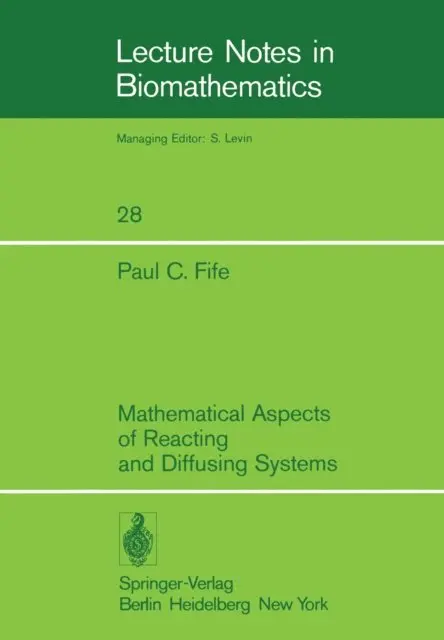
    Mathematical Aspects of Reacting and Diffusing Systems

    AvP. C. Fife

    Häftad, Engelska, 1979

    Del 28 i serien Lecture Notes in Biomathematics

    546 kr

    Beställningsvara. Skickas inom 10-15 vardagar. Fri frakt över 249 kr.

    Fler format och utgåvor

    E-bok

    712 kr

    Beskrivning

    Modeling and analyzing the dynamics of chemical mixtures by means of differ- tial equations is one of the prime concerns of chemical engineering theorists. These equations often take the form of systems of nonlinear parabolic partial d- ferential equations, or reaction-diffusion equations, when there is diffusion of chemical substances involved. A good overview of this endeavor can be had by re- ing the two volumes by R. Aris (1975), who himself was one of the main contributors to the theory. Enthusiasm for the models developed has been shared by parts of the mathematical community, and these models have, in fact, provided motivation for some beautiful mathematical results. There are analogies between chemical reactors and certain biological systems. One such analogy is rather obvious: a single living organism is a dynamic structure built of molecules and ions, many of which react and diffuse. Other analogies are less obvious; for example, the electric potential of a membrane can diffuse like a chemical, and of course can interact with real chemical species (ions) which are transported through the membrane. These facts gave rise to Hodgkin's and Huxley's celebrated model for the propagation of nerve signals. On the level of populations, individuals interact and move about, and so it is not surprising that here, again, the simplest continuous space-time interaction-migration models have the same g- eral appearance as those for diffusing and reacting chemical systems.

    Produktinformation

    • Utgivningsdatum:1979-03-05
    • Mått:170 x 244 x 17 mm
    • Vikt:354 g
    • Format:Häftad
    • Språk:Engelska
    • Serie:Lecture Notes in Biomathematics
    • Antal sidor:185
    • Förlag:Springer-Verlag Berlin and Heidelberg GmbH & Co. KG
    • ISBN:9783540091172

    Utforska kategorier

    • Tillämpad matematik inom Naturvetenskap och teknik

    Innehållsförteckning

    • Preface and General Introduction.- 1. Modeling Considerations.- 1.1 Basic hypotheses.- 1.2 Redistribution processes.- 1.3 Boundaries and interfaces.- 1.4 Reactions with migration.- 1.5 The reaction mechanism.- 1.6 Positivity of the density.- 1.7 Homogeneous systems.- 1.8 Modeling the rate functions.- 1.9 Colony models.- 1.10 Simplifying the model by means of asymptotics.- 2. Fisher’s Nonlinear Diffusion Equation and Selection-Migration Models.- 2.1 Historical overview.- 2.2 Assumptions for the present model.- 2.3 Reduction to a simpler model.- 2.4 Comments on the comparison of models.- 2.5 The question of formal approximation.- 2.6 The case of a discontinuous carrying capacity.- 2.7 Discussion.- 3. Formulation of Mathematical Problems.- 3.1 The standard problems.- 3.2 Asymptotic states.- 3.3 Existence questions.- 4. The Scalar Case.- 4.1 Comparison methods.- 4.2 Derivative estimates.- 4.3 Stability and instability of stationary solutions.- 4.4 Traveling waves.- 4.5 Global stability of traveling waves.- 4.6 More on Lyapunov methods.- 4.7 Further results in the bistable case.- 4.8 Stationary solutions for x-dependent source function.- 5. Systems: Comparison Techniques.- 5.1 Basic comparison theorems.- 5.2 An example from ecology.- 6. Systems: Linear Stability Techniques.- 6.1 Stability considerations for nonconstant stationary solutions and traveling waves.- 6.2 Pattern stability for a class of model systems.- 7. Systems: Bifurcation Techniques.- 7.1 Small amplitude stationary solutions.- 7.2 Small amplitude wave trains.- 7.3 Bibliographical discussion.- 8. Systems: Singular Perturbation and Scaling Techniques.- 8.1 Fast wave trains.- 8.2 Sharp fronts (review).- 8.3 Slowly varying waves (review).- 8.4 Partitioning (review).- 8.5 Transient asymptotics.- 9. References toOther Topics.- 9.1 Reaction-diffusion systems modeling nerve signal propagation.- 9.2 Miscellaneous.- References.