• Fri frakt över 249 kr
  • •
  • Snabba leveranser
  • •
  • Billiga böcker
Kundservice

Du är på sajten för privatpersoner.

Företag, bibliotek eller offentlig verksamhet?

Du handlar på classic.bokus.com, där alla dina funktioner finns intakta.
Till classic.bokus.com
Bokus logotyp. Gå till startsidan.
  • Erbjudanden
  • Student
  • Topplistor
  • Barn & ungdom
  • Bokus Play
  • E-böcker
  • Ljudböcker
  • Pocketböcker
  • Spel och pussel

Pocketfynda! Hundratals böcker för 49 kr/st →

Sidfot

Mina sidor

    Hjälp

    • Kundservice
    • Vanliga frågor och svar
    • Frakt och leverans
    • Retur vid ångerrätt
    • Reklamera vara
    • Betalning
    • Köpvillkor
    • Allmänna villkor
    • Information om webbplatsens tillgänglighet

    Om Bokus

    • Om oss
    • Pressrum
    • För studenter
    • För företag
    • För bibliotek och offentlig verksamhet
    • För leverantörer
    • Hållbarhet

    Populärt

    • Aktuella erbjudanden
    • Presentkort
    • Studentlitteratur
    • Nya böcker
    • Topplistor
    • Signerade böcker
    • Engelska böcker

    Inspiration

    • Boktips
    • BookTok
    • Barnbokskaraktärer
    • Populära författare
    Logotyp för Bokus
    Följ oss på Facebook (extern länk)Följ oss på Instagram (extern länk)Följ oss på YouTube (extern länk)Följ oss på TikTok (extern länk)
    bokus @ CookiesAnpassa cookiesIntegritetspolicyKöpvillkor
    Till Citymail hemsida (extern länk)Till Budbee hemsida (extern länk)Till Postnord hemsida (extern länk)Till Schenker hemsida (extern länk)Till Early Bird hemsida (extern länk)Till Walleys hemsida (extern länk)
    1. Naturvetenskap och teknik
    2. Matematik och naturvetenskap
    3. Biologi
    4. Biokemi

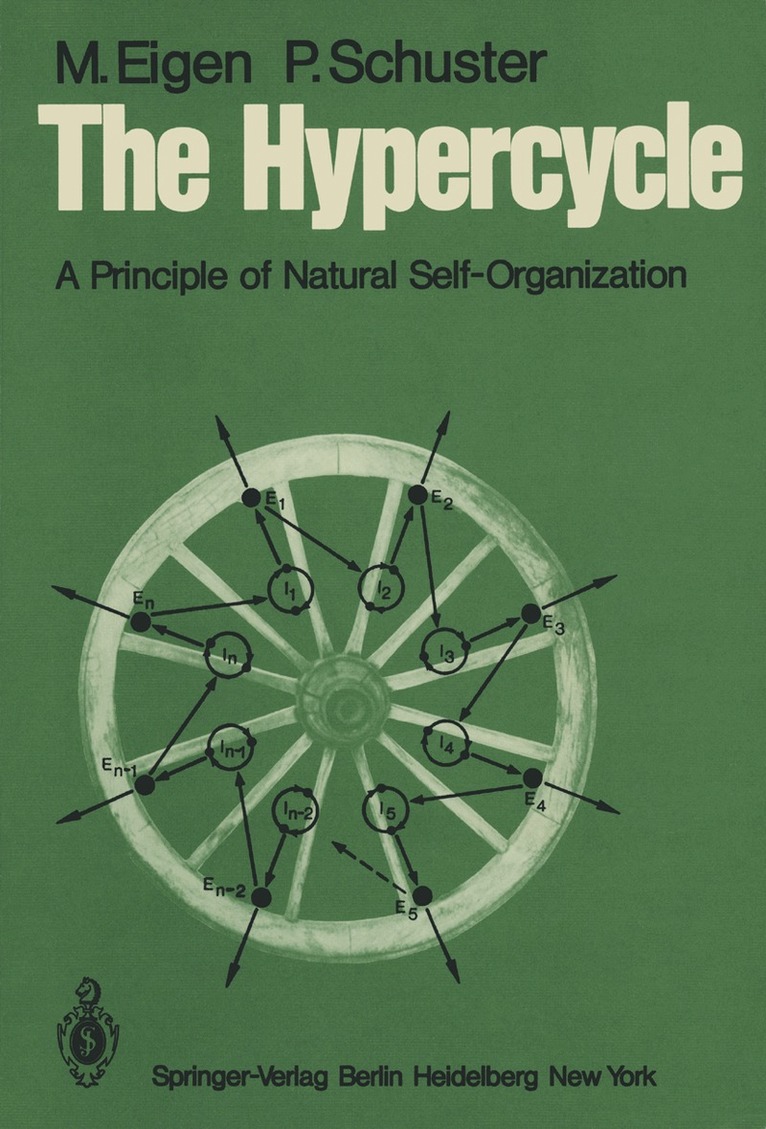
    Hypercycle

    A Principle of Natural Self-Organization

    AvM. Eigen,Peter Schuster

    Häftad, Engelska, 1979

    1 506 kr

    Beställningsvara. Skickas inom 10-15 vardagar. Fri frakt över 249 kr.

    Beskrivning

    This book originated from a series of papers which were published in "Die Naturwissenschaften" in 1977178. Its division into three parts is the reflection of a logic structure, which may be abstracted in the form of three theses: A. Hypercycles are a principle of natural selforganization allowing an inte­ gration and coherent evolution of a set of functionally coupled self-rep­ licative entities. B. Hypercycles are a novel class of nonlinear reaction networks with unique properties, amenable to a unified mathematical treatment. C. Hypercycles are able to originate in the mutant distribution of a single Darwinian quasi-species through stabilization of its diverging mutant genes. Once nucleated hypercycles evolve to higher complexity by a process analogous to gene duplication and specialization. In order to outline the meaning of the first statement we may refer to another principle of material selforganization, namely to Darwin's principle of natural selection. This principle as we see it today represents the only understood means for creating information, be it the blue print for a complex living organism which evolved from less complex ancestral forms, or be it a meaningful sequence of letters the selection of which can be simulated by evolutionary model games.

    Produktinformation

    • Utgivningsdatum:1979-04-01
    • Mått:210 x 280 x 7 mm
    • Vikt:277 g
    • Format:Häftad
    • Språk:Engelska
    • Antal sidor:92
    • Förlag:Springer-Verlag Berlin and Heidelberg GmbH & Co. KG
    • ISBN:9783540092933

    Utforska kategorier

    • Biokemi inom Naturvetenskap och teknik
    • Biovetenskap inom Naturvetenskap och teknik

    Innehållsförteckning

    • A. Emergency of the Hypercycle.- I. The Paradigm of Unity and Diversity in Evolution.- II. What Is a Hypercycle?.- III. Darwinian System.- IV. Error Threshold and Evolution.- B. The Abstract Hypercycle.- V. The Concrete Problem.- VI. General Classification of Dynamic Systems.- VII. Fixed-Point Analysis of Self-Organizing Reaction Networks.- VIII. Dynamics of the Elementary Hypercycle.- IX. Hypercycles with Translation.- X. Hypercyclic Networks.- C. The Realistic Hypercycle.- XI. How to Start Translation.- XII. The Logic of Primordial Coding.- XIII. Physics of Primordial Coding.- XIV. The GC-Frame Code.- XV. Hypercyclic Organization of the Early Translation Apparatus.- XVI. Ten Questions.- XVII. Realistic Boundary Conditions.- XVIII. Continuity of Evolution.- References.