• Fri frakt över 249 kr
  • •
  • Snabba leveranser
  • •
  • Billiga böcker
Kundservice

Du är på sajten för privatpersoner.

Företag, bibliotek eller offentlig verksamhet?

Du handlar på classic.bokus.com, där alla dina funktioner finns intakta.
Till classic.bokus.com
Bokus logotyp. Gå till startsidan.
  • Erbjudanden
  • Nyheter
  • Student
  • Topplistor
  • Barn & ungdom
  • Bokus Play
  • E-böcker
  • Pocketböcker
  • Spel & pussel

10% rabatt på allt med kod: NYSTART10 →

Sidfot

Mina sidor

    Hjälp

    • Kundservice
    • Vanliga frågor och svar
    • Frakt och leverans
    • Retur vid ångerrätt
    • Reklamera vara
    • Betalning
    • Köpvillkor
    • Allmänna villkor
    • Information om webbplatsens tillgänglighet

    Om Bokus

    • Om oss
    • Pressrum
    • För studenter
    • För företag
    • För bibliotek och offentlig verksamhet
    • För leverantörer
    • Hållbarhet

    Populärt

    • Aktuella erbjudanden
    • Presentkort
    • Studentlitteratur
    • Nya böcker
    • Topplistor
    • Signerade böcker
    • Engelska böcker

    Inspiration

    • Boktips
    • BookTok
    • Populära bokserier
    • Barnbokskaraktärer
    • Populära författare
    Logotyp för Bokus
    Följ oss på Facebook (extern länk)Följ oss på Instagram (extern länk)Följ oss på YouTube (extern länk)Följ oss på TikTok (extern länk)
    bokus @ CookiesAnpassa cookiesIntegritetspolicyKöpvillkor
    Till Citymail hemsida (extern länk)Till Budbee hemsida (extern länk)Till Postnord hemsida (extern länk)Till Schenker hemsida (extern länk)Till Early Bird hemsida (extern länk)Till Walleys hemsida (extern länk)
    1. Naturvetenskap och teknik
    2. Matematik och naturvetenskap
    3. Biologi
    4. Biovetenskap

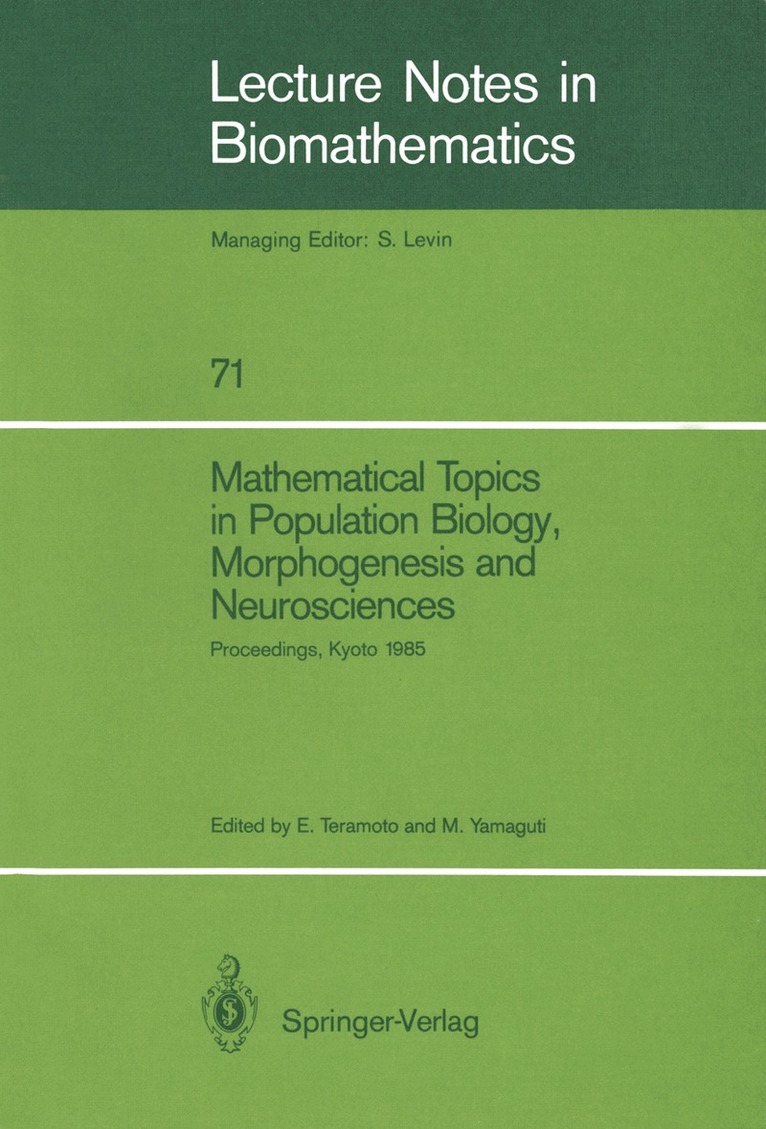
    Mathematical Topics in Population Biology, Morphogenesis and Neurosciences

    Proceedings of an International Symposium held in Kyoto, November 10–15, 1985

    AvEi Teramoto,Masaya Yamaguti

    Häftad, Engelska, 1987

    Del 71 i serien Lecture Notes in Biomathematics

    547 kr

    Beställningsvara. Skickas inom 10-15 vardagar. Fri frakt över 249 kr.

    Beskrivning

    This volume represents the edited proceedings of the International Symposium on Mathematical Biology held in Kyoto, November 10-15, 1985. The symposium was or­ ganized by an international committee whose members are: E. Teramoto, M. Yamaguti, S. Amari, S.A. Levin, H. Matsuda, A. Okubo, L.M. Ricciardi, R. Rosen, and L.A. Segel. The symposium included technical sessions with a total of 11 invited papers, 49 contributed papers and a poster session where 40 papers were displayed. These Proceedings consist of selected papers from this symposium. This symposium was the second Kyoto meeting on mathematical topics in biology. The first was held in conjunction with the Sixth International Biophysics Congress in 1978. Since then this field of science has grown enormously, and the number of scientists in the field has rapidly increased. This is also the case in Japan. About 80 young japanese scientists and graduate students participated this time. . The sessions were divided into 4 ; , categories: 1) Mathematical Ecology and Population Biology, 2) Mathematical Theory of Developmental Biology and Morphogenesis, 3) Theoretical Neurosciences, and 4) Cell Kinetics and Other Topics. In every session, there were stimulating and active discussions among the participants. We are convinced that the symposium was highly successful in transmitting scientific information across disciplines and in establishing fruitful contacts among the participants. We owe this success to the cooperation of all participants.

    Produktinformation

    • Utgivningsdatum:1987-06-01
    • Mått:170 x 244 x 20 mm
    • Vikt:628 g
    • Format:Häftad
    • Språk:Engelska
    • Serie:Lecture Notes in Biomathematics
    • Antal sidor:352
    • Förlag:Springer-Verlag Berlin and Heidelberg GmbH & Co. KG
    • ISBN:9783540178750

    Utforska kategorier

    • Biovetenskap inom Naturvetenskap och teknik
    • Naturvetenskap:allmänt inom Naturvetenskap och teknik

    Innehållsförteckning

    • Introductory Lectures.- Chaos and fractals.- Recurrent themes in mathematical biology.- I. Mathematical Ecology and Population Biology.- The Structure of Populations and Communities.- Fantastic voyage into the deep: marine biofluid mechanics.- On the mathematical synthesis of physiological and behavioural mechanisms and population dynamics.- A necessary and sufficient assembly rule for real ecosystems.- Markovian foraging models.- The theory of population dynamics: back to first principles.- Dispersal.- Ecological and evolutionary aspects of dispersal.- The speeds of traveling frontal waves in heterogeneous environments.- Quantitative modeling of growth and dispersal in population models.- The interaction between dispersal and dormancy strategies in varying and heterogeneous environments.- Segregation structures of competing species mediated by a diffusive predator.- A spatially aggregating population model involving size-distributed dynamics.- Evolution.- Evolution of the number of sexes.- A lattice model for population biology.- Population genetical mechanism of molecular evolution — stochastic selection as an alternative to random drift —.- Evolutionary and ecological stability of prey-predator systems with predatory switching.- II. Mathematical Theories of Pattern and Morphogenesis.- Morphogenesis and Pattern Formation.- Pattern formation by coupled oscillations: the pigmentation patterns on the shells of molluscs.- From map systems to plant morphogenesis.- The cortical tractor: a new model for epithelial morphogenesis.- Pattern Formation in Dictyostelium discoideum.- An equilibrium theory of cell distribution in Dictyostelium discoideum.- A model for pattern formation in Dictyostelium discoideum.- A density dependent model for prestalk/prespore patternformation in Dictyostelium discoideum I. Basic mathematical framework.- Origin of bursting and birhythmicity in a model for cyclic AMP oscillations in Dictyostelium cells.- III. Theoretical Neurosciences and Related Problems in Physiology.- Neurosciences.- Mathematical modelling of macroscopic brain phenomena.- A formal classification of bursting mechanisms in excitable systems.- On the topological representation of signals in self-organizing nerve fields.- The dynamics of a glia-modulated neural network and its relation to brain functions.- Self-organization in nervous systems: some illustrations.- Physiology and Related Problems.- Toward molecular sensory physiology: mathematical models.- Outline of some recent results on the first-passage-time problem in biological modeling.- Active rotator model for large populations of oscillatory and excitable elements.- The harnessing and stability of striated muscle.