• Fri frakt över 249 kr
  • •
  • Snabba leveranser
  • •
  • Billiga böcker
Kundservice

Du är på sajten för privatpersoner.

Företag, bibliotek eller offentlig verksamhet?

Du handlar på classic.bokus.com, där alla dina funktioner finns intakta.
Till classic.bokus.com
Bokus logotyp. Gå till startsidan.
  • Erbjudanden
  • Nyheter
  • Student
  • Topplistor
  • Barn & ungdom
  • Bokus Play
  • E-böcker
  • Pocketböcker
  • Spel & pussel

10% rabatt på allt med kod: NYSTART10 →

Sidfot

Mina sidor

    Hjälp

    • Kundservice
    • Vanliga frågor och svar
    • Frakt och leverans
    • Retur vid ångerrätt
    • Reklamera vara
    • Betalning
    • Köpvillkor
    • Allmänna villkor
    • Information om webbplatsens tillgänglighet

    Om Bokus

    • Om oss
    • Pressrum
    • För studenter
    • För företag
    • För bibliotek och offentlig verksamhet
    • För leverantörer
    • Hållbarhet

    Populärt

    • Aktuella erbjudanden
    • Presentkort
    • Studentlitteratur
    • Nya böcker
    • Topplistor
    • Signerade böcker
    • Engelska böcker

    Inspiration

    • Boktips
    • BookTok
    • Populära bokserier
    • Barnbokskaraktärer
    • Populära författare
    Logotyp för Bokus
    Följ oss på Facebook (extern länk)Följ oss på Instagram (extern länk)Följ oss på YouTube (extern länk)Följ oss på TikTok (extern länk)
    bokus @ CookiesAnpassa cookiesIntegritetspolicyKöpvillkor
    Till Citymail hemsida (extern länk)Till Budbee hemsida (extern länk)Till Postnord hemsida (extern länk)Till Schenker hemsida (extern länk)Till Early Bird hemsida (extern länk)Till Walleys hemsida (extern länk)
    1. Naturvetenskap och teknik
    2. Geovetenskap
    3. Geovetenskap

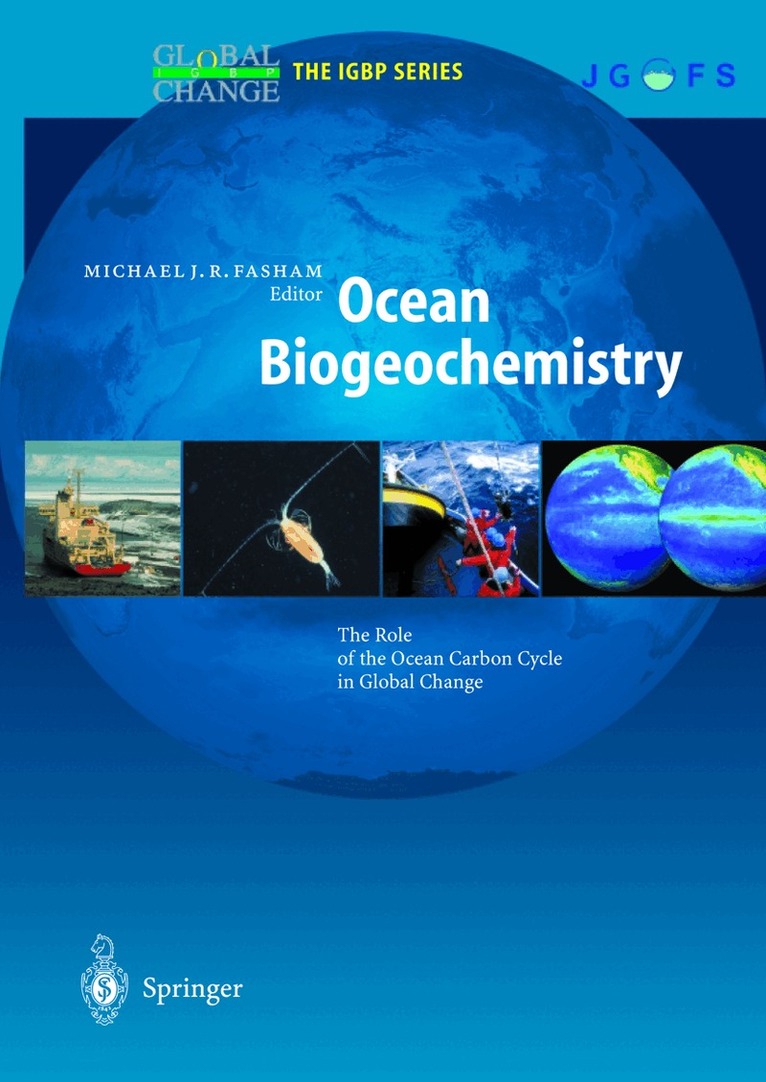
    Ocean Biogeochemistry

    The Role of the Ocean Carbon Cycle in Global Change

    AvMichael J.R. Fasham

    Inbunden, Engelska, 2003

    Del i serien Global Change - The IGBP Series

    2 165 kr

    Beställningsvara. Skickas inom 10-15 vardagar. Fri frakt över 249 kr.

    Beskrivning

    Oceans account for 50% of the anthropogenic CO2 released into the atmosphere. During the past 15 years an international programme, the Joint Global Ocean Flux Study (JGOFS), has been studying the ocean carbon cycle to quantify and model the biological and physical processes whereby CO2 is pumped from the ocean's surface to the depths of the ocean, where it can remain for hundreds of years. This project is one of the largest multi-disciplinary studies of the oceans ever carried out and this book synthesises the results. It covers all aspects of the topic ranging from air-sea exchange with CO2, the role of physical mixing, the uptake of CO2 by marine algae, the fluxes of carbon and nitrogen through the marine food chain to the subsequent export of carbon to the depths of the ocean. Special emphasis is laid on predicting future climatic change.

    Produktinformation

    • Utgivningsdatum:2003-04-08
    • Mått:210 x 279 x 25 mm
    • Vikt:874 g
    • Format:Inbunden
    • Språk:Engelska
    • Serie:Global Change - The IGBP Series
    • Antal sidor:301
    • Upplaga:2003
    • Förlag:Springer-Verlag Berlin and Heidelberg GmbH & Co. KG
    • ISBN:9783540423980

    Utforska kategorier

    • Geovetenskap inom Naturvetenskap och teknik
    • Biokemi inom Naturvetenskap och teknik

    Recensioner i media

    From the reviews: "The volume consistently conveys both the importance of the ocean in the global carbon cycle and the uncertainty of the oceanic response to global change. ... The stated objective of The IGBP Series, to present key results of the JGOFS project, is accomplished. ... The design of the book is very attractive, the type clear, and the figure size appropriate. ... this volume provides a valuable state of the art of ocean biogeochemistry for those interested in the carbon cycle or climate change." (Mary-Elena Carr, Ecology, Vol. 85 (7), 2004)

    Innehållsförteckning

    • Acknowledgements.- References.- 1 Biogeochemical Provinces: Towards a JGOFS Synthesis.- 1.1 Plankton Community Structure and Distribution.- 1.2 Partitioning the Oceans.- 1.3 Primary Production in Ocean Domains and Provinces.- 1.4 Bacterial Production and DOC Flux.- 1.5 A Provincial Outlook.- Acknowledgements.- References.- 2 Physical Transport of Nutrients and the Maintenance of Biological Production.- 2.1 Introduction.- 2.2 Global Overturning Circulation and Nutrient Transport.- 2.3 Convection.- 2.4 Wind-Driven Circulations: Gyres and Boundary Currents.- 2.5 Smaller-Scale Circulations: Mesoscale Eddies, Waves and Sub-Mesoscale Fronts.- 2.6 Interannual and Long-Term Variability.- 2.7 Conclusions.- Acknowledgements.- Notes.- References.- 3 Continental Margin Exchanges.- 3.1 Introduction.- 3.2 Recycling Systems.- 3.3 Export Systems.- 3.4 Coastal Upwelling Systems.- 3.5 California Current System.- 3.6 Humboldt Current System.- 3.7 Benguela Current System.- 3.8 Monsoonal Upwelling Systems.- 3.9 Biogeochemical Budgeting.- 3.10 The Arctic Shelves.- 3.11 Marginal Seas.- Acknowledgments.- References.- Apendix 3.1 — Continental Margins: Site Descriptions.- 4 Phytoplankton and Their Role in Primary, New, and Export Production.- 4.1 Introduction.- 4.2 Synthesis.- References.- 5 Carbon Dioxide Fluxes in the Global Ocean.- 5.1 Introduction.- 5.2 The Oceans’ Influence on Atmospheric CO2.- 5.3 How Big is the Global Ocean Sink?.- 5.4 What Processes Control Air-Sea CO2 Flux?.- 5.5 Variability in the CO2 Signal.- 5.6 The Gas Transfer Velocity.- 5.7 Conclusion: the Next Ten Years.- Acknowledgements.- References.- 6 Water Column Biogeochemistry below the Euphotic Zone.- 6.1 Introduction.- 6.2 The Twilight Zone: Biology, Biogeochemical Processes and Fluxes.- 6.3 The Fluxes of BiogenicMatter versus Depth.- 6.4 The Variable Composition of the World Ocean Waters along the Conveyor Belt.- 6.5 Conclusions and Perspectives.- References.- 7 The Impact of Climate Change and Feedback Processes on the Ocean Carbon Cycle.- 7.1 Introduction.- 7.2 Feedbacks.- 7.3 What do Current Models Predict?.- 7.4 Status of Our Understanding of Feedbacks.- 7.5 Nutrient Dynamics.- 7.6 Phytoplankton and Carbon Limitation.- 7.7 The Calcifiers.- 7.8 Iron Supply to the Oceans.- 7.9 Dimethyl Sulphide and the Biota.- 7.10 UV-B and Ozone Depletion.- 7.11 Summary of Biotic Feedbacks.- 7.12 Climate — Variability versus Change.- 7.13 Modeling — Future Goals.- 7.14 The Future.- 7.15 Summary.- Acknowledgements.- References.- 8 Benthic Processes and the Burial of Carbon.- 8.1 Introduction.- 8.2 Processes of Transport and Turnover of Material in the Deep Ocean.- 8.3 Quantitative Estimates of Carbon Deposition and Carbon Turnover.- 8.4 Proxy Indicators of Paleoproductivity.- 8.5 Conclusions.- References.- 9 Global Ocean Carbon Cycle Modeling.- 9.1 Introduction.- 9.2 Anthropogenic Carbon Uptake, Transient Tracers, and Physics.- 9.3 Global Biogeochemical Cycles.- 9.4 Ecosystem Dynamics.- 9.5 Other Topics.- 9.6 Summary.- Acknowledgements.- References.- 10 Temporal Studies of Biogeochemical Processes Determined from Ocean Time-Series Observations During the JGOFS Era.- 10.1 Introduction.- 10.2 The Oceanic Carbon Cycle and the Biological Carbon Pump.- 10.3 Global Inventory of JGOFS Time-Series Programs.- 10.4 Some Practical Lessons Learned from the JGOFS Time-Series Programs.- 10.5 Cross Ecosystem Habitat Comparisons: Nutrient, Chlorophyll and Production-Export Relationships.- 10.6 Beyond JGOFS: a Prospectus.- Acknowledgements.- References.- 11 JGOFS: a Retrospective View.- 11.1 The JGOFSScience Plan.- 11.2 The Process Studies.- 11.3 Iron Fertilisation Experiments.- 11.4 The Time Series Stations.- 11.5 The Global Survey.- 11.6 Remote Sensing.- 11.7 Benthic Studies.- 11.8 Continental Margins.- 11.9 Data Archiving.- 11.10 Models and Synthesis.- 11.11 Overall Conclusions.- References.