• Fri frakt över 249 kr
  • •
  • Snabba leveranser
  • •
  • Billiga böcker
Kundservice

Du är på sajten för privatpersoner.

Företag, bibliotek eller offentlig verksamhet?

Du handlar på classic.bokus.com, där alla dina funktioner finns intakta.
Till classic.bokus.com
Bokus logotyp. Gå till startsidan.
  • Erbjudanden
  • Nyheter
  • Student
  • Topplistor
  • Barn & ungdom
  • Bokus Play
  • E-böcker
  • Pocketböcker
  • Spel & pussel

10% rabatt på allt med kod: NYSTART10 →

Sidfot

Mina sidor

    Hjälp

    • Kundservice
    • Vanliga frågor och svar
    • Frakt och leverans
    • Retur vid ångerrätt
    • Reklamera vara
    • Betalning
    • Köpvillkor
    • Allmänna villkor
    • Information om webbplatsens tillgänglighet

    Om Bokus

    • Om oss
    • Pressrum
    • För studenter
    • För företag
    • För bibliotek och offentlig verksamhet
    • För leverantörer
    • Hållbarhet

    Populärt

    • Aktuella erbjudanden
    • Presentkort
    • Studentlitteratur
    • Nya böcker
    • Topplistor
    • Signerade böcker
    • Engelska böcker

    Inspiration

    • Boktips
    • BookTok
    • Populära bokserier
    • Barnbokskaraktärer
    • Populära författare
    Logotyp för Bokus
    Följ oss på Facebook (extern länk)Följ oss på Instagram (extern länk)Följ oss på YouTube (extern länk)Följ oss på TikTok (extern länk)
    bokus @ CookiesAnpassa cookiesIntegritetspolicyKöpvillkor
    Till Citymail hemsida (extern länk)Till Budbee hemsida (extern länk)Till Postnord hemsida (extern länk)Till Schenker hemsida (extern länk)Till Early Bird hemsida (extern länk)Till Walleys hemsida (extern länk)
    1. Data och IT
    2. Systemvetenskap och AI

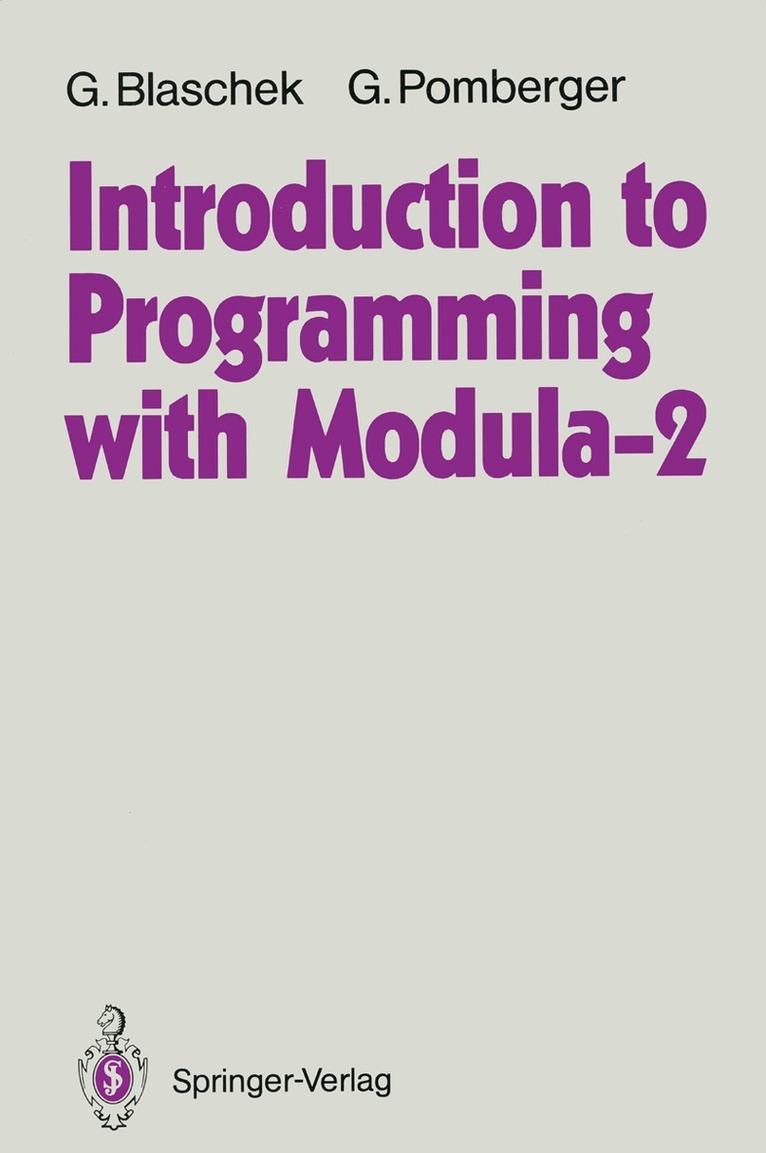
    Introduction to Programming with Modula-2

    AvGünther Blaschek,Gustav Pomberger

    Häftad, Engelska, 1990

    563 kr

    Beställningsvara. Skickas inom 10-15 vardagar. Fri frakt över 249 kr.

    Beskrivning

    This book is intended for the novice as well as for the experienced programmer who wants to learn Modula-2. We do not limit ourselves to just a description of Modula-2. Instead, we seek to familiarize the reader with the concept of algorithms and to show him/her how to implement algorithms in Modula-2. The programming language Modula-2 was developed by Niklaus Wirth (also the father of world-famous Pascal) and made public in 1978. Compared to other programming languages such as Ada, COBOL or PL/!, Modula-2 is a compact language, which makes it easy to learn. Nevertheless, Modula-2 contains all important language elements necessary for formulating complicated algorithms and for implementing the modern concepts of software engineering. Modula-2 is distinguished by a systematic structure that makes it possible to write easily readable programs. The language supports many of the principles of modern software engineering. All this makes Modula-2 a useful instrument for an introduction to the basics of programming. This textbook strives to establish a solid foundation in the techniques of programming with up-to-date methods of program development. Use of the programming language Modula-2 is reinforced with numerous hands-on exercises. This book does not presuppose any knowledge of programming, but it does require a certain ability in the realm of abstract thinking, some pleasure in problem solving, and a desire to come to terms with complex interrelationships.

    Produktinformation

    • Utgivningsdatum:1990-11-22
    • Mått:155 x 235 x 15 mm
    • Vikt:417 g
    • Format:Häftad
    • Språk:Engelska
    • Antal sidor:261
    • Förlag:Springer-Verlag Berlin and Heidelberg GmbH & Co. KG
    • ISBN:9783540520382
    • Översättare:R. Bach

    Utforska kategorier

    • Systemvetenskap och AI inom Data och IT
    • Programvaruutveckling inom Data och IT
    • Programspråk inom Data och IT

    Innehållsförteckning

    • 1 Algorithms.- 1.1 Examples of Algorithms.- 1.2 Definition of the Term “Algorithm”.- 1.3 Objects and Actions.- 1.4 Means of Representing Algorithms.- 1.5 Some Simple Algorithms.- 1.6 Algorithms and Programs.- Exercises.- 2 Principles of Program Development.- 2.1 The Principle of Stepwise Refinement.- 2.2 Data Capsules.- 2.3 The Module Concept.- Exercises.- 3 The Programming Language Modula-2.- 3.1 Notation for Language Description.- 3.2 Lexical Elements of Modula-2.- 3.3 Elementary Program Structure.- 3.4 Declarations.- 3.5 Expressions.- 3.6 Statements.- 3.7 Procedures.- 3.8 The Module Concept of Modula-2.- 3.9 System-Dependent Language Properties.- 3.10 Processes and Coroutines.- 4 Writing Modula-2 Programs.- 4.1 Some Simple Modula-2 Programs.- 4.2 Input/Output.- 4.3 Dynamic Data Structures.- 4.4 Recursion.- 4.5 Language Extension Modules.- 4.6 Parallel Processes.- Exercises.- 5 Programming Style and Program Testing.- 5.1 Programming Style.- 5.2 Program Testing.- 6 Software Engineering with Modula-2.- 6.1 Modula-2 as a Tool for Specification.- 6.2 Modularizing and Structuring.- 6.3 Data Capsules and Data Abstraction.- 6.4 Separate Compilation and Type Binding.- Appendix A: Syntax Diagrams.- Appendix B: Predefined Identifiers.- Appendix C: Compatibility Rules.- Appendix D: ASCII Table.- References.