• Fri frakt över 249 kr
  • •
  • Snabba leveranser
  • •
  • Billiga böcker
Kundservice

Du är på sajten för privatpersoner.

Företag, bibliotek eller offentlig verksamhet?

Du handlar på classic.bokus.com, där alla dina funktioner finns intakta.
Till classic.bokus.com
Bokus logotyp. Gå till startsidan.
  • Erbjudanden
  • Nyheter
  • Student
  • Topplistor
  • Barn & ungdom
  • Bokus Play
  • E-böcker
  • Pocketböcker
  • Spel & pussel

10% rabatt på allt med kod NYSTART10 →

Sidfot

Mina sidor

    Hjälp

    • Kundservice
    • Vanliga frågor och svar
    • Frakt och leverans
    • Retur vid ångerrätt
    • Reklamera vara
    • Betalning
    • Köpvillkor
    • Allmänna villkor
    • Information om webbplatsens tillgänglighet

    Om Bokus

    • Om oss
    • Pressrum
    • För studenter
    • För företag
    • För bibliotek och offentlig verksamhet
    • För leverantörer
    • Hållbarhet

    Populärt

    • Aktuella erbjudanden
    • Presentkort
    • Studentlitteratur
    • Nya böcker
    • Topplistor
    • Signerade böcker
    • Engelska böcker

    Inspiration

    • Boktips
    • BookTok
    • Populära bokserier
    • Barnbokskaraktärer
    • Populära författare
    Logotyp för Bokus
    Följ oss på Facebook (extern länk)Följ oss på Instagram (extern länk)Följ oss på YouTube (extern länk)Följ oss på TikTok (extern länk)
    bokus @ CookiesAnpassa cookiesIntegritetspolicyKöpvillkor
    Till Citymail hemsida (extern länk)Till Budbee hemsida (extern länk)Till Postnord hemsida (extern länk)Till Schenker hemsida (extern länk)Till Early Bird hemsida (extern länk)Till Walleys hemsida (extern länk)
    1. Ekonomi och Ledarskap
    2. Nationalekonomi

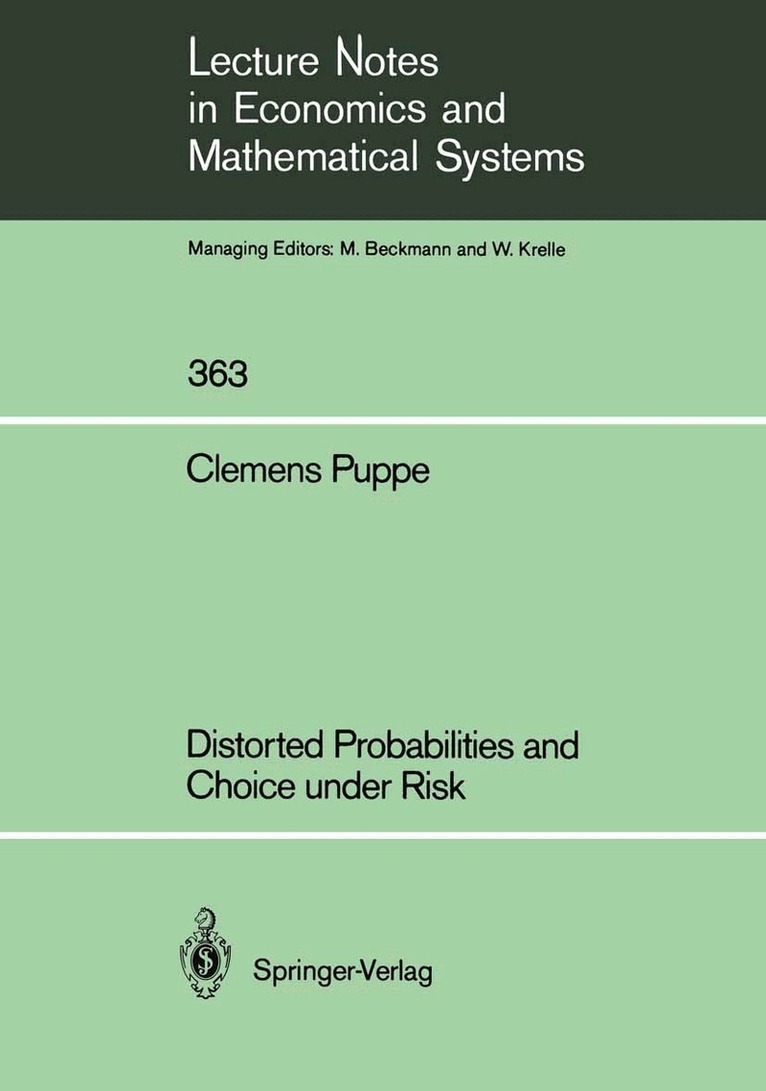
    Distorted Probabilities and Choice under Risk

    AvClemens Puppe

    Häftad, Engelska, 1991

    Del i serien Lecture Notes in Economics and Mathematical Systems

    546 kr

    Beställningsvara. Skickas inom 10-15 vardagar. Fri frakt över 249 kr.

    Fler format och utgåvor

    E-bok

    732 kr

    Beskrivning

    This book provides a systematic, formal treatment of a recently proposed extension of the expected utility model of choice under risk: the so-called rank-dependent utility model. In this approach the representation of preferences is based upon a (generalized) utility function defined on the outcome/probability-plane. The main purpose of the book is to demonstrate the flexibility of this model with respect to its explanatory power. This is achieved by analyzing a certain subclass of the rank-dependent utility approach which incorporates the notion of price-dependent distortions of probabilities. This particular approach captures an optimistic point of view towards gambling (as can often be observed), whilst being compatible with a suitably formulated concept of risk aversion. The resulting model is used to explain some of the observed behavioral patterns as the Allais-paradox and the behavior described by the Friedman-Savage hypothesis.

    Produktinformation

    • Utgivningsdatum:1991-07-10
    • Mått:170 x 242 x undefined mm
    • Vikt:214 g
    • Format:Häftad
    • Språk:Engelska
    • Serie:Lecture Notes in Economics and Mathematical Systems
    • Antal sidor:100
    • Förlag:Springer-Verlag Berlin and Heidelberg GmbH & Co. KG
    • ISBN:9783540542476

    Utforska kategorier

    • Nationalekonomi inom Ekonomi och Ledarskap
    • Matematisk statistik inom Naturvetenskap och teknik

    Innehållsförteckning

    • 1 Axiomatic Utility Theory under Risk.- 1.1 Historical Overview.- 1.2 The Axiomatic Basis of Expected Utility Theory.- 1.3 The Empirical Evidence against the Independence Axiom.- 1.4 Non-Linear Utility Theory under Risk.- 2 A Rank-Dependent Utility Model with Prize-Dependent Distortion of Probabilities.- 2.1 Rank-Dependent Utility Theory Reconsidered.- 2.2 Homogeneity on Elementary Lotteries.- 2.3 Further Evidence for Prize-Dependent Distortions of Probabilities.- 2.4 A Characterization Theorem.- 2.5 Rank-Dependent Utility Theory and Relative Utility.- 2.6 A Generalized Model.- 3 Risk Aversion.- 3.1 Risk Aversion in the General Rank-Dependent Utility Model.- 3.2 Risk Aversion and Homogeneity.- 3.3 Decreasing Risk Aversion.- 3.4 The Friedman-Savage Hypothesis.- Conclusion.- References.