• Fri frakt över 249 kr
  • •
  • Snabba leveranser
  • •
  • Billiga böcker
Kundservice

Du är på sajten för privatpersoner.

Företag, bibliotek eller offentlig verksamhet?

Du handlar på classic.bokus.com, där alla dina funktioner finns intakta.
Till classic.bokus.com
Bokus logotyp. Gå till startsidan.
  • Erbjudanden
  • Nyheter
  • Student
  • Topplistor
  • Barn & ungdom
  • Bokus Play
  • E-böcker
  • Pocketböcker
  • Spel & pussel

10% rabatt på allt med kod NYSTART10 →

Sidfot

Mina sidor

    Hjälp

    • Kundservice
    • Vanliga frågor och svar
    • Frakt och leverans
    • Retur vid ångerrätt
    • Reklamera vara
    • Betalning
    • Köpvillkor
    • Allmänna villkor
    • Information om webbplatsens tillgänglighet

    Om Bokus

    • Om oss
    • Pressrum
    • För studenter
    • För företag
    • För bibliotek och offentlig verksamhet
    • För leverantörer
    • Hållbarhet

    Populärt

    • Aktuella erbjudanden
    • Presentkort
    • Studentlitteratur
    • Nya böcker
    • Topplistor
    • Signerade böcker
    • Engelska böcker

    Inspiration

    • Boktips
    • BookTok
    • Populära bokserier
    • Barnbokskaraktärer
    • Populära författare
    Logotyp för Bokus
    Följ oss på Facebook (extern länk)Följ oss på Instagram (extern länk)Följ oss på YouTube (extern länk)Följ oss på TikTok (extern länk)
    bokus @ CookiesAnpassa cookiesIntegritetspolicyKöpvillkor
    Till Citymail hemsida (extern länk)Till Budbee hemsida (extern länk)Till Postnord hemsida (extern länk)Till Schenker hemsida (extern länk)Till Early Bird hemsida (extern länk)Till Walleys hemsida (extern länk)
    1. Data och IT
    2. Systemvetenskap och AI

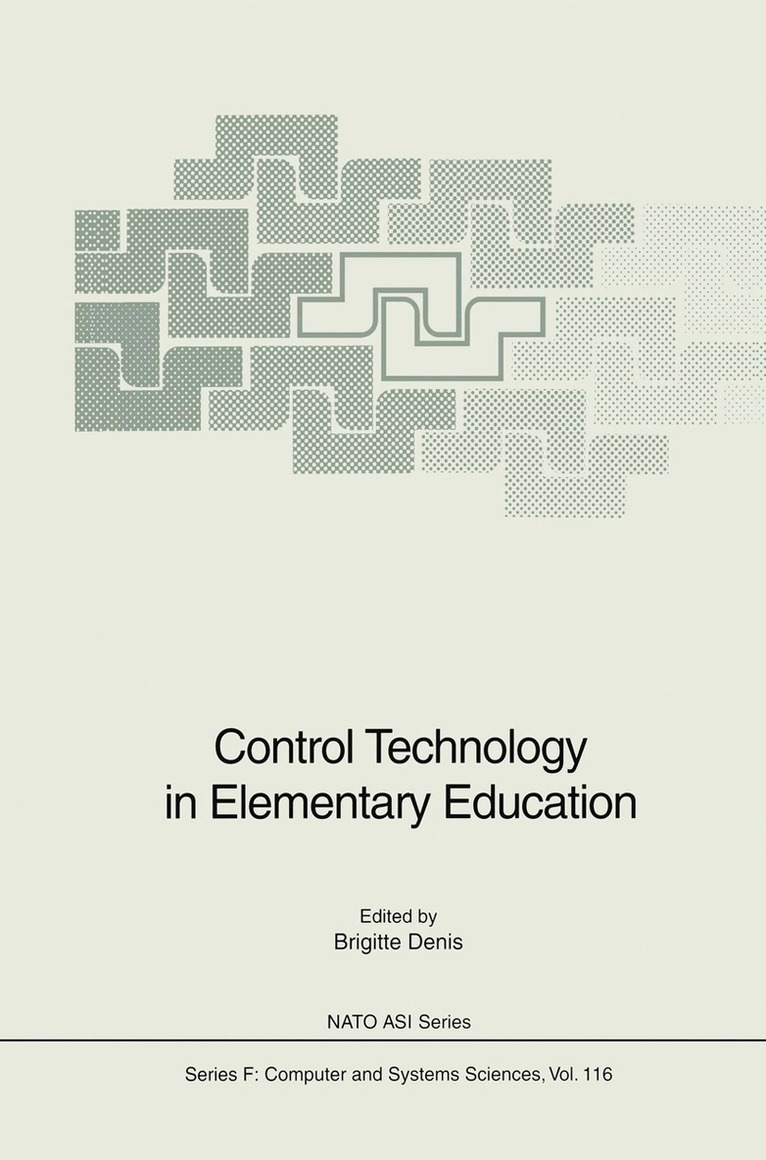
    Control Technology in Elementary Education

    AvBrigitte Denis

    Inbunden, Engelska, 1993

    Del i serien NATO ASI Subseries F:

    1 579 kr

    Beställningsvara. Skickas inom 10-15 vardagar. Fri frakt över 249 kr.

    Beskrivning

    Control technology is a new learning environment whichoffers the opportunity to take up the economic andeducational challenge of enabling people to adapt to newtechnologies and use them to solve problems. Giving youngchildren (and also adults) easy access to control technologyintroduces them to a learning environment where they canbuild their knowledge across a range of topics. As theybuild and program their own automata and robots, they learnto solve problems, work incollaboration, and be creative. They also learn more about science, electronics, physics,computer literacy, computer assisted manufacturing, and soon. This book, based on a NATO Advanced Research Workshop in theSpecial Programme on Advanced Educational Technology,presents a cross-curricular approach to learning aboutcontrol technology. The recommended methodology is activelearning, where the teacher's role is to stimulate thelearner to build knowledge by providing him/her withappropriate materials (hardware and software) andsuggestions to develop the target skills.The results areencouraging, although more tools are needed to help thelearner to generalize from his/her concrete experiment incontrol technology as well as to evaluate its effect on thetarget skills. The contributions not only discussepistemological controversies linked to such learningenvironments as control technology, but also report on thestate of the art and new developments in the field andpresent some stimulating ideas.

    Produktinformation

    • Utgivningsdatum:1993-09-29
    • Mått:155 x 235 x 23 mm
    • Vikt:658 g
    • Format:Inbunden
    • Språk:Engelska
    • Serie:NATO ASI Subseries F:
    • Antal sidor:311
    • Upplaga:1993
    • Förlag:Springer-Verlag Berlin and Heidelberg GmbH & Co. KG
    • ISBN:9783540567103

    Utforska kategorier

    • Systemvetenskap och AI inom Data och IT
    • Material och digital teknik i undervisningen inom Psykologi och pedagogik
    • Skolan och förskolan inom Psykologi och pedagogik

    Innehållsförteckning

    • 1. Theoretical Aspects of Learning Environments.- Knowledge Representation and the Learning Process: Taking Account of Developmental Features and Support Features in Interactive Learning Environments.- Reasoning Involved in Control Technology.- Cognitive Spectacles.- Language Control Language: Control Microworlds of the Mind.- What Role Is There for Control Technology in Learning with Computational Expressive Media?.- 2. Experiments and Case Studies.- 2.1. Course Contents.- Robotics and Telecommunication (Experience of the Ecole Active de Malagnou in Geneva Within the Framework of a Computerized Educational Environment).- Could the Robotics/Control Technology Be an Interdisciplinary Tool in School?.- Control Technology and the Creative Thinking Process for Teachers and Students.- 2.2. Methodology.- Integrating the Use of LEGO-LOGO into the Curriculum of a Primary School: A Case Study.- An Aesthetic of Learning Environment Design.- Situation Graphs as Tools for Ordering of Students’ Thinking and Understanding of Actual Existing Servo Mechanisms.- Problems Associated with Getting Control Technology Working in Schools.- Promoting Active Learning: A Pragmatic Approach.- Workshops and Discussion about Educational Situations.- 2.3. The Teacher’s Role.- Educational Uses of Control Technology.- Measuring some Cognitive Effects of Using Control Technology.- 3. Tools Developed for Control Technology.- 3.1. State of the Art.- Workshops.- Hands-on Control Technology with New LEGO Dacta Tools.- 3.2. Future Trends.- A New Development of Control Technology.- A Data Acquisition System in a Learning Environment.- Concurrent Control for Children.- Learning Mode in the Exploration of Parallelism in Pedagogical Robotics.- ActNet-A Heterogeneous Network of Actors for Learning ofParallelism, Communication, and Synchronization.