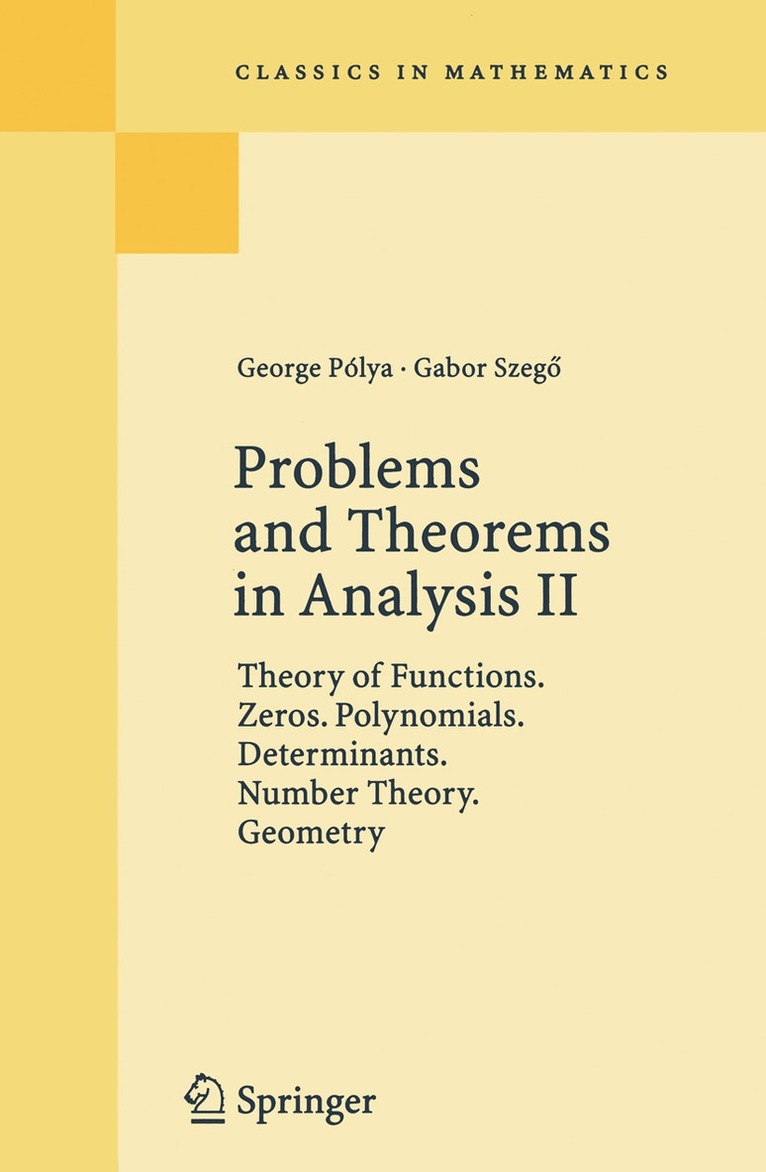
Häftad, Engelska, 1997
Problems and Theorems in Analysis II
Theory of Functions. Zeros. Polynomials. Determinants. Number Theory. Geometry
Del i serien Classics in Mathematics
597 kr
Beställningsvara. Skickas inom 10-15 vardagar. Fri frakt över 249 kr.
Beskrivning
Produktinformation
- Utgivningsdatum: 1997-12-11
- Mått: 155 x 235 x 23 mm
- Vikt: 622 g
- Format: Häftad
- Språk: Engelska
- Serie: Classics in Mathematics
- Antal sidor: 392
- Upplaga: 1998
- Förlag: Springer-Verlag Berlin and Heidelberg GmbH & Co. KG
- ISBN: 9783540636861
- Översättare: C.E. Billigheimer, C. E. Billigheimer
Utforska kategorier
Mer om författaren
Biography of George Polya Born in Budapest, December 13, 1887, George Polya initially studied law, then languages and literature in Budapest. He came to mathematics in order to understand philosophy, but the subject of his doctorate in 1912 was in probability theory and he promptly abandoned philosophy. After a year in Gottingen and a short stay in Paris, he received an appointment at the ETH in Zurich. His research was multi-faceted, ranging from series, probability, number theory and combinatorics to astronomy and voting systems. Some of his deepest work was on entire functions. He also worked in conformal mappings, potential theory, boundary value problems, and isoperimetric problems in mathematical physics, as well as heuristics late in his career. When Polya left Europe in 1940, he first went to Brown University, then two years later to Stanford, where he remained until his death on September 7, 1985. Biography of Gabor Szego Born in Kunhegyes, Hungary, January 20, 1895, Szego studied in Budapest and Vienna, where he received his Ph. D. in 1918, after serving in the Austro-Hungarian army in the First World War. He became a privatdozent at the University of Berlin and in 1926 succeeded Knopp at the University of Ksnigsberg. It was during his time in Berlin that he and Polya collaborated on their great joint work, the Problems and Theorems in Analysis. Szego's own research concentrated on orthogonal polynomials and Toeplitz matrices. With the deteriorating situation in Germany at that time, he moved in 1934 to Washington University, St. Louis, where he remained until 1938, when he moved to Stanford. As department head at Stanford, he arranged for Polya to join the Stanford faculty in 1942. Szego remained at Stanford until his death on August 7, 1985.
Recensioner i media
From the reviews: "... In the past, more of the leading mathematicians proposed and solved problems than today, and there were problem departments in many journals. Polya and Szego must have combed all of the large problem literature from about 1850 to 1925 for their material, and their collection of the best in analysis is a heritage of lasting value. The work is unashamedly dated. With few exceptions, all of its material comes from before 1925. We can judge its vintage by a brief look at the author indices (combined). Let's start on the C's: Cantor, Caratheodory, Carleman, Carlson, Catalan, Cauchy, Cayley, Cesaro,... Or the L's: Lacour, Lagrange, Laguerre, Laisant, Lambert, Landau, Laplace, Lasker, Laurent, Lebesgue, Legendre,... Omission is also information: Carlitz, Erdos, Moser, etc." -Bull.Americ.Math.Soc.
Betyg & recensioner
0 recensioner
Inga recensioner tillgängliga.