• Fri frakt över 249 kr
  • •
  • Snabba leveranser
  • •
  • Billiga böcker
Kundservice

Du är på sajten för privatpersoner.

Företag, bibliotek eller offentlig verksamhet?

Du handlar på classic.bokus.com, där alla dina funktioner finns intakta.
Till classic.bokus.com
Bokus logotyp. Gå till startsidan.
  • Erbjudanden
  • Student
  • Topplistor
  • Barn & ungdom
  • Bokus Play
  • E-böcker
  • Ljudböcker
  • Pocketböcker
  • Spel & pussel

Upp till 25% på utvalda nyheter →

Sidfot

Mina sidor

    Hjälp

    • Kundservice
    • Vanliga frågor och svar
    • Frakt och leverans
    • Retur vid ångerrätt
    • Reklamera vara
    • Betalning
    • Köpvillkor
    • Allmänna villkor
    • Information om webbplatsens tillgänglighet

    Om Bokus

    • Om oss
    • Pressrum
    • För studenter
    • För företag
    • För bibliotek och offentlig verksamhet
    • För leverantörer
    • Hållbarhet

    Populärt

    • Aktuella erbjudanden
    • Presentkort
    • Studentlitteratur
    • Nya böcker
    • Topplistor
    • Signerade böcker
    • Engelska böcker

    Inspiration

    • Boktips
    • BookTok
    • Populära bokserier
    • Barnbokskaraktärer
    • Populära författare
    Logotyp för Bokus
    Följ oss på Facebook (extern länk)Följ oss på Instagram (extern länk)Följ oss på YouTube (extern länk)Följ oss på TikTok (extern länk)
    bokus @ CookiesAnpassa cookiesIntegritetspolicyKöpvillkor
    Till Citymail hemsida (extern länk)Till Budbee hemsida (extern länk)Till Postnord hemsida (extern länk)Till Schenker hemsida (extern länk)Till Early Bird hemsida (extern länk)Till Walleys hemsida (extern länk)
    1. Data och IT
    2. Programmeringsböcker
    3. Programvaruutveckling

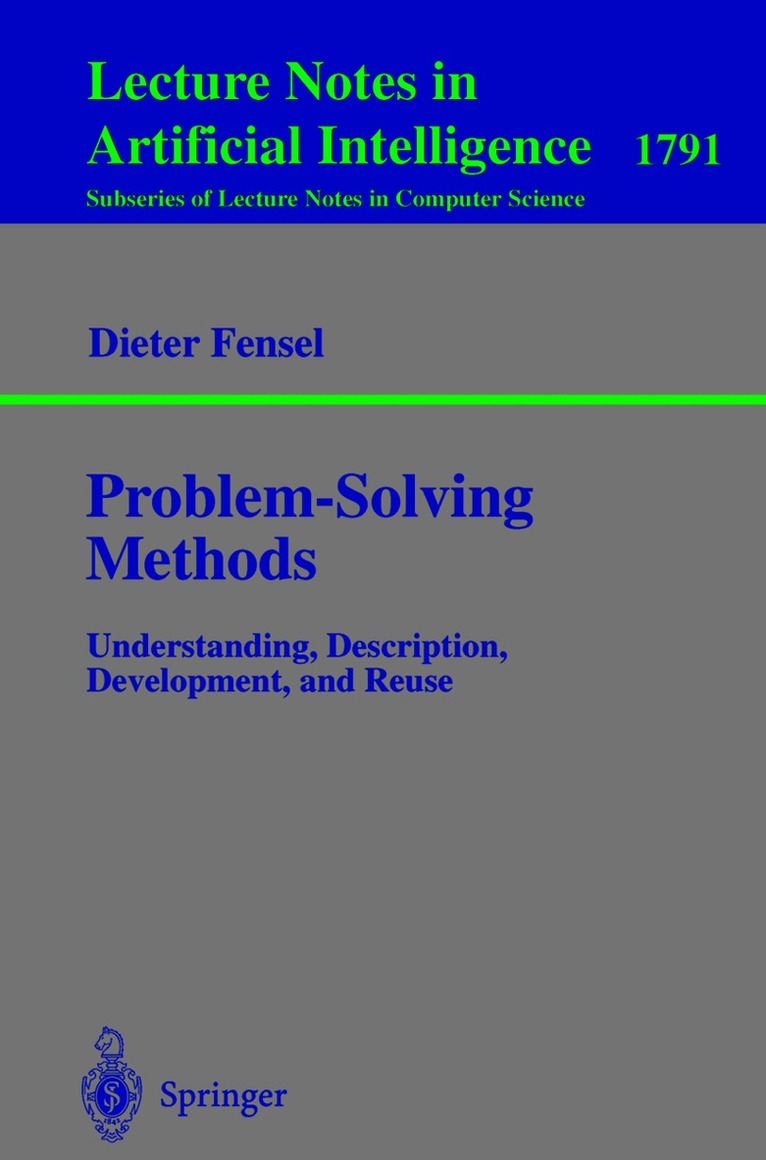
    Problem-Solving Methods

    Understanding, Description, Development, and Reuse

    AvDieter Fensel

    Häftad, Engelska, 2000

    Del i serien Lecture Notes in Computer Science

    563 kr

    Beställningsvara. Skickas inom 10-15 vardagar. Fri frakt över 249 kr.

    Fler format och utgåvor

    E-bok

    732 kr

    Beskrivning

    Researchers in Artificial Intelligence have traditionally been classified into two categories: the “neaties” and the “scruffies”. According to the scruffies, the neaties concentrate on building elegant formal frameworks, whose properties are beautifully expressed by means of definitions, lemmas, and theorems, but which are of little or no use when tackling real-world problems. The scruffies are described (by the neaties) as those researchers who build superficially impressive systems that may perform extremely well on one particular case study, but whose properties and underlying theories are hidden in their implementation, if they exist at all. As a life-long, non-card-carrying scruffy, I was naturally a bit suspicious when I first started collaborating with Dieter Fensel, whose work bears all the formal hallmarks of a true neaty. Even more alarming, his primary research goal was to provide sound, formal foundations to the area of knowledge-based systems, a traditional stronghold of the scruffies - one of whom had famously declared it “an art”, thus attempting to place it outside the range of the neaties (and to a large extent succeeding in doing so).

    Produktinformation

    • Utgivningsdatum:2000-09-27
    • Mått:155 x 235 x undefined mm
    • Format:Häftad
    • Språk:Engelska
    • Serie:Lecture Notes in Computer Science
    • Antal sidor:160
    • Förlag:Springer-Verlag Berlin and Heidelberg GmbH & Co. KG
    • ISBN:9783540678168

    Utforska kategorier

    • Programvaruutveckling inom Data och IT
    • Artificiell intelligens inom Data och IT

    Innehållsförteckning

    • What Are Problem-Solving Methods.- Making Assumptions for Efficiency Reasons.- What Are Problem-Solving Methods.- Making Assumptions for Efficiency Reasons.- An Empirical Survey of Assumptions.- How to Describe Problem-Solving Methods.- A Four Component Architecture for Knowledge-Based Systems.- Logics for Knowledge-Based Systems: MLPM and MCL.- A Verification Framework for Knowledge-Based Systems.- How to Develop and Reuse Problem-Solving Methods.- Methods for Context Explication and Adaptation.- Organizing a Library of Problem-Solving Methods.- Conclusions and Future Work.- Conclusions and Future Work.