• Fri frakt över 249 kr
  • •
  • Snabba leveranser
  • •
  • Billiga böcker
Kundservice

Du är på sajten för privatpersoner.

Företag, bibliotek eller offentlig verksamhet?

Du handlar på classic.bokus.com, där alla dina funktioner finns intakta.
Till classic.bokus.com
Bokus logotyp. Gå till startsidan.
  • Erbjudanden
  • Nyheter
  • Student
  • Topplistor
  • Barn & ungdom
  • Bokus Play
  • E-böcker
  • Pocketböcker
  • Spel & pussel

10% rabatt på allt med kod NYSTART10 →

Sidfot

Mina sidor

    Hjälp

    • Kundservice
    • Vanliga frågor och svar
    • Frakt och leverans
    • Retur vid ångerrätt
    • Reklamera vara
    • Betalning
    • Köpvillkor
    • Allmänna villkor
    • Information om webbplatsens tillgänglighet

    Om Bokus

    • Om oss
    • Pressrum
    • För studenter
    • För företag
    • För bibliotek och offentlig verksamhet
    • För leverantörer
    • Hållbarhet

    Populärt

    • Aktuella erbjudanden
    • Presentkort
    • Studentlitteratur
    • Nya böcker
    • Topplistor
    • Signerade böcker
    • Engelska böcker

    Inspiration

    • Boktips
    • BookTok
    • Populära bokserier
    • Barnbokskaraktärer
    • Populära författare
    Logotyp för Bokus
    Följ oss på Facebook (extern länk)Följ oss på Instagram (extern länk)Följ oss på YouTube (extern länk)Följ oss på TikTok (extern länk)
    bokus @ CookiesAnpassa cookiesIntegritetspolicyKöpvillkor
    Till Citymail hemsida (extern länk)Till Budbee hemsida (extern länk)Till Postnord hemsida (extern länk)Till Schenker hemsida (extern länk)Till Early Bird hemsida (extern länk)Till Walleys hemsida (extern länk)
    1. Naturvetenskap och teknik
    2. Matematik och naturvetenskap
    3. Matematik
    4. Matematisk statistik

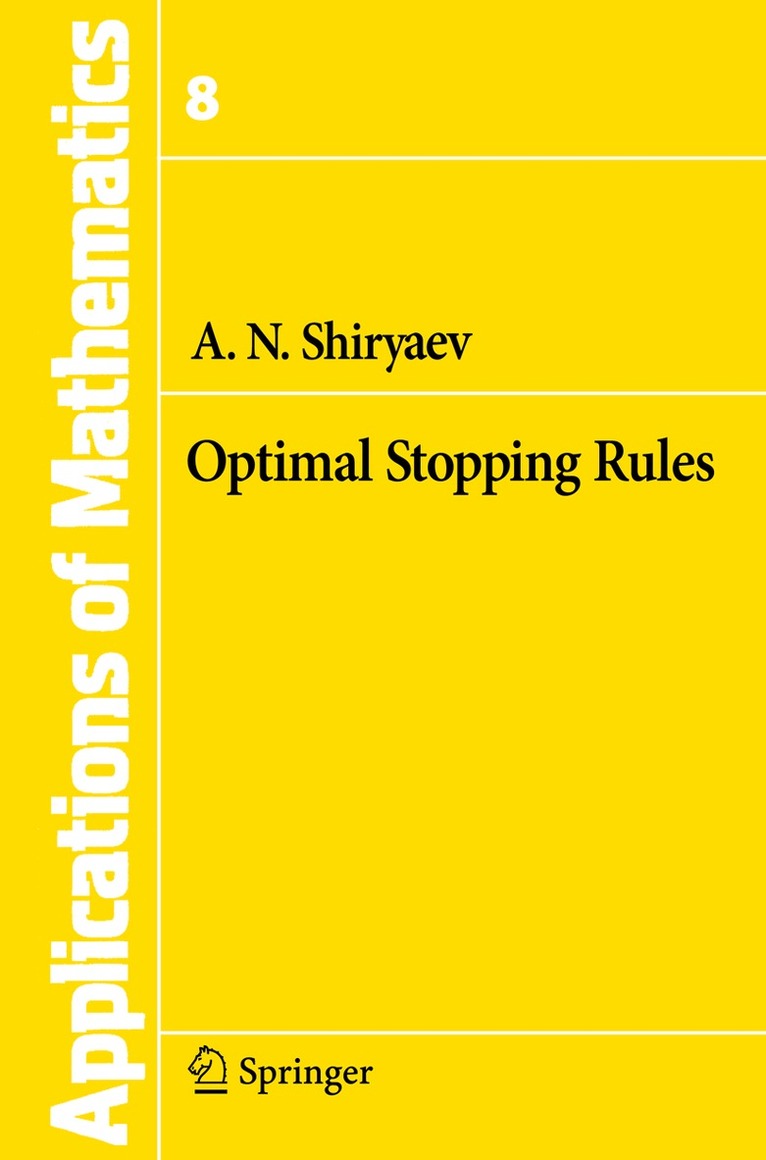
    Optimal Stopping Rules

    AvAlbert N. Shiryaev

    Häftad, Engelska, 2007

    Del i serien Stochastic Modelling and Applied Probability

    923 kr

    Beställningsvara. Skickas inom 10-15 vardagar. Fri frakt över 249 kr.

    Fler format och utgåvor

    E-bok

    1 176 kr

    Beskrivning

    Along with conventional problems of statistics and probability, the - vestigation of problems occurring in what is now referred to as stochastic theory of optimal control also started in the 1940s and 1950s. One of the most advanced aspects of this theory is the theory of optimal stopping rules, the development of which was considerably stimulated by A. Wald, whose Sequential ~nal~sis' was published in 1947. In contrast to the classical methods of mathematical statistics, according to which the number of observations is fixed in advance, the methods of sequential analysis are characterized by the fact that the time at which the observations are terminated (stopping time) is random and is defined by the observer based on the data observed. A. Wald showed the advantage of sequential methods in the problem of testing (from independent obser- tions) two simple hypotheses. He proved that such methods yield on the average a smaller number of observations than any other method using fixed sample size (and the same probabilities of wrong decisions). Furth- more, Wald described a specific sequential procedure based on his sequ- tial probability ratio criterion which proved to be optimal in the class of all sequential methods. By the sequential method, as applied to the problem of testing two simple hypotheses, we mean a rule according to which the time at which the observations are terminated is prescribed as well as the terminal decision as to which of the two hypotheses is true.

    Produktinformation

    • Utgivningsdatum:2007-11-07
    • Mått:155 x 235 x undefined mm
    • Format:Häftad
    • Språk:Engelska
    • Serie:Stochastic Modelling and Applied Probability
    • Antal sidor:220
    • Förlag:Springer-Verlag Berlin and Heidelberg GmbH & Co. KG
    • ISBN:9783540740100
    • Översättare:A.B. Aries, A. B. Aries

    Utforska kategorier

    • Matematisk statistik inom Naturvetenskap och teknik
    • Tillämpad matematik inom Naturvetenskap och teknik

    Innehållsförteckning

    • Random Processes: Markov Times.- Optimal Stopping of Markov Sequences.- Optimal Stopping of Markov Processes.- Some Applications to Problems of Mathematical Statistics.