• Fri frakt över 249 kr
  • •
  • Snabba leveranser
  • •
  • Billiga böcker
Kundservice

Du är på sajten för privatpersoner.

Företag, bibliotek eller offentlig verksamhet?

Du handlar på classic.bokus.com, där alla dina funktioner finns intakta.
Till classic.bokus.com
Bokus logotyp. Gå till startsidan.
  • Erbjudanden
  • Student
  • Topplistor
  • Barn & ungdom
  • Bokus Play
  • E-böcker
  • Ljudböcker
  • Pocketböcker
  • Spel och pussel

Pocketfynda! Hundratals böcker för 49 kr/st →

Sidfot

Mina sidor

    Hjälp

    • Kundservice
    • Vanliga frågor och svar
    • Frakt och leverans
    • Retur vid ångerrätt
    • Reklamera vara
    • Betalning
    • Köpvillkor
    • Allmänna villkor
    • Information om webbplatsens tillgänglighet

    Om Bokus

    • Om oss
    • Pressrum
    • För studenter
    • För företag
    • För bibliotek och offentlig verksamhet
    • För leverantörer
    • Hållbarhet

    Populärt

    • Aktuella erbjudanden
    • Presentkort
    • Studentlitteratur
    • Nya böcker
    • Topplistor
    • Signerade böcker
    • Engelska böcker

    Inspiration

    • Boktips
    • BookTok
    • Barnbokskaraktärer
    • Populära författare
    Logotyp för Bokus
    Följ oss på Facebook (extern länk)Följ oss på Instagram (extern länk)Följ oss på YouTube (extern länk)Följ oss på TikTok (extern länk)
    bokus @ CookiesAnpassa cookiesIntegritetspolicyKöpvillkor
    Till Citymail hemsida (extern länk)Till Budbee hemsida (extern länk)Till Postnord hemsida (extern länk)Till Schenker hemsida (extern länk)Till Early Bird hemsida (extern länk)Till Walleys hemsida (extern länk)
    1. Naturvetenskap och teknik
    2. Teknik och industri
    3. Elektronik och kommunikationer

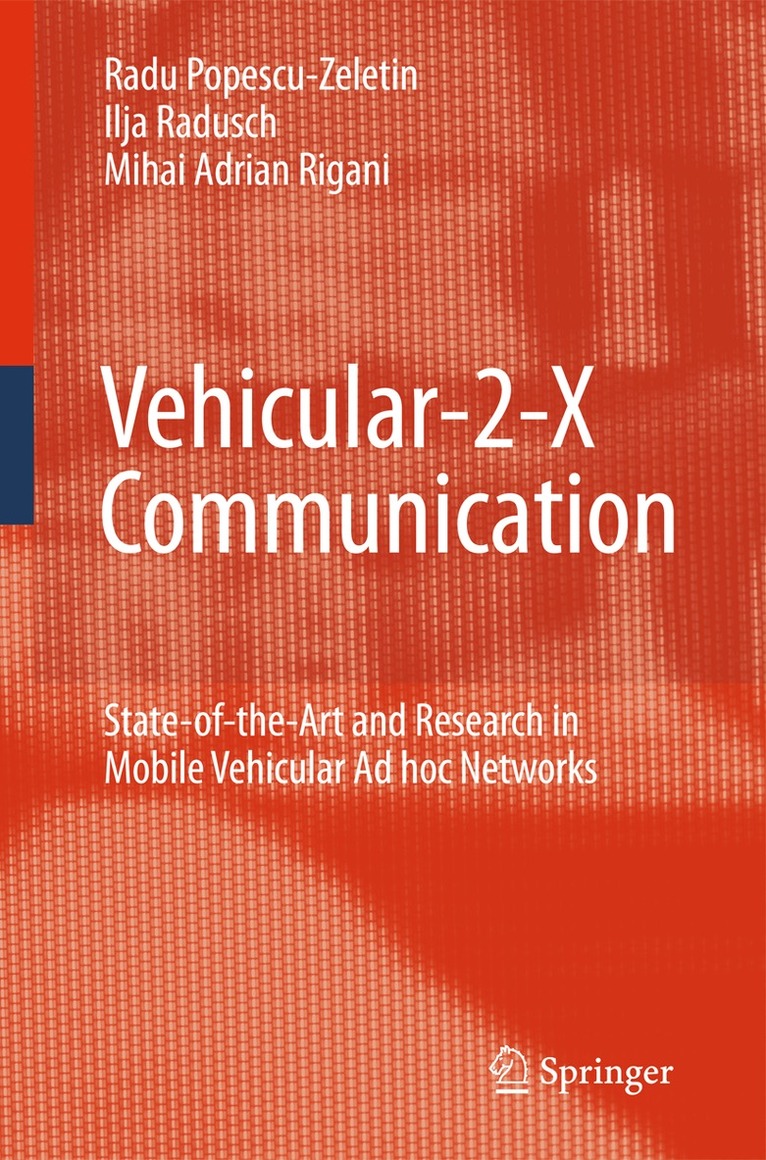
    Vehicular-2-X Communication

    State-of-the-Art and Research in Mobile Vehicular Ad hoc Networks

    AvRadu Popescu-Zeletin,Ilja Radusch

    Inbunden, Engelska, 2010

    1 078 kr

    Beställningsvara. Skickas inom 10-15 vardagar. Fri frakt över 249 kr.

    Fler format och utgåvor

    Häftad

    1 078 kr

    Beskrivning

    Universal vehicular communication promises many improvements in terms of ac- dent avoidance and mitigation, better utilization of roads and resources such as time and fuel, and new opportunities for infotainment applications. However, before widespread acceptance, vehicular communication must meet challenges comparable to the trouble and disbelief that accompanied the introduction of traf c lights back then. The rst traf c light was installed in 1868 in London to signal railway, but only later, in 1912, was invented the rst red-green electric traf c light. And roughly 50 years after the rst traf c light, in 1920, the rst four-way traf c signal comparable to our today’s traf c lights was introduced. The introduction of traf c signals was necessary after automobiles soon became prevalent once the rst car in history, actually a wooden motorcycle, was constructed in 1885. Soon, the scene became complicated, requiring the introduction of the “right-of-way” philosophy and later on the very rst traf c light. In the same way the traf c light was a necessary mean to regulate the beginning of the automotive life and to protect drivers, passengers, as well as pedestrians and other inhabitants of the road infrastructure, vehicular communication is necessary to accommodate the further growth of traf c volume and to signi cantly reduce the number of accidents.

    Produktinformation

    • Utgivningsdatum:2010-05-12
    • Mått:155 x 235 x undefined mm
    • Format:Inbunden
    • Språk:Engelska
    • Antal sidor:112
    • Förlag:Springer-Verlag Berlin and Heidelberg GmbH & Co. KG
    • ISBN:9783540771425

    Utforska kategorier

    • Elektronik och kommunikationer inom Naturvetenskap och teknik
    • Motorfordon inom Naturvetenskap och teknik
    • Artificiell intelligens inom Data och IT

    Mer om författaren

    Radu Popescu-Zeletin is Professor at the Technical University Berlin, and, since its foundation, has been director of the Fraunhofer Institute for Open Communication Systems, FOKUS, (formerly a GMD Institute). For many years he was head of the Research and Development Department of the BERKOM project at Deutsche Telekom. He has published numerous articles on distributed computer systems and applications. He is an active member of numerous standardization committees and is a leading player in the development of telecommunication standards. As holder of the Chair of Open Communication Systems, he also plays a major role in the development of the vision of I-centric Communications. Prof. Popescu-Zeletin has been appointed chairman of the Scientific Advisory Council of DeTeCon International. As a member of the Motorola Visionary Board, he is one of 30 leading international experts helping to shape the future in the field of mobile communications. He has also been invited by the University of Technology, Tokyo to assume a full professorship; appointment formalities are now underway (early 2004).Prof. Popescu-Zeletin graduated at the Polytechnic Institute in Bucharest, Romania, gained his Ph.D. at the University of Bremen, and habilitated at the Technical University of Berlin. Prof. Popescu-Zeletin is Senior Member of the IEEE, Doctor honoris causa at the Polytechnic Institute in Bucharest, and Professor honoris causa at the Catholic University of Campinas, Brasil. Furthermore he is member of the Motorola Visionary Board 2004/2005 as well as member of the Rumanian Academy. Prof. Popescu-Zeletin is bearer of the Public Service Medal of the Republic of Romania Ilja Radusch received his M.Sc. in Computer Science from the University of Technology Berlin (TUB). Since 2003 he is researcher with the Open Communication Systems (OKS) as well as with Fraunhofer FOKUS since 2005. Since 2006 he is group leader at the Daimler Center for Automotive Information Technology Innovations (DCAITI). He is working in the field of Car-2-Car Communication, Sensor and Ad-hoc Networks, and Context-aware Services. His responsibility includes several projects for industry partners such as Deutsche Telekom and DaimlerChrysler as well as research projects for the German Ministry of Education and Research and the European Union. Furthermore, he is giving various lecture courses at the TU Berlin Mihai Adrian Rigani received his degree in Electrotechnics in 2005 at Polytechnic University of Bucharest. Since then he is research scientist with the Daimler Center for Automotive Information Technology Innovations (DCAITI) at the Open Communication Systems (OKS) department of the Technische Universitat Berlin (TUB).

    Recensioner i media

    Aus den Rezensionen: "... bieten Experten von Fraunhofer FOKUS und der TU Berlin erstmals einen umfassenden Uberblick uber den aktuellen Forschungs und Technologiestand im Bereich Fahrzeug zu Fahrzeug und Fahrzeug zu Infrastruktur Kommunikation. ... stellt Kommunikations systeme und Anwendungen vor ... prasentiert Forschungsansatze und Simulationsmodelle, die Verkehrs leitsysteme verbessern, Unfalle vermelden und das Reisen komfortabler gestalten konnen." (Radu Popescu Zeletin, in: TU intern, January/2011, Issue 1, S. 6)

    Innehållsförteckning

    • Applications of Vehicular Communication.- Communication Regimes.- Information in the Vehicular Network.- Routing.- Medium Access for Vehicular Communications.- Physical Layer Technologies.- Security.