• Fri frakt över 249 kr
  • •
  • Snabba leveranser
  • •
  • Billiga böcker
Kundservice

Du är på sajten för privatpersoner.

Företag, bibliotek eller offentlig verksamhet?

Du handlar på classic.bokus.com, där alla dina funktioner finns intakta.
Till classic.bokus.com
Bokus logotyp. Gå till startsidan.
  • Erbjudanden
  • Nyheter
  • Student
  • Topplistor
  • Barn & ungdom
  • Bokus Play
  • E-böcker
  • Pocketböcker
  • Spel & pussel

10% rabatt på allt med kod: NYSTART10 →

Sidfot

Mina sidor

    Hjälp

    • Kundservice
    • Vanliga frågor och svar
    • Frakt och leverans
    • Retur vid ångerrätt
    • Reklamera vara
    • Betalning
    • Köpvillkor
    • Allmänna villkor
    • Information om webbplatsens tillgänglighet

    Om Bokus

    • Om oss
    • Pressrum
    • För studenter
    • För företag
    • För bibliotek och offentlig verksamhet
    • För leverantörer
    • Hållbarhet

    Populärt

    • Aktuella erbjudanden
    • Presentkort
    • Studentlitteratur
    • Nya böcker
    • Topplistor
    • Signerade böcker
    • Engelska böcker

    Inspiration

    • Boktips
    • BookTok
    • Populära bokserier
    • Barnbokskaraktärer
    • Populära författare
    Logotyp för Bokus
    Följ oss på Facebook (extern länk)Följ oss på Instagram (extern länk)Följ oss på YouTube (extern länk)Följ oss på TikTok (extern länk)
    bokus @ CookiesAnpassa cookiesIntegritetspolicyKöpvillkor
    Till Citymail hemsida (extern länk)Till Budbee hemsida (extern länk)Till Postnord hemsida (extern länk)Till Schenker hemsida (extern länk)Till Early Bird hemsida (extern länk)Till Walleys hemsida (extern länk)
    1. Data och IT
    2. Människa – datorinteraktion

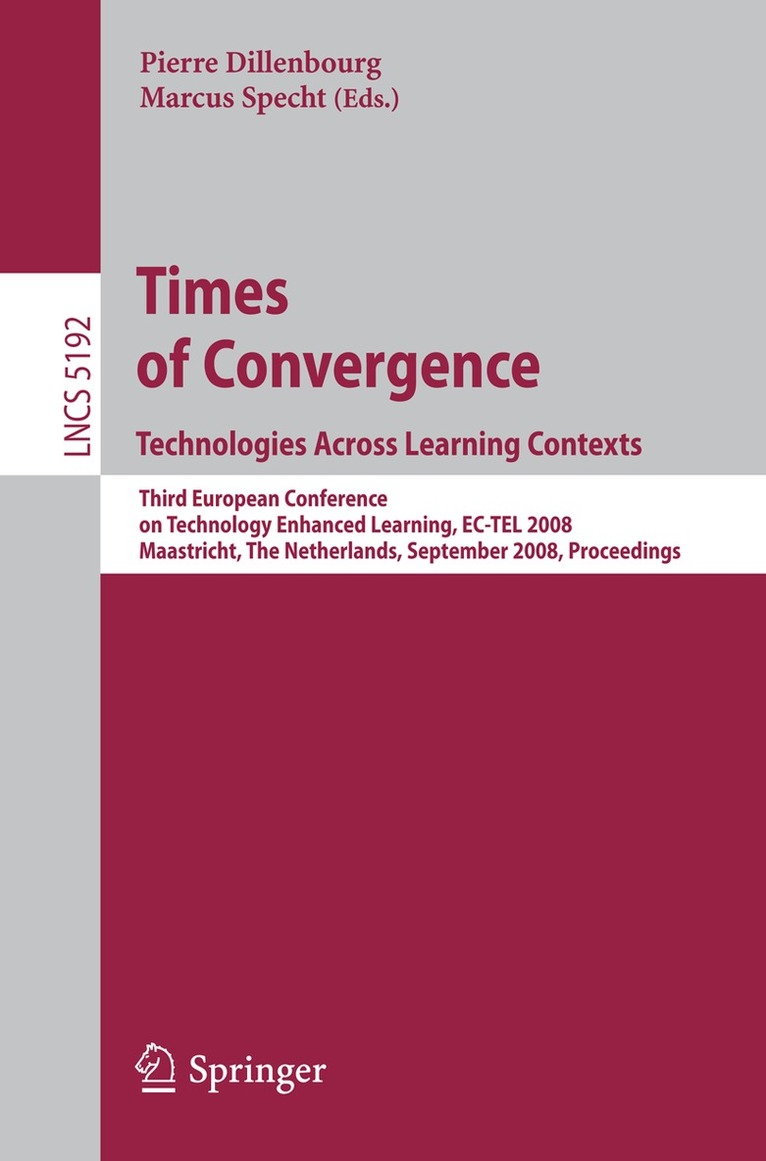
    Times of Convergence. Technologies Across Learning Contexts

    Third European Conference on Technology Enhanced Learning, EC-TEL 2008, Maastricht, The Netherlands, September 16-19, 2008, Proceedings

    AvPierre Dillenbourg,Marcus Specht

    Häftad, Engelska, 2008

    Del i serien Lecture Notes in Computer Science

    531 kr

    Beställningsvara. Skickas inom 10-15 vardagar. Fri frakt över 249 kr.

    Beskrivning

    The European Conference on Technology-Enhanced Learning (EC-TEL 2008) was the third event of a series that started in 2006. The two first editions were organized by Pro- Learn (http://www.prolearn-project.org/), a European Network of Excellence. In 2008, several members of Kaleidoscope, the other European Network of Excellence (http://www.noe-kaleidoscope.org/pub/), joined as co-chair, committee members, reviewers and authors. These two networks are no longer funded, but our aim was to turn EC-TEL into a sustainable series of high-quality events and thereby to contribute to the scientific landscape of technology-enhanced learning. A new network, named STELLAR, will be launched in 2009, with members from both existing networks as well as new members and will support the future editions of this conference. The scope of EC-TEL 2008 covered the different fields of learning technologies: e- cation, psychology, computer science. The contributions in this volume address the - sign of innovative environments, computational models and architectures, results of empirical studies on socio-cognitive processes, field studies regarding the use of te- nologies in context, collaborative processes, pedagogical scenarios, reusable learning objects and emerging objects, groups and communities, learning networks, interaction analysis, metadata, personalization, collaboration scripts, learning adaptation, collabo- tive environments, resources, tangible tools, as well as learning management systems.

    Produktinformation

    • Utgivningsdatum:2008-09-08
    • Mått:155 x 235 x 27 mm
    • Vikt:744 g
    • Format:Häftad
    • Språk:Engelska
    • Serie:Lecture Notes in Computer Science
    • Antal sidor:478
    • Upplaga:2008
    • Förlag:Springer-Verlag Berlin and Heidelberg GmbH & Co. KG
    • ISBN:9783540876045

    Utforska kategorier

    • Människa – datorinteraktion inom Data och IT
    • Grafik och bildbehandling inom Data och IT
    • Artificiell intelligens inom Data och IT

    Innehållsförteckning

    • Using Interaction Analysis to Reveal Self-Regulated Learning in Virtual Communities.- Evaluating Spatial Knowledge through Problem-Solving in Virtual Learning Environments.- Role-Play Virtual Environments: Recreational Learning of Software Design.- A Socio-technical Approach towards Supporting Intra-organizational Collaboration.- Reflect: An Interactive Table for Regulating Face-to-Face Collaborative Learning.- Face to Face Cooperation with CoFFEE.- The Influence of the Faculty Attitude on the Adoption of ICTs’ Innovations for Learning Purposes: Analysis of a Shared Web.- Flexible Analysis of User Actions in Heterogeneous Distributed Learning Environments.- A Service Providing Awareness of Learning Object Evolutions in a Distributed Environment.- ALOA: A Web Services Driven Framework for Automatic Learning Object Annotation.- Reusing Collaborative Knowledge as Learning Objects –The Implementation and Evaluation of AnnForum.- Evaluation of Interoperability between MOT and Regular Learning Management Systems.- Implications of Writing, Reading, and Tagging on the Web for Reflection Support in Informal Learning.- A Distributed Ontological Approach as a Basis for Software in the Context of Academic Programs.- Systems Engineering for Technology Enhanced Learning.- Defining Adaptation in a Generic Multi Layer Model: CAM: The GRAPPLE Conceptual Adaptation Model.- Imperfect Answers in Multiple Choice Questionnaires.- Towards a Semantic-Rich Collaborative Environment for Learning Software Patterns.- Tinkering or Sketching: Apprentices’ Use of Tangibles and Drawings to Solve Design Problems.- Design of an Annotation Tool to Support Simulation Training of Medical Teams.- A Domain-Specific-Modeling Approach to Support Scenarios-Based Instructional Design.- A Heuristic NLPBased Approach for Getting Didactic Resources from Electronic Documents.- Fostering Self-Directed Learning with Social Software: Social Network Analysis and Content Analysis.- Capture of Lifecycle Information to Support Personal Information Management.- A Model of Re-use of E-Learning Content.- Knowledge Services for Work-Integrated Learning.- Designing Software for Pupils with Special Needs: Analysis of an Example for Complementary Action Design.- Adaptation in the Context of Explanatory Visualization.- Interaction Analysis Supporting Participants’ Self-regulation in a Generic CSCL System.- WHURLE 2.0: Adaptive Learning Meets Web 2.0.- Towards Accessing Disparate Educational Data in a Single, Unified Manner.- Bridging the Gap between Practitioners and E-Learning Standards: A Domain-Specific Modeling Approach.- Supporting Learners’ Organization in Collective Challenges.- When Co-learners Work on Complementary Texts: Effects on Outcome Convergence.- Using LEGO Mindstorms as an Instructional Aid in Technical and Vocational Secondary Education: Experiences from an Empirical Case Study.- Measuring Learning Object Reuse.- Issues in the Design of an Environment to Support the Learning of Mathematical Generalisation.- ISiS: An Intention-Oriented Model to Help Teachers in Learning Scenarios Design.- Open Educational Resources: Inquiring into Author Reuse Behaviors.- No Guru, No Method, No Teacher: Self-classification and Self-modelling of E-Learning Communities.- Extraction of Socio-semantic Data from Chat Conversations in Collaborative Learning Communities.- Knowledge Processing and Contextualisation by Automatical Metadata Extraction and Semantic Analysis.- Knowing What the Peer Knows: The Differential Effect of Knowledge Awareness on Collaborative Learning Performanceof Asymmetric Pairs.- Onto’CoPE: Ontology for Communities of Practice of E-Learning.- A Flexible and Tailorable Architecture for Scripts in F2F Collaboration.- Semantic Technologies for Socially-Enhanced Context-Aware Mobile Learning.- Knowledge Practices Environment: Design and Application of Technology for Trialogical Learning.- Towards Lightweight LMS 2.0: A Blog-Based Approach to Online Assessment.- CoChemEx: Supporting Conceptual Chemistry Learning Via Computer-Mediated Collaboration Scripts.- Immediate Elaborated Feedback Personalization in Online Assessment.- Application of Petri Nets on the Execution of IMS Learning Design Documents.- A Supporting Architecture for Generic Service Integration in IMS Learning Design.