• Fri frakt över 249 kr
  • •
  • Snabba leveranser
  • •
  • Billiga böcker
Kundservice

Du är på sajten för privatpersoner.

Företag, bibliotek eller offentlig verksamhet?

Du handlar på classic.bokus.com, där alla dina funktioner finns intakta.
Till classic.bokus.com
Bokus logotyp. Gå till startsidan.
  • Erbjudanden
  • Nyheter
  • Student
  • Topplistor
  • Barn & ungdom
  • Bokus Play
  • E-böcker
  • Pocketböcker
  • Spel & pussel

10% rabatt på allt med kod NYSTART10 →

Sidfot

Mina sidor

    Hjälp

    • Kundservice
    • Vanliga frågor och svar
    • Frakt och leverans
    • Retur vid ångerrätt
    • Reklamera vara
    • Betalning
    • Köpvillkor
    • Allmänna villkor
    • Information om webbplatsens tillgänglighet

    Om Bokus

    • Om oss
    • Pressrum
    • För studenter
    • För företag
    • För bibliotek och offentlig verksamhet
    • För leverantörer
    • Hållbarhet

    Populärt

    • Aktuella erbjudanden
    • Presentkort
    • Studentlitteratur
    • Nya böcker
    • Topplistor
    • Signerade böcker
    • Engelska böcker

    Inspiration

    • Boktips
    • BookTok
    • Populära bokserier
    • Barnbokskaraktärer
    • Populära författare
    Logotyp för Bokus
    Följ oss på Facebook (extern länk)Följ oss på Instagram (extern länk)Följ oss på YouTube (extern länk)Följ oss på TikTok (extern länk)
    bokus @ CookiesAnpassa cookiesIntegritetspolicyKöpvillkor
    Till Citymail hemsida (extern länk)Till Budbee hemsida (extern länk)Till Postnord hemsida (extern länk)Till Schenker hemsida (extern länk)Till Early Bird hemsida (extern länk)Till Walleys hemsida (extern länk)
    1. Naturvetenskap och teknik
    2. Matematik och naturvetenskap
    3. Biologi
    4. Biokemi

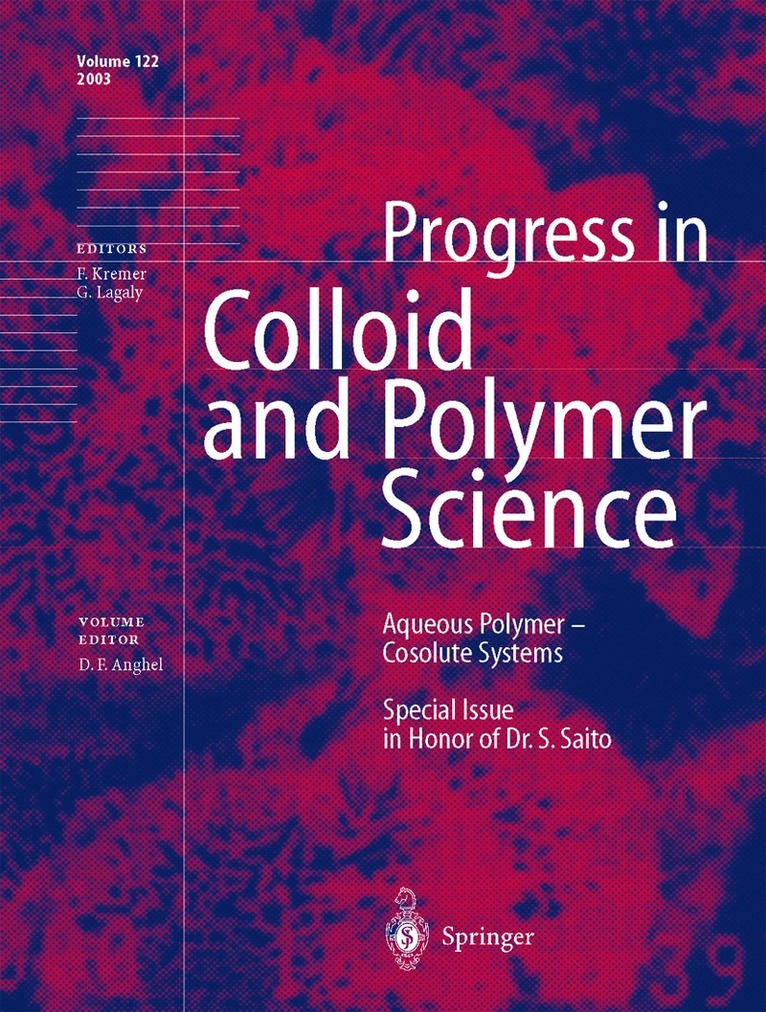
    Aqueous Polymer — Cosolute Systems

    Special Issue in Honor of Dr. Shuji Saito

    AvDan F. Anghel

    Häftad, Engelska, 2010

    Del 122 i serien Progress in Colloid and Polymer Science

    1 623 kr

    Beställningsvara. Skickas inom 10-15 vardagar. Fri frakt över 249 kr.

    Beskrivning

    Springer-Verlag 2003 This issue is dedicated to Doctor Shuji Saito on the occasion of the 50th anniversary of his ?rst paper published in the Journal of German Colloid Society. The paper entitled "Die Solubilisation von Polyvinylazetat" by N. Sata and S. Saito appeared in the Kolloid Zeitschrift (1952) 128: 154. According to the title, the paper dealt with the solubilization of poly(vinyl acetate) (PVAc) in aqueous sodium dodecyl sulfate (SDS) solutions. The authors observed that PVAc, a water-insoluble polymer, is c- pletely dissolved by micellar SDS solutions, a result that mostly intrigued them. One has to recall that at that time, the micellar solubilization was the only available theory to explain the dissolution of hydrophobic compounds in micellar systems. The theory worked well in the case of low molecular weight compounds like hydrocarbons, oleophilic dyes, etc. , which are solubilized in the inner core of the micelle, but how can a small micelle accommodate a giant polymer molecule? To solve this problem Sata and Saito originally proposed a model consisting of surfactant aggregates formed along the polymer backbone.The model based on simple viscometric measurements was later in the eighties con?rmed by the advent of the more sophisticated neutron scattering technique and is nowadays called the "necklace model". During his career, Dr.

    Produktinformation

    • Utgivningsdatum:2010-12-09
    • Mått:210 x 279 x 10 mm
    • Vikt:436 g
    • Format:Häftad
    • Språk:Engelska
    • Serie:Progress in Colloid and Polymer Science
    • Antal sidor:158
    • Förlag:Springer-Verlag Berlin and Heidelberg GmbH & Co. KG
    • ISBN:9783642055126

    Utforska kategorier

    • Biokemi inom Naturvetenskap och teknik
    • Fysikalisk kemi inom Naturvetenskap och teknik
    • Materietillstånd inom Naturvetenskap och teknik

    Recensioner i media

    Praise to D.F. Anghel's Aqueous Polymer POLYMERNEWS "The volume will be a valuable resource for those interested in complexation between water-soluble polymers and surfactants and application scientists working in this area."

    Innehållsförteckning

    • Surfactant structure effects on binding with oppositely charged polyelectrolytes observed by fluorescence of a pyrene probe and label.- Dependence of the aggregation mode of two bidentate azo dyes in polycation/dye multilayers on the dye structure and the polycation conformation.- Counterion effect of cationic surfactants on the interaction with poly(acrylic acid).- Polyelectrolyte-induced structural changes in the isotropic phase of the sulfobetaine/ pentanol/toluene/water system.- Surfactant-polymer aggregates of mixed cationic micelles and anionic polyelectrolytes: a surfactant head group contribution.- Physicochemical investigations on the interaction of cationic cellulose ether derivatives with cationic amphiphiles in an aqueous environment.- Use of nonionic ethylene oxide surfactants as phase-transfer catalysts for poly(acrylic acid) adsorption to silica against an electrostatic repulsion.- Molecular modeling of anthracycline—DNA interaction.- Interactions between high-molecular-weight poly(ethylene oxide) and sodium dodecyl sulfate.- Diverse actions of added alkanols on the binding of dibucaine cation to an anionic polymer.- The aqueous liquid/liquid interphases formed by chitosan-anionic surfactant complexes.- Microcalorimetric evidence and rheological consequences of the salt effect on carbopol-surfactant interactions.- Swelling isotherms of surfactant-responsive polymer gels.- A comparison study between sodium decyl sulfonate and sodium decyl sulfate with respect to the interaction with poly(vinylpyrrolidone).- Influence of the polycation architecture on the oscillatoric forces of aqueous free-standing polyelectrolyte/surfactant films.- Thermodynamic analysis of serum albumin denaturation by sodium dodecyl sulfate.- The surfactant characteristics ofshort-chain lecithins analyzed through lecithin-lecithin and lecithin-biopolymer interactions.- Isothermal titration calorimetry and fluorescence spectroscopy studies of the interactions between surfactants and a phosphorylcholine-based polybetaine.