• Fri frakt över 249 kr
  • •
  • Snabba leveranser
  • •
  • Billiga böcker
Kundservice

Du är på sajten för privatpersoner.

Företag, bibliotek eller offentlig verksamhet?

Du handlar på classic.bokus.com, där alla dina funktioner finns intakta.
Till classic.bokus.com
Bokus logotyp. Gå till startsidan.
  • Erbjudanden
  • Nyheter
  • Student
  • Topplistor
  • Barn & ungdom
  • Bokus Play
  • E-böcker
  • Pocketböcker
  • Spel & pussel

10% rabatt på allt med kod NYSTART10 →

Sidfot

Mina sidor

    Hjälp

    • Kundservice
    • Vanliga frågor och svar
    • Frakt och leverans
    • Retur vid ångerrätt
    • Reklamera vara
    • Betalning
    • Köpvillkor
    • Allmänna villkor
    • Information om webbplatsens tillgänglighet

    Om Bokus

    • Om oss
    • Pressrum
    • För studenter
    • För företag
    • För bibliotek och offentlig verksamhet
    • För leverantörer
    • Hållbarhet

    Populärt

    • Aktuella erbjudanden
    • Presentkort
    • Studentlitteratur
    • Nya böcker
    • Topplistor
    • Signerade böcker
    • Engelska böcker

    Inspiration

    • Boktips
    • BookTok
    • Populära bokserier
    • Barnbokskaraktärer
    • Populära författare
    Logotyp för Bokus
    Följ oss på Facebook (extern länk)Följ oss på Instagram (extern länk)Följ oss på YouTube (extern länk)Följ oss på TikTok (extern länk)
    bokus @ CookiesAnpassa cookiesIntegritetspolicyKöpvillkor
    Till Citymail hemsida (extern länk)Till Budbee hemsida (extern länk)Till Postnord hemsida (extern länk)Till Schenker hemsida (extern länk)Till Early Bird hemsida (extern länk)Till Walleys hemsida (extern länk)
    1. Data och IT
    2. Systemvetenskap och AI

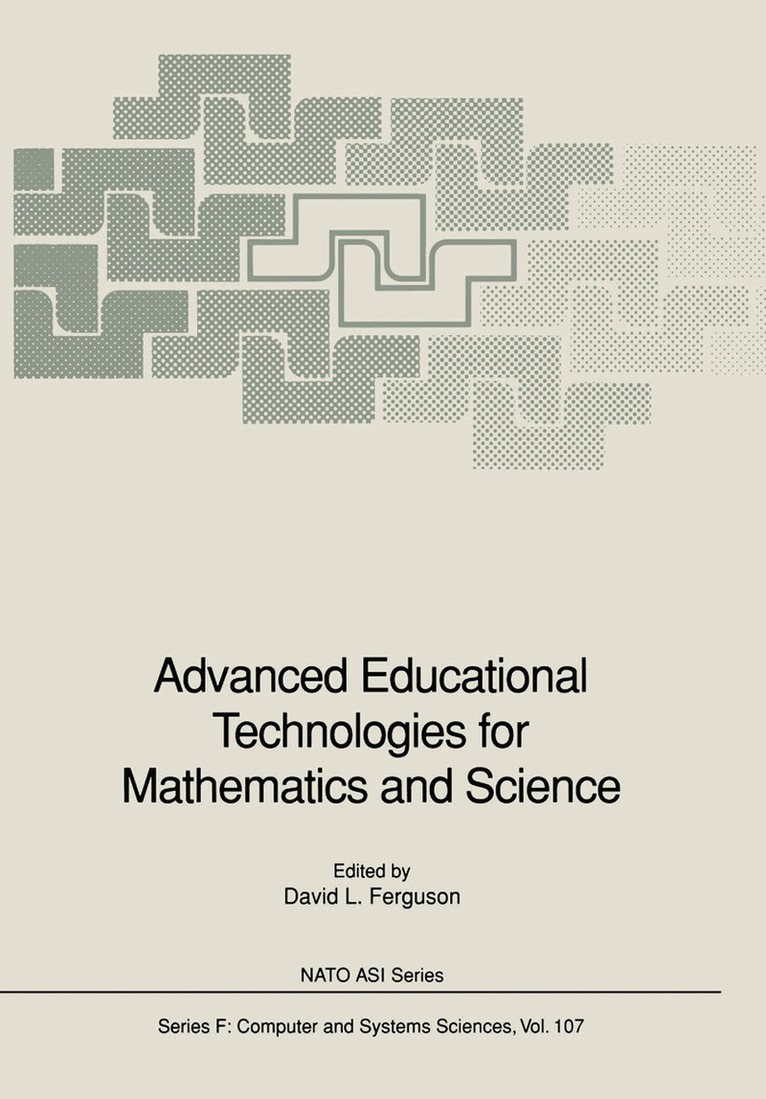
    Advanced Educational Technologies for Mathematics and Science

    AvDavid L. Ferguson

    Häftad, Engelska, 2010

    Del i serien NATO ASI Subseries F:

    3 243 kr

    Beställningsvara. Skickas inom 10-15 vardagar. Fri frakt över 249 kr.

    Beskrivning

    This book contains revised and updated versions of papers presented at a NATO Advanced Research Workshop held in Milton Keynes, U.K., in summer 1990.The workshop brought together about 30 world leaders in the use of advanced technologies in the teaching of mathematics and science. The papers demonstrate how technology is impacting the view in the teaching profession of what should be taught, what can be taught, and how teachers should go about their work in the various disciplines. They offer great insight into the central issues of teaching and learning in a wide range of disciplines and across many grade levels, ranging from elementary school through college and undergraduate education. The book has two major parts, on advanced technologies in the teaching of science and mathematics respectively, although many of the papers address topics of interest to specialists in both areas. The papers reflect examples drawn from a wide range of fields, including mathematics, physics, computer science, engineering, chemistry, and biology. Some demonstrate the use of software inteaching difficult but restricted concepts within a discipline.Other show an integrated approach that exploits the power of educational software throughout a course. The notions of discovery, representation, qualitative models for reasoning, model building, and the management of complexity are key elements in numerous papers.

    Produktinformation

    • Utgivningsdatum:2010-12-15
    • Mått:170 x 244 x 42 mm
    • Vikt:1 306 g
    • Format:Häftad
    • Språk:Engelska
    • Serie:NATO ASI Subseries F:
    • Antal sidor:756
    • Förlag:Springer-Verlag Berlin and Heidelberg GmbH & Co. KG
    • ISBN:9783642081521

    Utforska kategorier

    • Systemvetenskap och AI inom Data och IT
    • Referensverk och tvärvetenskap inom Samhälle och politik
    • Matematik inom Naturvetenskap och teknik

    Innehållsförteckning

    • 1. Advanced Technologies in the Teaching of Science.- Using Technology to Teach Thermodynamics: Achieving Integrated Understanding.- LEGO/Logo and Electronic Bricks: Creating a Scienceland for Children.- Modelling and Theory Building: Technology in Support of Student Theorizing.- Courseware for Introductory Foundations of Computer Science.- Learning Electricity and Cognitive Modeling.- The Didactic Potential of Computer Aided Modeling for Physics Education.- The Computer as a Conceptual Lab: Learning Dynamics with an Exploratory Environment.- Oscillating Reactions: Cognitive Theory Approach.- Intelligent Learning Technology for Science Learning.- The Use of Interactive Software for the Exploration of Simple Feedback Systems.- Teaching Operations Research Using “Home Made” Software.- Learning Problem Solving Through Computer Programming.- Interactive Learning and Biology: A Hypermedia Approach.- 2. Advanced Technologies in the Teaching of Mathematics.- Interrelationships Between Mind and Computer: Processes, Images, Symbols.- Deconstructing Microworlds.- Productivity Tools as an Integrated Modeling and Problem Solving Environment.- Software to Think With: The Case of Algebra.- Understanding Concepts in Algebra Using Linked Representation Tools.- Computers in Teaching and Learning Discrete Mathematics and Abstract Algebra.- Symbolic Computation Systems and Algebraic, and Numerical Viewpoints in Elementary Calculus.- Experiences of Computer Laboratory in Mathematics Teaching.- Mathematics and Technologies.- Intelligent Tutoring Systems and Mathematics: A Survey of What’s Going on in France.- The Computer: Some Changes in Mathematics Teaching and Learning 6 8.- An Introductory Course in Quantitative Methods: Computers in the Teaching of Problem Solving to CollegeStudents.- Biographies.