• Fri frakt över 249 kr
  • •
  • Snabba leveranser
  • •
  • Billiga böcker
Kundservice

Du är på sajten för privatpersoner.

Företag, bibliotek eller offentlig verksamhet?

Du handlar på classic.bokus.com, där alla dina funktioner finns intakta.
Till classic.bokus.com
Bokus logotyp. Gå till startsidan.
  • Erbjudanden
  • Student
  • Topplistor
  • Barn & ungdom
  • Bokus Play
  • E-böcker
  • Ljudböcker
  • Pocketböcker
  • Spel och pussel

Pocketfynda! Hundratals böcker för 49 kr/st →

Sidfot

Mina sidor

    Hjälp

    • Kundservice
    • Vanliga frågor och svar
    • Frakt och leverans
    • Retur vid ångerrätt
    • Reklamera vara
    • Betalning
    • Köpvillkor
    • Allmänna villkor
    • Information om webbplatsens tillgänglighet

    Om Bokus

    • Om oss
    • Pressrum
    • För studenter
    • För företag
    • För bibliotek och offentlig verksamhet
    • För leverantörer
    • Hållbarhet

    Populärt

    • Aktuella erbjudanden
    • Presentkort
    • Studentlitteratur
    • Nya böcker
    • Topplistor
    • Signerade böcker
    • Engelska böcker

    Inspiration

    • Boktips
    • BookTok
    • Barnbokskaraktärer
    • Populära författare
    Logotyp för Bokus
    Följ oss på Facebook (extern länk)Följ oss på Instagram (extern länk)Följ oss på YouTube (extern länk)Följ oss på TikTok (extern länk)
    bokus @ CookiesAnpassa cookiesIntegritetspolicyKöpvillkor
    Till Citymail hemsida (extern länk)Till Budbee hemsida (extern länk)Till Postnord hemsida (extern länk)Till Schenker hemsida (extern länk)Till Early Bird hemsida (extern länk)Till Walleys hemsida (extern länk)
    1. Ekonomi och Ledarskap
    2. Företagsekonomi
    3. Affärsutveckling

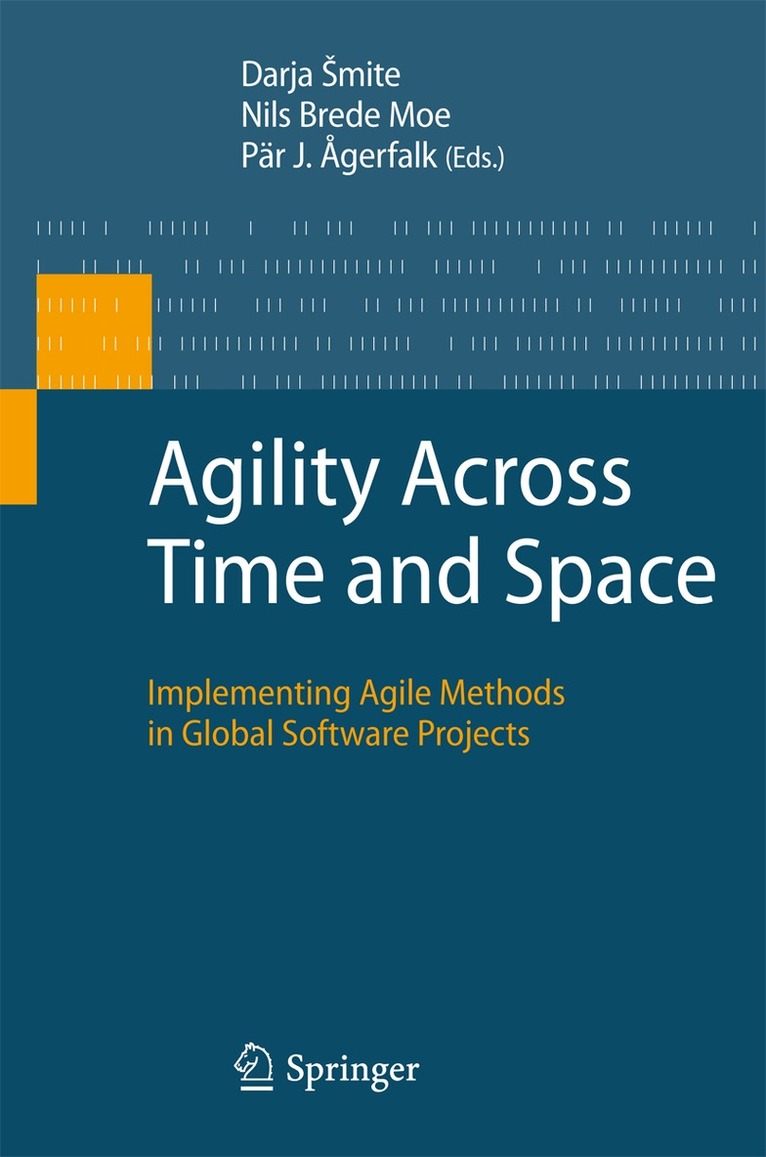
    Agility Across Time and Space

    Implementing Agile Methods in Global Software Projects

    AvDarja Šmite,Nils Brede Moe

    Inbunden, Engelska, 2010

    559 kr

    Beställningsvara. Skickas inom 10-15 vardagar. Fri frakt över 249 kr.

    Beskrivning

    Rather than deciding whether or not to get involved in global sourcing, many companies are facing decisions about whether or not to apply agile methods in their distributed projects. These companies are often motivated by the opportunities to solve the coordination and communication difficulties associated with global software development. Yet while agile principles prescribe close interaction and co-location, the very nature of distributed software development does not support these prerequisites. Šmite, Moe, and Ågerfalk structured the book into five parts. In “Motivation” the editors introduce the fundamentals of agile distributed software development and explain the rationale behind the application of agile practices in globally distributed software projects. “ Transition” describes implementation strategies, adoption of particular agile practices for distributed projects, and general concepts of agility. “Management” details practical implications for project planning, time management, and customer and subcontractor interaction. “Teams” discusses agile distributed team configuration, effective communication and knowledge transfer, and allocation of roles and responsibilities. Finally, in the “Epilogue” the editors summarize all contributions and present future trends for research and practice in agile distributed development. This book is primarily targeted at researchers, lecturers, and students in empirical software engineering, and at practitioners involved in globally distributed software projects. The contributions are based on sound empirical research and identify gaps and commonalities in both the existing state of the art and state of the practice. In addition, they also offer practical advice through many hints, checklists, and experience reports. Questions answered in this book include: What should companies expect from merging agile and distributed strategies? What are the stumbling blocks that prevent companies from realizing the benefits of the agile approach in distributed environments, and how can we recognize infeasible strategies and unfavorable circumstances? What helps managers cope with the challenges of implementing agile approaches in distributed software development projects? How can distributed teams survive the decisions taken by management and become efficient through the application of agile approaches?

    Produktinformation

    • Utgivningsdatum:2010-05-22
    • Mått:155 x 235 x 25 mm
    • Vikt:735 g
    • Format:Inbunden
    • Språk:Engelska
    • Antal sidor:341
    • Upplaga:2010
    • Förlag:Springer-Verlag Berlin and Heidelberg GmbH & Co. KG
    • ISBN:9783642124419

    Utforska kategorier

    • Affärsutveckling inom Ekonomi och Ledarskap
    • Programvaruutveckling inom Data och IT
    • Affärsförhandlingar inom Ekonomi och Ledarskap

    Mer om författaren

    Darja Šmite is a senior researcher at Blekinge Institute of Technology, which has recently been ranked as number 11 among the top institutions in the world in systems and software engineering by the Journal of Systems and Software. Her main research efforts are directed towards improving industrial practice with off-shoring and outsourcing software development. Before pursuing an academic career she has been engaged in industrial positions at a number of software houses in Latvia. Nils Brede Moe is a research scientist at SINTEF Information and Communication Technology in Trondheim, Norway. He has 11 years of experience working as a project manager and researcher within software development and is a co-author of the book “Process Improvement in Practice—A Handbook for IT Companies”. His current research interests include global software development, process improvement, self-management, and agile software development. Pär J. Ågerfalk is a professor at Uppsala University where he holdsthe Chair in Computer Science in Intersection with Social Sciences. Among many other responsibilities, he is the founding chair of the AIS Special Interest Group on Pragmatist Information Systems Research.

    Recensioner i media

    From the reviews: "The researchers and practitioners who collectively wrote this volume have been examining without prejudice what works and what does not, and trying to get at the root cause, giving us another and better perspective on this fascinating wave: the agile software development movement." - from the Foreword by Philippe Kruchten, University of British Columbia, Vancouver, Canada "If you have anything to do with software projects at multiple locations, you should read this book. ... provides a coherent framework and a logical flow of information. ... easy to read and conducive to skimming for high-value information. ... useful feature is the practice of inserting practical tips in shaded panels, at regular intervals. I recommend this book to professionals involved in distributed projects ... . It will also useful ... to academics with research interests in agile programming, distributed software development, or both." (Neil D. Burgess, ACM Computing Reviews, October, 2010)

    Innehållsförteckning

    • Motivation.- Fundamentals of Agile Distributed Software Development.- Transition.- Implementing Extreme Programming in Distributed Software Project Teams: Strategies and Challenges.- Transitioning from Distributed and Traditional to Distributed and Agile: An Experience Report.- Tailoring Agility: Promiscuous Pair Story Authoring and Value Calculation.- Scrum and Global Delivery: Pitfalls and Lessons Learned.- Onshore and Offshore Outsourcing with Agility: Lessons Learned.- Contribution of Agility to Successful Distributed Software Development.- Preparing your Offshore Organization for Agility: Experiences in India.- Management.- Improving Global Development Using Agile.- Turning Time from Enemy into an Ally Using the Pomodoro Technique.- MBTA: Management By Timeshifting Around.- The Dilemma of High Level Planning in Distributed Agile Software Projects: An Action Research Study in a Danish Bank.- Tools for Supporting Distributed Agile Project Planning.- Combining Agile and Traditional:Customer Communication in Distributed Environment.- Coordination Between Global Agile Teams: From Process to Architecture.- Considering Subcontractors in Distributed Scrum Teams.- Teams.- Using Scrum Practices in GSD Projects.- Feature Teams—Distributed and Dispersed.- Roles and Responsibilities in Feature Teams.- Getting Communication Right: The Difference Between Distributed Bliss or Miss.- A Task-Driven Approach on Agile Knowledge Transfer.- Architecture-Centric Development in Globally Distributed Projects.- Epilogue.- Agility Across Time and Space: Summing up and Planning for the Future.