• Fri frakt över 249 kr
  • •
  • Snabba leveranser
  • •
  • Billiga böcker
Kundservice

Du är på sajten för privatpersoner.

Företag, bibliotek eller offentlig verksamhet?

Du handlar på classic.bokus.com, där alla dina funktioner finns intakta.
Till classic.bokus.com
Bokus logotyp. Gå till startsidan.
  • Erbjudanden
  • Student
  • Topplistor
  • Barn & ungdom
  • Bokus Play
  • E-böcker
  • Ljudböcker
  • Pocketböcker
  • Spel & pussel

10% rabatt på allt med kod NYSTART10 →

Sidfot

Mina sidor

    Hjälp

    • Kundservice
    • Vanliga frågor och svar
    • Frakt och leverans
    • Retur vid ångerrätt
    • Reklamera vara
    • Betalning
    • Köpvillkor
    • Allmänna villkor
    • Information om webbplatsens tillgänglighet

    Om Bokus

    • Om oss
    • Pressrum
    • För studenter
    • För företag
    • För bibliotek och offentlig verksamhet
    • För leverantörer
    • Hållbarhet

    Populärt

    • Aktuella erbjudanden
    • Presentkort
    • Studentlitteratur
    • Nya böcker
    • Topplistor
    • Signerade böcker
    • Engelska böcker

    Inspiration

    • Boktips
    • BookTok
    • Populära bokserier
    • Barnbokskaraktärer
    • Populära författare
    Logotyp för Bokus
    Följ oss på Facebook (extern länk)Följ oss på Instagram (extern länk)Följ oss på YouTube (extern länk)Följ oss på TikTok (extern länk)
    bokus @ CookiesAnpassa cookiesIntegritetspolicyKöpvillkor
    Till Citymail hemsida (extern länk)Till Budbee hemsida (extern länk)Till Postnord hemsida (extern länk)Till Schenker hemsida (extern länk)Till Early Bird hemsida (extern länk)Till Walleys hemsida (extern länk)
    1. Data och IT
    2. Programmeringsböcker
    3. Programvaruutveckling

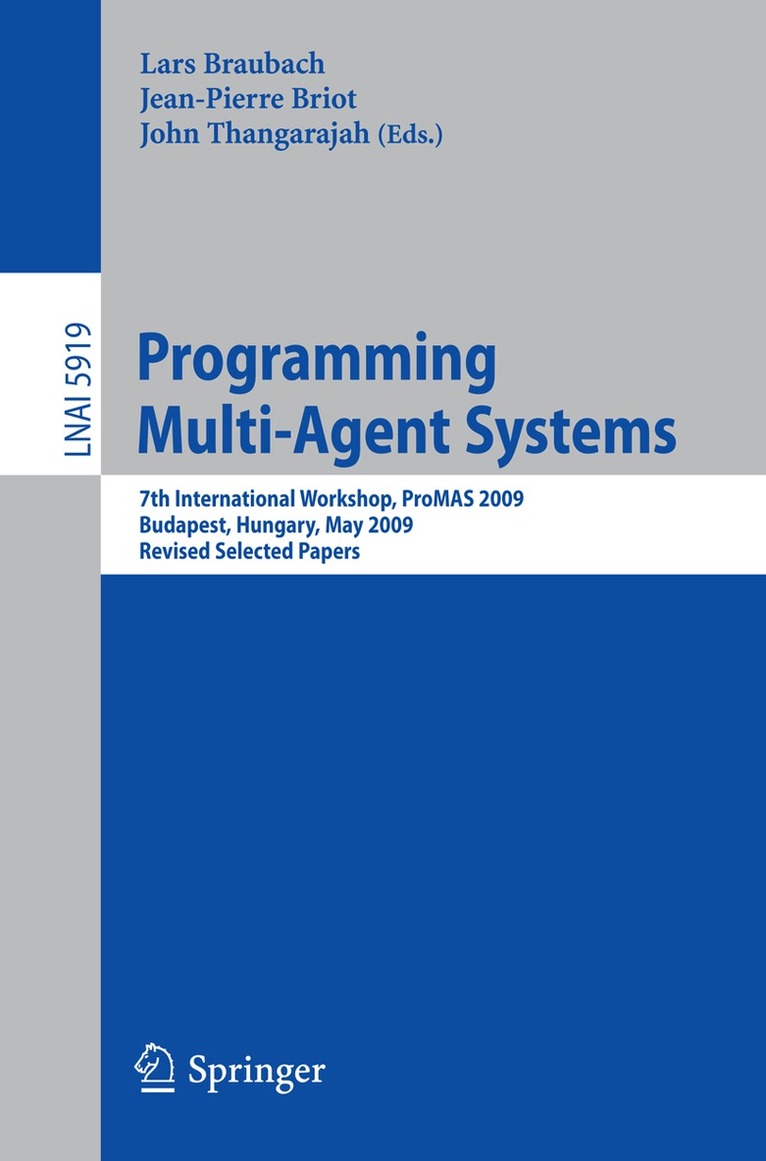
    Programming Multi-Agent Systems

    7th International Workshop, ProMAS 2009, Budapest, Hungary, May10-15, 2009.Revised Selected Papers

    AvLars Braubach,Jean-Pierre Briot

    Häftad, Engelska, 2010

    Del i serien Lecture Notes in Computer Science

    562 kr

    Beställningsvara. Skickas inom 10-15 vardagar. Fri frakt över 249 kr.

    Beskrivning

    The earliest work on agents may be traced at least to the ?rst conceptualization of the actor model by Carl Hewitt. In a paper in an AI conference in the early 1970s, Hewitt described actors as entities with knowledge and goals. Research on actors continued to focus on AI with the development of the Sprites model in which a monotonically growing knowledge base could be accessed by actors (inspired by what Hewitt called “the Scienti?c Computing Metaphor”). In the late1970sandwellinto 1980s,controversyragedinAIbetweenthosearguingfor declarative languages and those arguing for procedural ones. Actor researchers stood on the side of a procedural view of knowledge, arguing for an open s- tems perspective rather than the closed world hypothesis necessary for a logical, declarativeview. In the open systemsview,agentshad armslength relationships and could not be expected to store consistent facts, nor could the information in a system be considered complete (the “negation as failure” model). Subsequent work on actors, including my own, focused on using actors for general purpose concurrent and distributed programming. In the late 1980s, a number of actor languages and frameworks were built. These included Act++ (in C++) by Dennis Kafura and Actalk (in Smalltalk) by Jean-Pierre Briot. In recent times, the use of the Actor model, in various guises, has proliferated as new parallel and distributed computing platforms and applications have become common:clusters,Webservices,P2Pnetworks,clientprogrammingonmulticore processors, and cloud computing.

    Produktinformation

    • Utgivningsdatum:2010-09-03
    • Format:Häftad
    • Språk:Engelska
    • Serie:Lecture Notes in Computer Science
    • Antal sidor:285
    • Förlag:Springer-Verlag Berlin and Heidelberg GmbH & Co. KG
    • ISBN:9783642148422

    Utforska kategorier

    • Programvaruutveckling inom Data och IT
    • Artificiell intelligens inom Data och IT
    • Hårdvara inom Data och IT

    Innehållsförteckning

    • Communication Models.- Programming Multiagent Systems without Programming Agents.- Elements of a Business-Level Architecture for Multiagent Systems.- A Computational Semantics for Communicating Rational Agents Based on Mental Models.- Formal Models.- Multi-Agent Systems: Modeling and Verification Using Hybrid Automata.- Probabilistic Behavioural State Machines.- Golog Speaks the BDI Language.- Organizations and Environments.- A Middleware for Modeling Organizations and Roles in Jade.- An Open Architecture for Service-Oriented Virtual Organizations.- Formalising the Environment in MAS Programming: A Formal Model for Artifact-Based Environments.- Analysis and Debugging.- Debugging BDI-Based Multi-Agent Programs.- Space-Time Diagram Generation for Profiling Multi Agent Systems.- Infrastructure for Forensic Analysis of Multi-Agent Based Simulations.- Agent Architectures.- Representing Long-Term and Interest BDI Goals.- Introducing Relevance Awareness in BDI Agents.- Modularity and Compositionality in Jason.- Applications.- A MultiAgent System for Monitoring Boats in Marine Reserves.- Agent-Oriented Control in Real-Time Computer Games.