• Fri frakt över 249 kr
  • •
  • Snabba leveranser
  • •
  • Billiga böcker
Kundservice

Du är på sajten för privatpersoner.

Företag, bibliotek eller offentlig verksamhet?

Du handlar på classic.bokus.com, där alla dina funktioner finns intakta.
Till classic.bokus.com
Bokus logotyp. Gå till startsidan.
  • Erbjudanden
  • Student
  • Topplistor
  • Barn & ungdom
  • Bokus Play
  • Bokus Play
  • E-böcker
  • Ljudböcker
  • Pocketböcker
  • Spel & pussel

10% rabatt på allt med kod NYSTART10 →

Sidfot

Mina sidor

    Hjälp

    • Kundservice
    • Vanliga frågor och svar
    • Frakt och leverans
    • Retur vid ångerrätt
    • Reklamera vara
    • Betalning
    • Köpvillkor
    • Allmänna villkor
    • Information om webbplatsens tillgänglighet

    Om Bokus

    • Om oss
    • Pressrum
    • För studenter
    • För företag
    • För bibliotek och offentlig verksamhet
    • För leverantörer
    • Hållbarhet

    Populärt

    • Aktuella erbjudanden
    • Presentkort
    • Studentlitteratur
    • Nya böcker
    • Topplistor
    • Signerade böcker
    • Engelska böcker

    Inspiration

    • Boktips
    • BookTok
    • Populära bokserier
    • Barnbokskaraktärer
    • Populära författare
    Logotyp för Bokus
    Följ oss på Facebook (extern länk)Följ oss på Instagram (extern länk)Följ oss på YouTube (extern länk)Följ oss på TikTok (extern länk)
    bokus @ CookiesAnpassa cookiesIntegritetspolicyKöpvillkor
    Till Citymail hemsida (extern länk)Till Budbee hemsida (extern länk)Till Postnord hemsida (extern länk)Till Schenker hemsida (extern länk)Till Early Bird hemsida (extern länk)Till Walleys hemsida (extern länk)
    1. Data och IT
    2. Systemvetenskap och AI
    3. Artificiell intelligens

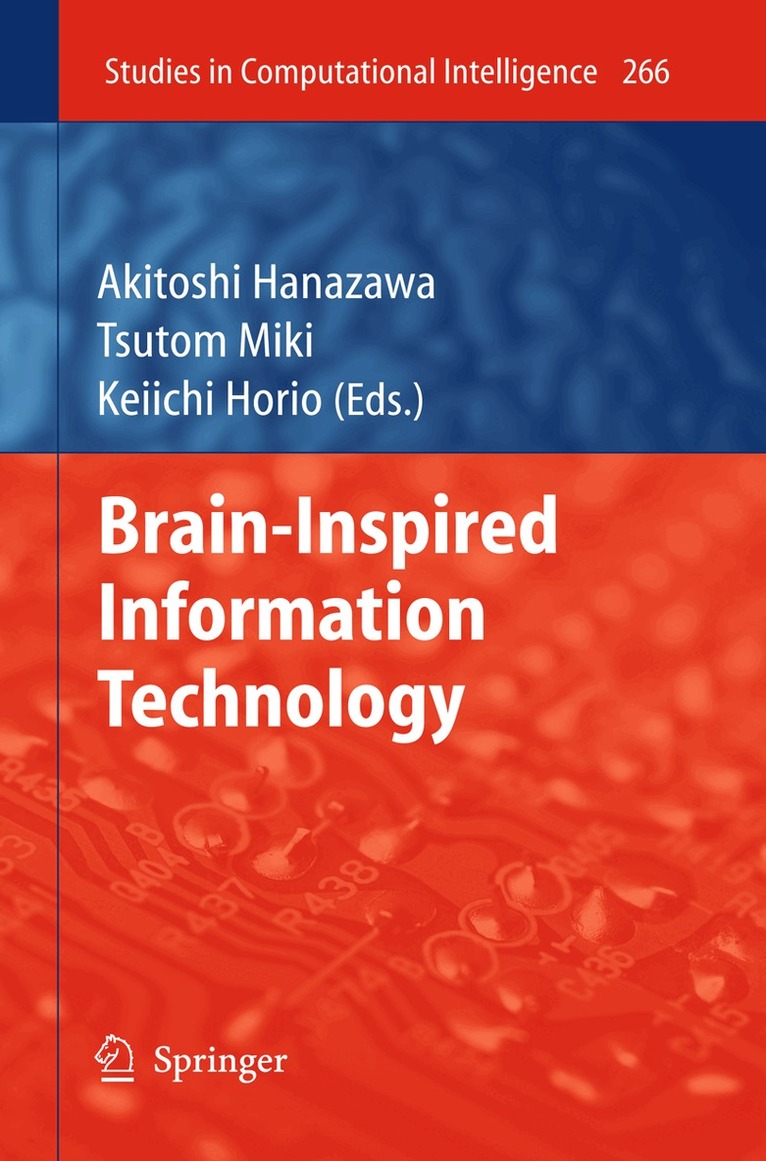
    Brain-Inspired Information Technology

    AvAkitoshi Hanazawa,Tsutom Miki

    Häftad, Engelska, 2012

    Del 266 i serien Studies in Computational Intelligence

    1 084 kr

    Beställningsvara. Skickas inom 10-15 vardagar. Fri frakt över 249 kr.

    Beskrivning

    "Brain-inspired information technology" is one of key concepts for the development of information technology in the next generation. Explosive progress of computer technology has been continuing based on a simple principle called "if-then rule". This means that the programmer of software have to direct every action of the computer programs in response to various inputs. There inherently is a limitation of complexity because we human have a limited capacity for managing complex systems. Actually, many bugs, mistakes of programming, exist in computer software, and it is quite difficult to extinguish them. The parts of computer programs where computer viruses attack are also a kind of programming mistakes, called security hole. Of course, human body or nervous system is not perfect. No creator or director, however, exists for us. The function of our brain is equipped by learning, self-organization, natural selection, and etc, resulting in adaptive and flexible information system. Brain-inspired information technology is aiming to realize such nature-made information processing system by using present computer system or specific hardware. To do so, researchers in various research fields are getting together to inspire each other and challenge cooperatively for the same goal.

    Produktinformation

    • Utgivningsdatum:2012-11-06
    • Mått:155 x 235 x 11 mm
    • Vikt:295 g
    • Format:Häftad
    • Språk:Engelska
    • Serie:Studies in Computational Intelligence
    • Antal sidor:178
    • Upplaga:2010
    • Förlag:Springer-Verlag Berlin and Heidelberg GmbH & Co. KG
    • ISBN:9783642265136

    Utforska kategorier

    • Artificiell intelligens inom Data och IT
    • Biovetenskap inom Naturvetenskap och teknik

    Innehållsförteckning

    • Mission Capable Autonomous Control Systems in the Oceans, in the Air and in Space.- Three Paths to Relevance.- Brain-Like Evolving Spiking Neural Networks for Multimodal Information Processing.- Human-Like Local Navigation System Inspired by a Hippocampal Memory Mechanism.- Brain-Inspired Emergence of Behaviors Based on Values and Curiosity in Mobile Robots.- Emergence of Behaviors by Reinforcement Learning Based on the Desire for Existence.- Classification and Novelty Detection of Omni-view Images Taken from a Mobile Robot.- Curiosity and Boredom Based on Prediction Error as Novel Internal Rewards.- Skill Transfer of a Mobile Robot Obtained by Reinforcement Learning to a Different Mobile Robot.- Effect of Fitness Functions on the Performance of Evolutionary Particle Swarm Optimization.- Constraint Satisfaction with Neural Network for Trajectory Planning.- Acquisition and Extinction of Avoidance Response by Social Interaction in Rats.- Positive and Negative Effects of Environmental Chemicals on Brain Function in Rodents.- Category Recognition in the Monkey Orbitofrontal Cortex.- An Adaptive Controller System Using mnSOM (2nd Report: Implementation into an Autonomous Underwater Robot).- An Environment Recognition System Using SOM.- A Novel Embedded Computer Based Autonomous Robot for Sewer Pipe Inspection.- The Angular Threshold for Frog Collision Avoidance Behavior Changes Depending on Not Only the Stimulus Location But Also the Behavioral Strategy.- Spike-Timing-Dependent LTP/LTD Caused by Uncorrelated Signals through Medial and Lateral Perforant Pathways in the Dentate Granule Cell.- Spatiotemporal Synchronization of Neuronal Activity in a Hippocampal CA3 Network Model Including the O-LM Cell.- The Regulation of Glutamate-Induced Astrocytic [Ca2?+?]i Responses bythe Desensitization of Metabotropic Glutamate Receptor.- Functional Properties of Resonate-and-Fire Neuron Circuits for Bio-Inspired Chemical Sensor Array.- A Robot Vision System Using a Silicon Retina.- Real-Time Human-Machine Interaction System Based on Face Authentication and Arm Posture Recognition.- Shadow Elimination Mimicking the Human Visual System.- An FPGA-Based Collision Warning System Using Moving-Object Detection Inspired by Neuronal Propagation in the Hippocampus.- A Chemical Sensor Array Inspired by Mouse Taste Buds.- Emotional Behavior and Expression Based on a Neural Network Model of Amygdala.- Effective and Adaptive Learning Based on Diversive/Specific Curiosity.