• Fri frakt över 249 kr
  • •
  • Snabba leveranser
  • •
  • Billiga böcker
Kundservice

Du är på sajten för privatpersoner.

Företag, bibliotek eller offentlig verksamhet?

Du handlar på classic.bokus.com, där alla dina funktioner finns intakta.
Till classic.bokus.com
Bokus logotyp. Gå till startsidan.
  • Erbjudanden
  • Nyheter
  • Student
  • Topplistor
  • Barn & ungdom
  • Bokus Play
  • E-böcker
  • Pocketböcker
  • Spel & pussel

10% rabatt på allt med kod: NYSTART10 →

Sidfot

Mina sidor

    Hjälp

    • Kundservice
    • Vanliga frågor och svar
    • Frakt och leverans
    • Retur vid ångerrätt
    • Reklamera vara
    • Betalning
    • Köpvillkor
    • Allmänna villkor
    • Information om webbplatsens tillgänglighet

    Om Bokus

    • Om oss
    • Pressrum
    • För studenter
    • För företag
    • För bibliotek och offentlig verksamhet
    • För leverantörer
    • Hållbarhet

    Populärt

    • Aktuella erbjudanden
    • Presentkort
    • Studentlitteratur
    • Nya böcker
    • Topplistor
    • Signerade böcker
    • Engelska böcker

    Inspiration

    • Boktips
    • BookTok
    • Populära bokserier
    • Barnbokskaraktärer
    • Populära författare
    Logotyp för Bokus
    Följ oss på Facebook (extern länk)Följ oss på Instagram (extern länk)Följ oss på YouTube (extern länk)Följ oss på TikTok (extern länk)
    bokus @ CookiesAnpassa cookiesIntegritetspolicyKöpvillkor
    Till Citymail hemsida (extern länk)Till Budbee hemsida (extern länk)Till Postnord hemsida (extern länk)Till Schenker hemsida (extern länk)Till Early Bird hemsida (extern länk)Till Walleys hemsida (extern länk)
    1. Naturvetenskap och teknik
    2. Matematik och naturvetenskap
    3. Matematik
    4. Tillämpad matematik

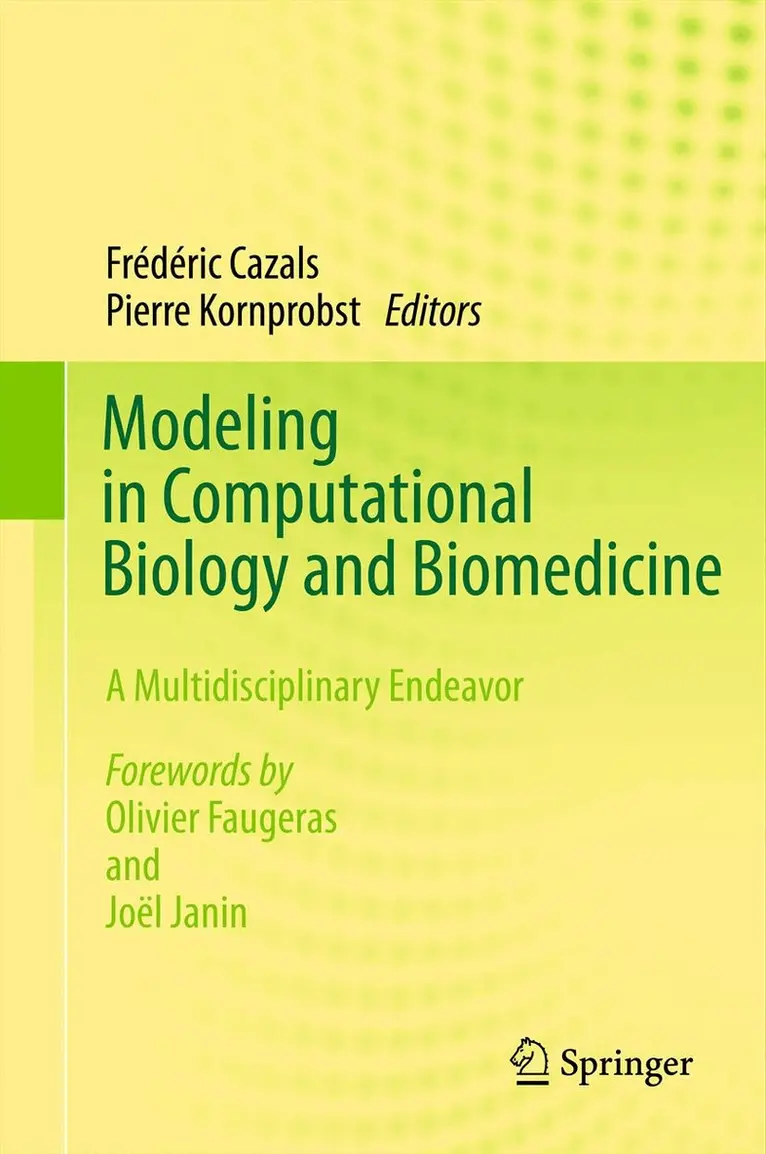
    Modeling in Computational Biology and Biomedicine

    A Multidisciplinary Endeavor

    AvFrédéric Cazals,Pierre Kornprobst

    Inbunden, Engelska, 2012

    1 086 kr

    Beställningsvara. Skickas inom 10-15 vardagar. Fri frakt över 249 kr.

    Beskrivning

    Computational biology, mathematical biology, biology and biomedicine are currently undergoing spectacular progresses due to a synergy between technological advances and inputs from physics, chemistry, mathematics, statistics and computer science. The goal of this book is to evidence this synergy by describing selected developments in the following fields: bioinformatics, biomedicine and neuroscience. This work is unique in two respects - first, by the variety and scales of systems studied and second, by its presentation: Each chapter provides the biological or medical context, follows up with mathematical or algorithmic developments triggered by a specific problem and concludes with one or two success stories, namely new insights gained thanks to these methodological developments. It also highlights some unsolved and outstanding theoretical questions, with a potentially high impact on these disciplines.   Two communities will be particularly interested in this book. The first one is the vast community of applied mathematicians and computer scientists, whose interests should be captured by the added value generated by the application of advanced concepts and algorithms to challenging biological or medical problems. The second is the equally vast community of biologists. Whether scientists or engineers, they will find in this book a clear and self-contained account of concepts and techniques from mathematics and computer science, together with success stories on their favorite systems. The variety of systems described represents a panoply of complementary conceptual tools. On a practical level, the resources listed at the end of each chapter (databases, software) offer invaluable support for getting started on a specific topic in the fields of biomedicine, bioinformatics and neuroscience.

    Produktinformation

    • Utgivningsdatum:2012-11-06
    • Mått:155 x 235 x 24 mm
    • Vikt:682 g
    • Format:Inbunden
    • Språk:Engelska
    • Antal sidor:318
    • Upplaga:2013
    • Förlag:Springer-Verlag Berlin and Heidelberg GmbH & Co. KG
    • ISBN:9783642312076

    Utforska kategorier

    • Tillämpad matematik inom Naturvetenskap och teknik
    • Biovetenskap inom Naturvetenskap och teknik

    Mer om författaren

    Frederic Cazals holds a PhD in Theoretical Computer Science from the University of Paris VII. He is Research Director at INRIA Sophia-Antipolis Mediterranee, where he leads the Algorithms-Biology-Structure project-team. His research interests span geometric and topological modeling, scientific software development, and computational structural biology. Pierre Kornprobst holds a PhD in Mathematics from the University of Nice Sophia Antipolis. He is a researcher at INRIA Sophia-Antipolis Mediterranee. His research interest is the study of vision, from computational and biological perspectives, including image processing using partial differential equations, retina modeling, motion perception estimation and categorization.

    Recensioner i media

    From the reviews: "'A principal goal of this book is to illustrate that in modeling biological systems, deeper insights can be gained using more advanced mathematical and algorithmic developments that implicate a wide spectrum of techniques from applied mathematics and computer science.' The book achieves this goal. ... this is a well-organized and well-written book, with timely information for multidisciplinary researchers in the bioinformatics, biomedical signal and image analysis, and neuroscience modeling fields." (Jindong Liu, Computing Reviews, April, 2013)

    Innehållsförteckning

    • Foreword by Olivier Faugeras.- Foreword by Joël Janin.- Preface.- Part I Bioinformatics.- 1.Modeling Macro-molecular Complexes: a Journey Across Scales. F.Cazals, T.Dreyfus, and C.H. Robert.- 1.1.Introduction.- 1.2.Modeling Atomic Resolution.- 1.3.Modeling Large Assemblies.- 1.4.Outlook.- 1.5.Online Resources.- References.- 2.Modeling and Analysis of Gene Regulatory Networks. G.Bernot, J-P.Comet, A.Richard, M.Chaves, J-L.Gouzé, and F.Dayan.- 2.1.Introduction.- 2.2.Continuous and Hybrid Models of Genetic Regulatory Networks.- 2.3.Discrete Models of GRN.- 2.4.Outlook.- 2.5.Online Resources.- 2.6.Acknowledgments.- References.- Part II Biomedical Signal and Image Analysis.- 3.Noninvasive Cardiac Signal Analysis Using Data Decomposition Techniques. V.Zarzoso, O.Meste, P.Comon, D.G.Latcu, and N.Saoudi.- 3.1.Preliminaries and Motivation.- 3.2.T-Wave Alternans Detection via Principal Component Analysis.- 3.3.Atrial Activity Extraction via Independent Component Analysis.- 3.4.Conclusion and Outlook.- 3.5.Online Resources.- References.- 4.Deconvolution and Denoising for Confocal Microscopy. P.Pankajakshan, G.Engler, L.Blanc-Féraud, and J.Zerubia.- 4.1.Introduction.- 4.2.Development of the Auxiliary Computational Lens.- 4.3.Outlook.- 4.4.Selected Online Resources.- References.- 5.Statistical Shape Analysis of Surfaces in Medical Images Applied to the Tetralogy of Fallot Heart. K.McLeod, T.Mansi, M.Sermesant, G.Pongiglione, and X.Pennec.- 5.1.Introduction.- 5.2.Statistical Shape Analysis.- 5.3.Shape Analysis of ToF Data.- 5.4.Conclusion.- 5.5.Online Resources.- References.- 6.From Diffusion MRI to Brain Connectomics. A.Ghosh and R.Deriche.- 6.1.Introduction.- 6.2.A Brief History of NMR and MRI.- 6.3.Nuclear Magnetic Resonance and Diffusion.- 6.4.From Diffusion MRI to Tissue Microstructure.- 6.5.Computational Framework for Processing Diffusion MR Images.- 6.6.Tractography: Inferring theConnectivity.- 6.7.Clinical Applications 6.8.Conclusion.- 6.9.Online Resources.- References.- Part III Modeling in neuroscience.- 7.Single-Trial Analysis of Bioelectromagnetic Signals: The Quest for Hidden Information. M.Clerc, T.Papadopoulo, and C.Bénar.- 7.1.Introduction.- 7.2.Data-driven Approaches: Non-linear Dimensionality Reduction.- 7.3.Model-Driven Approaches: Matching Pursuit and its Extensions.- 7.4.Success Stories.- 7.5.Conclusion.- 7.6.Selected Online Resources.- References.- 8 Spike Train Statistics from Empirical Facts to Theory: The Case of the Retina. B.Cessac and A.Palacios.- 8.1.Introduction.- 8.2.Unraveling the Neural Code in the Retina via Spike Train Statistics Analysis.- 8.3.Spike Train Statistics from a Theoretical Perspective.- 8.4.Using Gibbs Distributions to Analysing Spike Trains Statistics.- 8.5.Conclusion.- 8.6.Outlook.- 8.7.Online Resources.- References.- Biology, Medicine and Biophysics.- Mathematics and Computer Science.- Index.