• Fri frakt över 249 kr
  • •
  • Snabba leveranser
  • •
  • Billiga böcker
Kundservice

Du är på sajten för privatpersoner.

Företag, bibliotek eller offentlig verksamhet?

Du handlar på classic.bokus.com, där alla dina funktioner finns intakta.
Till classic.bokus.com
Bokus logotyp. Gå till startsidan.
  • Erbjudanden
  • Nyheter
  • Student
  • Topplistor
  • Barn & ungdom
  • Bokus Play
  • E-böcker
  • Pocketböcker
  • Spel & pussel

Må bättre, för mindre! Upp till 50% rabatt på hälsoböcker

Sidfot

Mina sidor

    Hjälp

    • Kundservice
    • Vanliga frågor och svar
    • Frakt och leverans
    • Retur vid ångerrätt
    • Reklamera vara
    • Betalning
    • Köpvillkor
    • Allmänna villkor
    • Information om webbplatsens tillgänglighet

    Om Bokus

    • Om oss
    • Pressrum
    • För studenter
    • För företag
    • För bibliotek och offentlig verksamhet
    • För leverantörer
    • Hållbarhet

    Populärt

    • Aktuella erbjudanden
    • Presentkort
    • Studentlitteratur
    • Nya böcker
    • Topplistor
    • Signerade böcker
    • Engelska böcker

    Inspiration

    • Boktips
    • BookTok
    • Populära bokserier
    • Barnbokskaraktärer
    • Populära författare
    Logotyp för Bokus
    Följ oss på Facebook (extern länk)Följ oss på Instagram (extern länk)Följ oss på YouTube (extern länk)Följ oss på TikTok (extern länk)
    bokus @ CookiesAnpassa cookiesIntegritetspolicyKöpvillkor
    Till Citymail hemsida (extern länk)Till Budbee hemsida (extern länk)Till Postnord hemsida (extern länk)Till Schenker hemsida (extern länk)Till Early Bird hemsida (extern länk)Till Walleys hemsida (extern länk)
    1. Naturvetenskap och teknik
    2. Teknik och industri
    3. Elektronik och kommunikationer

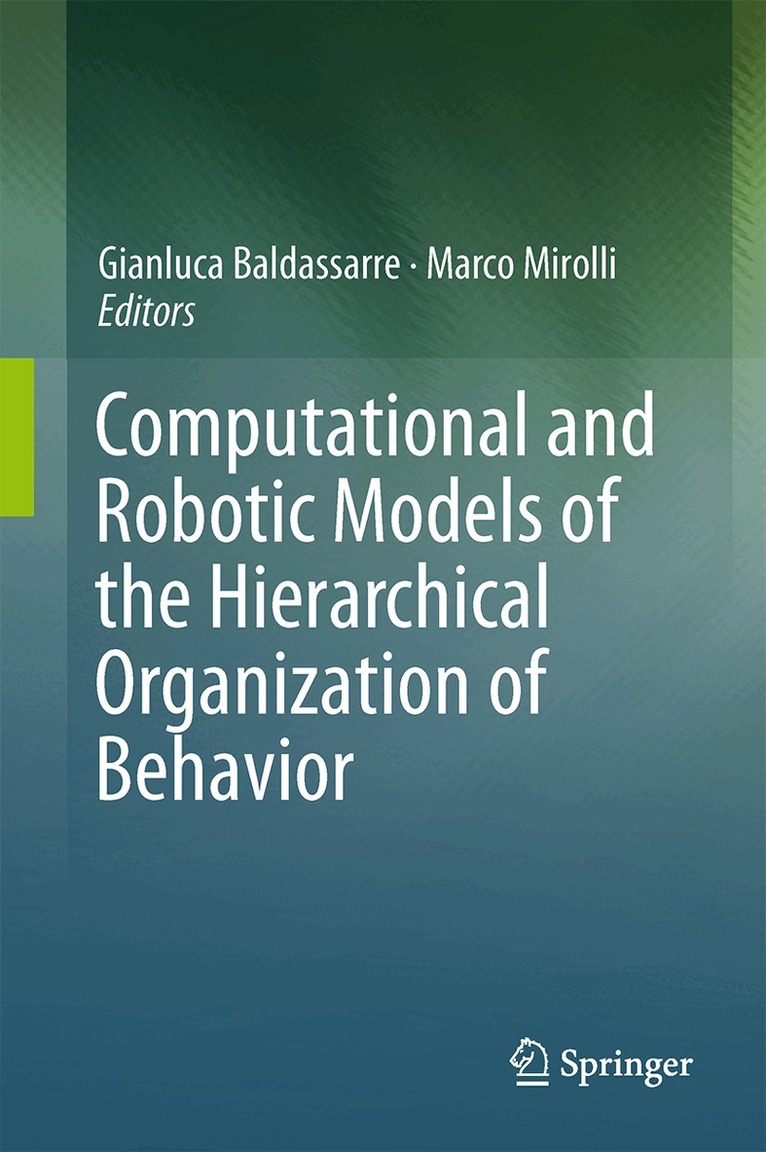
    Computational and Robotic Models of the Hierarchical Organization of Behavior

    AvGianluca Baldassarre,Marco Mirolli

    Inbunden, Engelska, 2013

    1 086 kr

    Beställningsvara. Skickas inom 10-15 vardagar. Fri frakt över 249 kr.

    Beskrivning

    Current robots and other artificial systems are typically able to accomplish only one single task. Overcoming this limitation requires the development of control architectures and learning algorithms that can support the acquisition and deployment of several different skills, which in turn seems to require a modular and hierarchical organization. In this way, different modules can acquire different skills without catastrophic interference, and higher-level components of the system can solve complex tasks by exploiting the skills encapsulated in the lower-level modules. While machine learning and robotics recognize the fundamental importance of the hierarchical organization of behavior for building robots that scale up to solve complex tasks, research in psychology and neuroscience shows increasing evidence that modularity and hierarchy are pivotal organization principles of behavior and of the brain. They might even lead to the cumulative acquisition of an ever-increasing number of skills, which seems to be a characteristic of mammals, and humans in particular.This book is a comprehensive overview of the state of the art on the modeling of the hierarchical organization of behavior in animals, and on its exploitation in robot controllers. The book perspective is highly interdisciplinary, featuring models belonging to all relevant areas, including machine learning, robotics, neural networks, and computational modeling in psychology and neuroscience. The book chapters review the authors' most recent contributions to the investigation of hierarchical behavior, and highlight the open questions and most promising research directions. As the contributing authors are among the pioneers carrying out fundamental work on this topic, the book covers the most important and topical issues in the field from a computationally informed, theoretically oriented perspective. The book will be of benefit to academic and industrial researchers and graduate students in related disciplines.

    Produktinformation

    • Utgivningsdatum:2013-12-02
    • Mått:155 x 235 x 26 mm
    • Vikt:711 g
    • Format:Inbunden
    • Språk:Engelska
    • Antal sidor:358
    • Upplaga:2013
    • Förlag:Springer-Verlag Berlin and Heidelberg GmbH & Co. KG
    • ISBN:9783642398742

    Utforska kategorier

    • Elektronik och kommunikationer inom Naturvetenskap och teknik
    • Artificiell intelligens inom Data och IT
    • Biovetenskap inom Naturvetenskap och teknik

    Mer om författaren

    Dr. Gianluca Baldassarre is a Researcher at the Institute of Cognitive Sciences and Technologies (ISTC) of the Italian National Research Council (CNR) where he is a member of the Laboratory of Computational Embodied Neuroscience; his research interests include computational embodied neuroscience, psychology, neuroscience, developmental robotics, artificial life, and machine learning.  Dr. Marco Mirolli is a Researcher at the Institute of Cognitive Sciences and Technologies (ISTC) of the Italian National Research Council (CNR) where he is a member of the Laboratory of Computational Embodied Neuroscience Laboratory; his research interests lie in the study of behavior through computer simulations, in particular the evolution of communication and language, the role of language as a cognitive tool, the biological bases of motivations and emotions, and the role of intrinsic motivations in cumulative learning.

    Innehållsförteckning

    • Chap. 1 - Computational and Robotic Models of the Hierarchical Organization of Behavior: An Overview.- Chap. 2 - Behavioral Hierarchy: Exploration and Representation.- Chap. 3 - Self-organized Functional Hierarchy Through Multiple Timescales: Neurodynamical Accounts for Behavioral Compositionality.- Chap. 4 - Autonomous Representation Learning in a Developing Agent.- Chap. 5 - Hierarchies for Embodied Action Perception.- Chap. 6 - Learning and Coordinating Repertoires of Behaviors with Common Reward: Credit Assignment and Module Activation.- Chap. 7 - Modular, Multimodal Arm Control Models.- Chap. 8 - Generalization and Interference in Human Motor Control.- Chap. 9 - A Developmental Framework for Cumulative Learning Robots.- Chap. 10 - The Hierarchical Accumulation of Knowledge in the Distributed Adaptive Control Architecture.- Chap. 11 - The Hierarchical Organization of Cortical and Basal Ganglia Systems: A Computationally Informed Review and Integrated Hypothesis.- Chap. 12 - Divide and Conquer: Hierarchical Reinforcement Learning and Task Decomposition in Humans.- Chap. 13 - Neural Network Modelling of Hierarchical Motor Function in the Brain.- Chap. 14 - Restoring Purpose in Behavior.