Häftad, Engelska, 2014
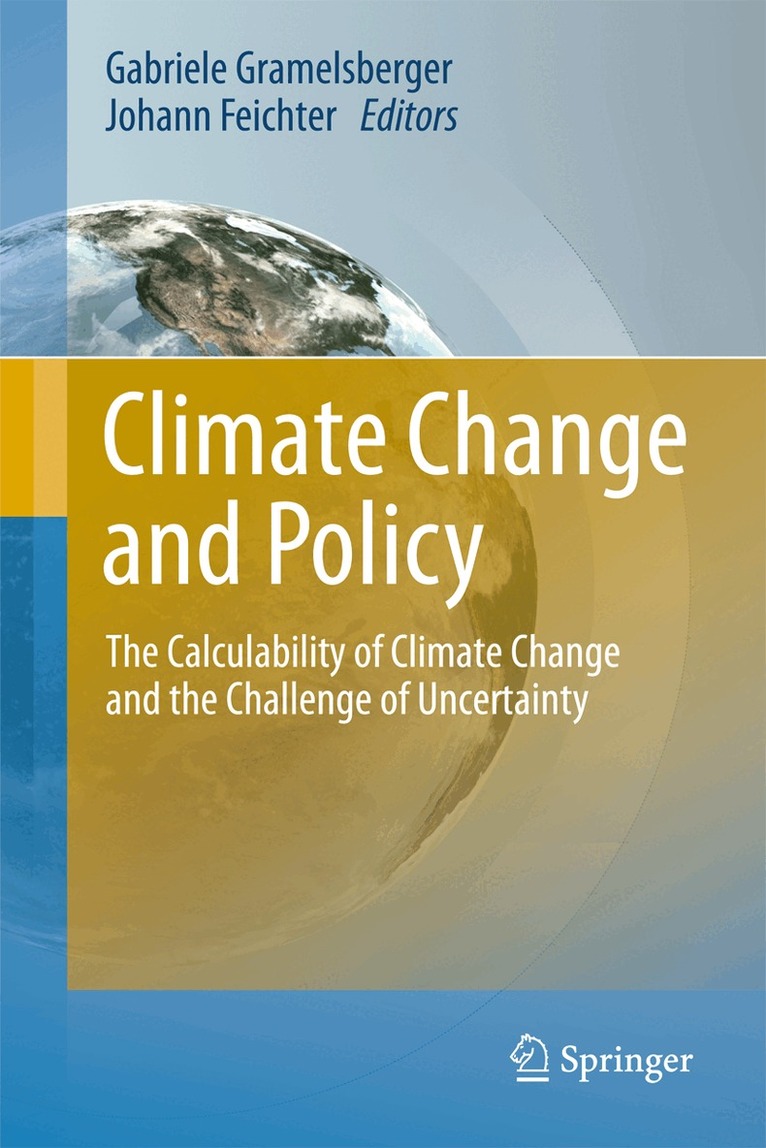
Climate Change and Policy
Av Gabriele Gramelsberger, Johann Feichter
1093 kr
Beställningsvara. Skickas inom 10-15 vardagar. Fri frakt över 249 kr.
Beskrivning
The debate on how mankind should respond to climate change is diverse, as the appropriate strategy depends on global as well as local circumstances.As scientists are denied the possibility of conducting experiments with the real climate, only climate models can give insights into man-induced climate change, by experimenting with digital climates under varying conditions and by extrapolating past and future states into the future. But the ‘nature’ of models is a purely representational one. A model is good if it is believed to represent the relevant processes of a natural system well. However, a model and its results, in particular in the case of climate models which interconnect countless hypotheses, is only to some extent testable, although an advanced infrastructure of evaluation strategies has been developed involving strategies of model intercomparison, ensemble prognoses, uncertainty metrics on the system and component levels. The complexity of climate models goes hand in hand with uncertainties, but uncertainty is in conflict with socio-political expectations. However, certain predictions belong to the realm of desires and ideals rather than to applied science. Today’s attempt to define and classify uncertainty in terms of likelihood and confidence reflect this awareness of uncertainty as an integral part of human knowledge, in particular on knowledge about possible future developments. The contributions in this book give a first hand insight into scientific strategies in dealing with uncertainty by using simulation models and into social, political and economical requirements in future projections on climate change. Do these strategies and requirements meet each other or fail?The debate on how mankind should respond to climate change is diverse, as the appropriate strategy depends on global as well as local circumstances. As scientists are denied the possibility of conducting experiments with the real climate, only climate models can give insights into man-induced climate change, by experimenting with digital climates under varying conditions and by extrapolating past and future states into the future. But the 'nature' of models is a purely representational one. A model is good if it is believed to represent the relevant processes of a natural system well. However, a model and its results, in particular in the case of climate models which interconnect countless hypotheses, is only to some extent testable, although an advanced infrastructure of evaluation strategies has been developed involving strategies of model intercomparison, ensemble prognoses, uncertainty metrics on the system and component levels. The complexity of climate models goes hand in hand with uncertainties, but uncertainty is in conflict with socio-political expectations. However, certain predictions belong to the realm of desires and ideals rather than to applied science. Today's attempt to define and classify uncertainty in terms of likelihood and confidence reflect this awareness of uncertainty as an integral part of human knowledge, in particular on knowledge about possible future developments. The contributions in this book give a first hand insight into scientific strategies in dealing with uncertainty by using simulation models and into social, political and economical requirements in future projections on climate change. Do these strategies and requirements meet each other or fail? Gabriele Gramelsberger is Principal Investigator of the Collaborative Research Project is Principal Investigator of the Collaborative Research Project
Produktinformation
- Utgivningsdatum: 2014-10-04
- Mått: 155 x 235 x 14 mm
- Vikt: 388 g
- Format: Häftad
- Språk: Engelska
- Antal sidor: 241
- Förlag: Springer-Verlag Berlin and Heidelberg GmbH & Co. KG
- ISBN: 9783642439629
Utforska kategorier
Betyg & recensioner
0 recensioner
Inga recensioner tillgängliga.