• Fri frakt över 249 kr
  • •
  • Snabba leveranser
  • •
  • Billiga böcker
Kundservice

Du är på sajten för privatpersoner.

Företag, bibliotek eller offentlig verksamhet?

Du handlar på classic.bokus.com, där alla dina funktioner finns intakta.
Till classic.bokus.com
Bokus logotyp. Gå till startsidan.
  • Erbjudanden
  • Nyheter
  • Student
  • Topplistor
  • Barn & ungdom
  • Bokus Play
  • E-böcker
  • Pocketböcker
  • Spel & pussel

10% rabatt på allt med kod: NYSTART10 →

Sidfot

Mina sidor

    Hjälp

    • Kundservice
    • Vanliga frågor och svar
    • Frakt och leverans
    • Retur vid ångerrätt
    • Reklamera vara
    • Betalning
    • Köpvillkor
    • Allmänna villkor
    • Information om webbplatsens tillgänglighet

    Om Bokus

    • Om oss
    • Pressrum
    • För studenter
    • För företag
    • För bibliotek och offentlig verksamhet
    • För leverantörer
    • Hållbarhet

    Populärt

    • Aktuella erbjudanden
    • Presentkort
    • Studentlitteratur
    • Nya böcker
    • Topplistor
    • Signerade böcker
    • Engelska böcker

    Inspiration

    • Boktips
    • BookTok
    • Populära bokserier
    • Barnbokskaraktärer
    • Populära författare
    Logotyp för Bokus
    Följ oss på Facebook (extern länk)Följ oss på Instagram (extern länk)Följ oss på YouTube (extern länk)Följ oss på TikTok (extern länk)
    bokus @ CookiesAnpassa cookiesIntegritetspolicyKöpvillkor
    Till Citymail hemsida (extern länk)Till Budbee hemsida (extern länk)Till Postnord hemsida (extern länk)Till Schenker hemsida (extern länk)Till Early Bird hemsida (extern länk)Till Walleys hemsida (extern länk)
    1. Naturvetenskap och teknik
    2. Matematik och naturvetenskap
    3. Biologi
    4. Biokemi

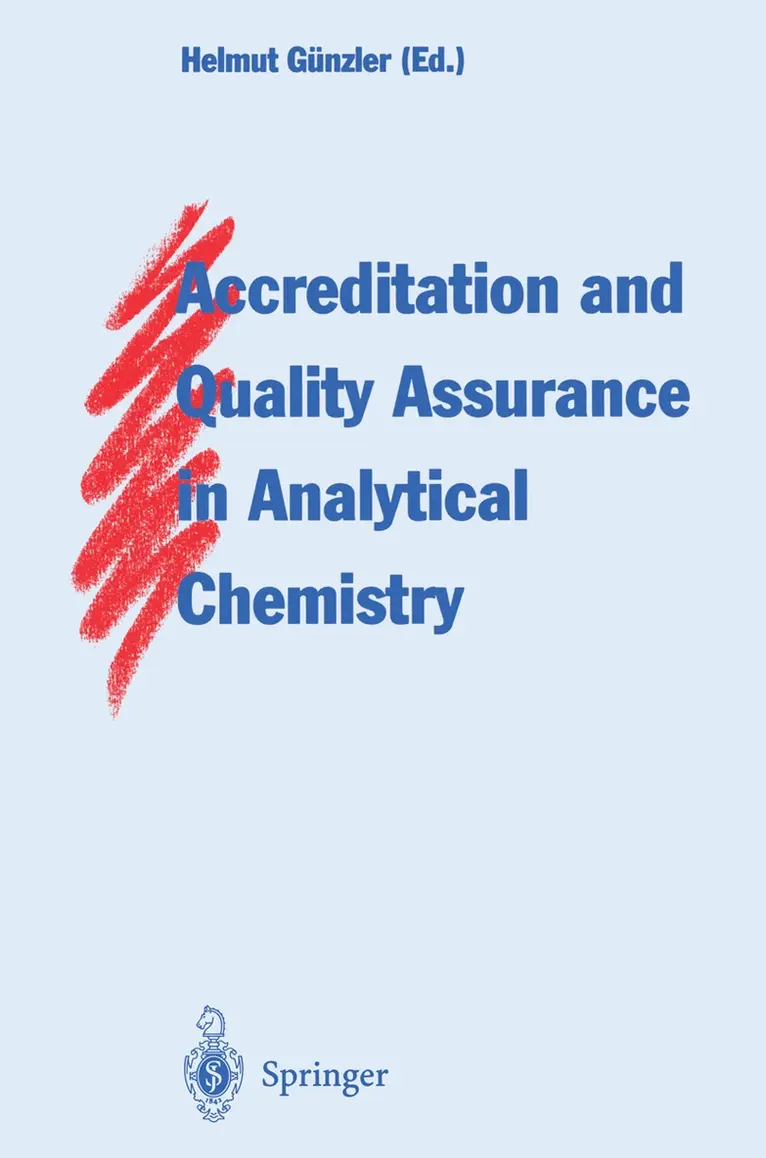
    Accreditation and Quality Assurance in Analytical Chemistry

    AvHelmut Günzler

    Häftad, Engelska, 2012

    547 kr

    Beställningsvara. Skickas inom 10-15 vardagar. Fri frakt över 249 kr.

    Beskrivning

    Quality assurance and accreditation in analytical chemistry laboratories is an important issue on the national and international scale. The book presents currently used methods to assure the quality of analytical results and it describes accreditation procedures for the mutual recognition of these results. The book describes in detail the accreditation systems in 13 European countries and the present situation in the United States of America. The editor also places high value on accreditation and certification practice and on the relevant legislation in Europe. The appendix lists invaluable information on important European accreditation organizations.

    Produktinformation

    • Utgivningsdatum:2012-05-02
    • Mått:155 x 235 x 16 mm
    • Vikt:441 g
    • Format:Häftad
    • Språk:Engelska
    • Antal sidor:266
    • Förlag:Springer-Verlag Berlin and Heidelberg GmbH & Co. KG
    • ISBN:9783642500817
    • Översättare:G. Lapitajs

    Utforska kategorier

    • Biokemi inom Naturvetenskap och teknik
    • Analytisk kemi inom Naturvetenskap och teknik
    • Kemi inom Naturvetenskap och teknik

    Recensioner i media

    "For the analyst in industry or university ...this is a volume that merits serious study; it has much to offer." Chemistry in Australia

    Innehållsförteckning

    • Significance of Certification and Accreditation Within the European Market.- 1.1 Introduction.- 1.2 The EC Commission’s Global Concept for Testing and Certification.- 1.3 The Result of the Council’s Discussion on the Global Concept.- 1.4 The Certification Contents of the New EC Harmonization Guidelines.- 1.5 The Influence of the EC Commission’s Global Concept on the Private Sector.- 1.6 Assessment of the European Certification/Accreditation Policy.- 2 The Accreditation of Chemical Laboratories.- 2.1 The European and International Framework.- 2.2 The Basic Principles and the Actual Description of the European and International Framework.- 2.3 The National Accreditation Systems in Europe.- 3 Quality Assurance in Analytical Chemistry.- 3.1 On Quality Assurance.- 3.2 Quality Policy and Quality Management.- 3.3 Quality Planning, Quality Control, Quality Inspection.- 3.4 Quality Assurance in Analytical Chemistry.- 3.5 QA Measures in Analytical Practice.- 3.6 Process Capability and Machine Capability.- 3.7 Certification of Quality Management Systems and Accreditation of Analytical Laboratories.- 3.8 References.- 4 Proper Sampling: A Precondition for Accurate Analyses.- Abstract.- 4.1 Sampling Within the Analytical Process.- 4.2 There Is No “Correct” Sampling Without A Clear Problem Definition!.- 4.3 Managing Without Sampling?.- 4.4 Planning Sampling Procedures.- 4.5 Aspects of Measurement Uncertainty Caused by Sampling.- 4.6 Conclusions.- 4.7 References.- 5 Significance of Statistics in Quality Assurance.- 5.1 Types of Errors Associated With Analytical Measurements.- 5.2 Systematic Errors.- 5.3 Random Errors.- 5.4 Significance Tests.- 5.5 Statistical Quality Assurance.- 5.6 Calibration of Analytical Procedures.- 5.7 References.- 6 Validation of Analytical Methods.-Summary.- 6.1 Introduction.- 6.2 Development of Analytical Procedures and Tasks of Basic Validation.- 6.3 Validation: Definitions.- 6.4 Scope and Sequence of Validation.- 6.5 Performance Characteristics.- 6.6 The Relation Between Purpose of the Procedure and Scope of Validation.- 6.7 Frequency of Validation.- 6.8 Special Technique of Validation.- 6.9 Conclusions.- 6.10 References.- 7 Traceability of Measurements to SI: How Does It Lead to Traceability of Quantitative Chemical Measurements?.- Preface.- 7.1 Introduction.- 7.2 Traceability of Chemical Measurements: The Problems.- 7.3 Physical and Chemical Measurements: Is There a Difference in Principle?.- 7.4 Traceability of Measurements: Are There Precedents?.- 7.5 Traceability of Amount Measurements: Present Status.- 7.6 The “Intersection” Points in a Traceability System.- 7.7 Purposes of Traceability of Amount Measurements.- 7.8 Criteria for Traceability of Amount Measurements to the Mole.- 7.9 How can Traceability to the Mole Be Established?.- 7.10 Conclusions.- 7.11 References.- 8 Reference Materials for Quality Assurance.- 8.1 Introduction.- 8.2 Definitions.- 8.3 Requirements for the Preparation of RMs and CRMs.- 8.4 The Use of RMs and CRMs in Chemical Analysis.- 8.5 References.- 9 Accreditation and Interlaboratory Studies.- 9.1 Introduction.- 9.2 Types of Interlaboratory Studies.- 9.3 Laboratory-Performance Studies in Accreditation Practice.- 9.4 Laboratory-Performance Studies and Quality of Testing.- 9.5 References.- 10 Accreditation Competence: Requirements for Accreditation Bodies.- 10.1 Standard Fundamentals.- 10.2 Organisation and Quality Management System.- 10.3 Arrangements for Accreditation.- 10.4 Operation.- 10.5 Sectoral Committees.- 10.6 Assessment.- 10.7 Assessors.- 10.8 Decision on Accreditation.-10.9 Diligence and Protective Duties.- 10.10 Surveillance.- 10.11 Accreditation and Standardization.- 10.12 National and International Agreements on Mutual Recognition.- 11 The Significance of Accreditation in Comparison with GLP.- 11.1 Introduction.- 11.2 GLP — Good Laboratory Practice.- 11.3 Accreditation.- 11.4 Comparison of GLP and Accreditation.- 11.5 Summary and Future Trends.- 12 EURACHEM Organization for the Promotion of Quality Assurance in Analytical Chemistry and the Accreditation of Analytical Laboratories in Europe.- 12.1 Foundation of EURACHEM.- 12.2 Objectives of EURACHEM.- 12.3 Structural Organization of EURACHEM.- 12.4 Tasks.- 12.5 Cooperation with Other Committees.- 12.6 Summary.- 12.7 References.- 13 The Accreditation of Environmental Laboratories in the United States.- 13.1 Introduction.- 13.2 Policy Development.- 13.3 Program Development.- 13.4 Conclusion.- 13.5 References.