• Fri frakt över 249 kr
  • •
  • Snabba leveranser
  • •
  • Billiga böcker
Kundservice

Du är på sajten för privatpersoner.

Företag, bibliotek eller offentlig verksamhet?

Du handlar på classic.bokus.com, där alla dina funktioner finns intakta.
Till classic.bokus.com
Bokus logotyp. Gå till startsidan.
  • Erbjudanden
  • Nyheter
  • Student
  • Topplistor
  • Barn & ungdom
  • Bokus Play
  • E-böcker
  • Pocketböcker
  • Spel & pussel

10% rabatt på allt med kod NYSTART10 →

Sidfot

Mina sidor

    Hjälp

    • Kundservice
    • Vanliga frågor och svar
    • Frakt och leverans
    • Retur vid ångerrätt
    • Reklamera vara
    • Betalning
    • Köpvillkor
    • Allmänna villkor
    • Information om webbplatsens tillgänglighet

    Om Bokus

    • Om oss
    • Pressrum
    • För studenter
    • För företag
    • För bibliotek och offentlig verksamhet
    • För leverantörer
    • Hållbarhet

    Populärt

    • Aktuella erbjudanden
    • Presentkort
    • Studentlitteratur
    • Nya böcker
    • Topplistor
    • Signerade böcker
    • Engelska böcker

    Inspiration

    • Boktips
    • BookTok
    • Populära bokserier
    • Barnbokskaraktärer
    • Populära författare
    Logotyp för Bokus
    Följ oss på Facebook (extern länk)Följ oss på Instagram (extern länk)Följ oss på YouTube (extern länk)Följ oss på TikTok (extern länk)
    bokus @ CookiesAnpassa cookiesIntegritetspolicyKöpvillkor
    Till Citymail hemsida (extern länk)Till Budbee hemsida (extern länk)Till Postnord hemsida (extern länk)Till Schenker hemsida (extern länk)Till Early Bird hemsida (extern länk)Till Walleys hemsida (extern länk)
    1. Samhälle och politik
    2. Samhälle och kultur
    3. Kultur och medier
    4. Referensverk och tvärvetenskap

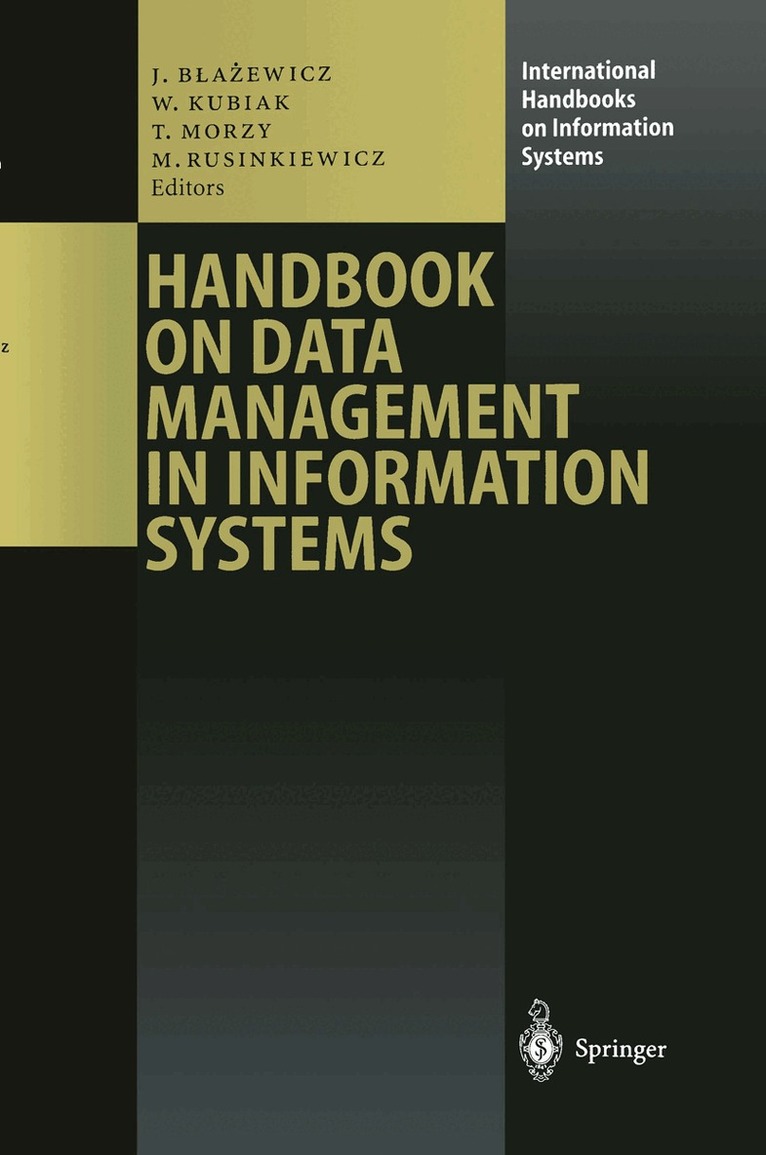
    Handbook on Data Management in Information Systems

    AvJacek Blazewicz,Wieslaw Kubiak

    Häftad, Engelska, 2012

    Del i serien International Handbooks on Information Systems

    2 227 kr

    Beställningsvara. Skickas inom 10-15 vardagar. Fri frakt över 249 kr.

    Beskrivning

    This book is the sixth of a running series of volumes dedicated to selected topics of information theory and practice. The objective of the series is to pro­ vide a reference source for problem solvers in business, industry, government, and professional researchers and gradute students. The first volume, Handbook on Architecture of Information Systems, presents a balanced number of contributions from academia and practition­ ers. The structure of the material follows a differentiation between model­ ing languages, tools and methodologies. The second volume, Handbook on Electronic Commerce, examines electronic commerce storefront, on-line busi­ ness, consumer interface, business-to-business networking, digital payment, legal issues, information product development and electronic business mod­ els. The third volume, Handbook on Parallel and Distributed Processing, presents basic concepts, methods, and recent developments in the field of parallel and distributed processing as well as some important aplications of parallel and distributed computing. In particular, the book examines such fundamental issues in the above area as languages for parallel processing, parallel operating systems, architecture of parallel and distributed systems, parallel database and multimedia systems, networking aspects of parallel and distributed systems, efficiency of parallel algorithms. The fourth volume on Information Technologies for Education and Training is· devoted to a pre­ sentation of current and future research and applications in the field of ed­ ucational technology. The fifth double volume on Knowledge Management contains an extensive, fundamental coverage of the knowledge management field.

    Produktinformation

    • Utgivningsdatum:2012-07-20
    • Mått:155 x 235 x 32 mm
    • Vikt:885 g
    • Format:Häftad
    • Språk:Engelska
    • Serie:International Handbooks on Information Systems
    • Antal sidor:578
    • Förlag:Springer-Verlag Berlin and Heidelberg GmbH & Co. KG
    • ISBN:9783642534416

    Utforska kategorier

    • Referensverk och tvärvetenskap inom Samhälle och politik
    • Databaser inom Data och IT
    • Programmeringsböcker inom Data och IT

    Innehållsförteckning

    • 1. Management of Data: State-of-the-Art and Emerging Trends.- 1 Introduction.- 2 Survey of the Volume.- 2. Database Systems: from File Systems to Modern Database Systems.- 1 Introduction — Database Concepts.- 2 Database System Generations.- 3 Network Database Systems.- 4 Hierarchical Database Systems.- 5 Relational Database Systems.- 6 Object-Oriented Database Systems.- 7 Federated, Mediated Database Systems and Data Warehouses.- 8 Conclusions.- 3. Data Modeling.- 1 Introduction.- 2 Early Concerns in Data Management.- 3 Abstraction in Data Modeling.- 4 Semantic Data Models.- 5 Models of Reality and Perception.- 6 Toward Cognition-Based Data Management.- 7 A Cognitive Approach to Data Modeling.- 8 Research Directions.- 4. Object-Oriented Database Systems.- 1 Introduction and Motivation.- 2 Object-Oriented Data Modeling.- 3 The Query Language OQL.- 4 Physical Object Management.- 5 Architecture of Client-Server-Systems.- 6 Indexing.- 7 Dealing with Set-Valued Attributes.- 8 Query Optimization.- 9 Conclusion.- 5. High Performance Parallel Database Management Systems.- 1 Introduction.- 2 Partitioning Strategies.- 3 Join Using Inter-Operator Parallelism.- 4 ORE: a Framework for Data Migration.- 5 Conclusions and Future Research Directions.- 6. Advanced Database Systems.- 1 Introduction.- 2 Preliminaries.- 3 Data Models and Modeling for Complex Objects.- 4 Advanced Query Languages.- 5 Advanced Database Server Capabilities.- 6 Conclusions and Outlook.- 7. Parallel and Distributed Multimedia Database Systems.- 1 Introduction.- 2 Media Fundamentals.- 3 MPEG as an Example of Media Compression.- 4 Organisation and Retrieval of Multimedia Data.- 5 Data Models for Multimedia Data.- 6 Multimedia Retrieval Sequence Using Images as an Example.- 7 Requirements for MultimediaApplications.- 8 Parallel and Distributed Processing of Multimedia Data.- 9 Parallel and Distributed Techniques for Multimedia Databases.- 10 Case Study: Cairo — Cluster Architecture for Image Retrieval and Organisation.- 11 Conclusions.- 8. Workflow Technology: the Support for Collaboration.- 1 Introduction.- 2 Application Scenario and Collaboration Requirements.- 3 Commercial Technologies Addressing Collaboration Requirements.- 4 Evaluation of Current Workflow Management Technology.- 5 Research Problems, Related Work, and Directions.- 6 Summary.- 9. Data Warehouses.- 1 Introduction.- 2 Basics.- 3 The Database of a Data Warehouse.- 4 The Data Warehouse Concept.- 5 Data Analysis of a Data Warehouse.- 6 Building a Data Warehouse.- 7 Future Research Directions.- 8 Conclusions.- 10. Mobile Computing.- 1 Introduction.- 2 Mobile Computing Infrastructure.- 3 Mobile Computing Software Architectures and Models.- 4 Disconnected Operation.- 5 Weak Connectivity.- 6 Data Delivery by Broadcast.- 7 Mobile Computing Resources and Pointers.- 8 Conclusions.- 11. Data Mining.- 1 Introduction.- 2 Mining Associations.- 3 Classification and Prediction.- 4 Clustering.- 5 Conclusions.- List of Contributors.