• Fri frakt över 249 kr
  • •
  • Snabba leveranser
  • •
  • Billiga böcker
Kundservice

Du är på sajten för privatpersoner.

Företag, bibliotek eller offentlig verksamhet?

Du handlar på classic.bokus.com, där alla dina funktioner finns intakta.
Till classic.bokus.com
Bokus logotyp. Gå till startsidan.
  • Erbjudanden
  • Nyheter
  • Student
  • Topplistor
  • Barn & ungdom
  • Bokus Play
  • E-böcker
  • Pocketböcker
  • Spel & pussel

10% rabatt på allt med kod: NYSTART10 →

Sidfot

Mina sidor

    Hjälp

    • Kundservice
    • Vanliga frågor och svar
    • Frakt och leverans
    • Retur vid ångerrätt
    • Reklamera vara
    • Betalning
    • Köpvillkor
    • Allmänna villkor
    • Information om webbplatsens tillgänglighet

    Om Bokus

    • Om oss
    • Pressrum
    • För studenter
    • För företag
    • För bibliotek och offentlig verksamhet
    • För leverantörer
    • Hållbarhet

    Populärt

    • Aktuella erbjudanden
    • Presentkort
    • Studentlitteratur
    • Nya böcker
    • Topplistor
    • Signerade böcker
    • Engelska böcker

    Inspiration

    • Boktips
    • BookTok
    • Populära bokserier
    • Barnbokskaraktärer
    • Populära författare
    Logotyp för Bokus
    Följ oss på Facebook (extern länk)Följ oss på Instagram (extern länk)Följ oss på YouTube (extern länk)Följ oss på TikTok (extern länk)
    bokus @ CookiesAnpassa cookiesIntegritetspolicyKöpvillkor
    Till Citymail hemsida (extern länk)Till Budbee hemsida (extern länk)Till Postnord hemsida (extern länk)Till Schenker hemsida (extern länk)Till Early Bird hemsida (extern länk)Till Walleys hemsida (extern länk)
    1. Naturvetenskap och teknik
    2. Geovetenskap
    3. Geovetenskap

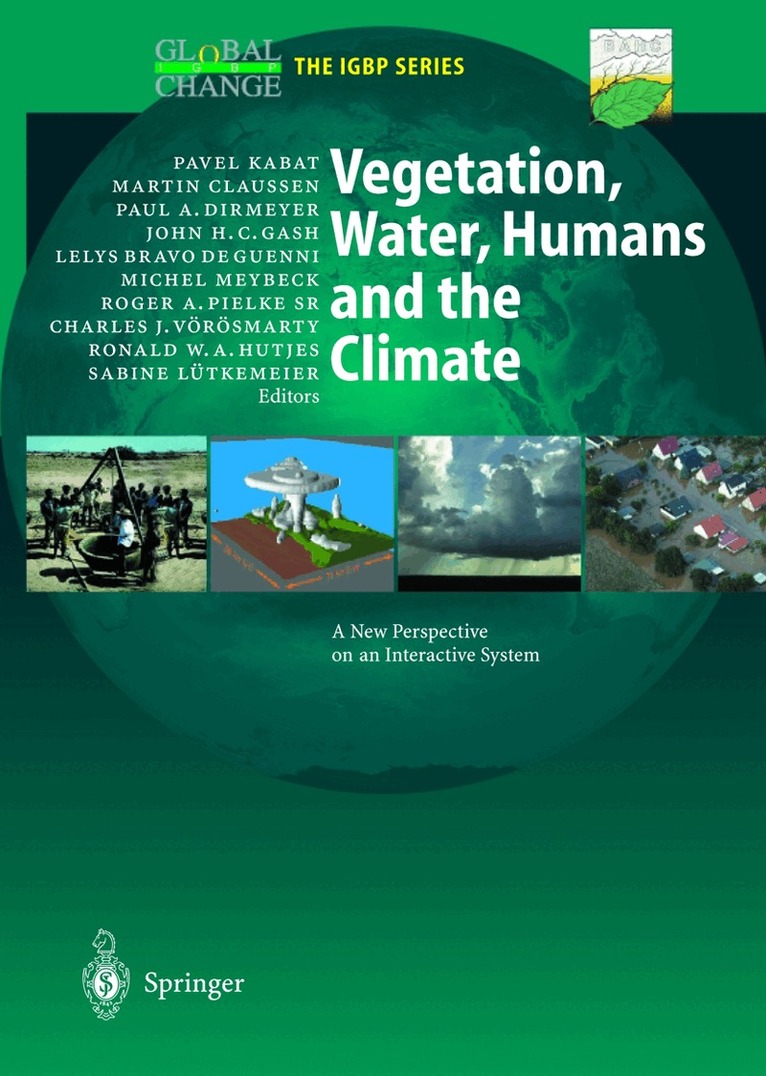
    Vegetation, Water, Humans and the Climate

    A New Perspective on an Interactive System

    AvPavel Kabat,Martin Claussen

    Häftad, Engelska, 2012

    Del i serien Global Change - The IGBP Series

    1 086 kr

    Beställningsvara. Skickas inom 10-15 vardagar. Fri frakt över 249 kr.

    Beskrivning

    A state-of-the-art overview of the influence of terrestrial vegetation and soils within the Earth system. The text deals especially with interactions between the terrestrial biosphere and the atmosphere via the hydrological cycle and their interlinkage with anthropogenic activities. Measurements gathered in integrated field experiments in the Sahel, the Amazon, North America and South-east Asia confirm the importance of these interactions. Observations are complemented by modelling studies, including regional models that simulate flows and transport in river catchments, coupled land-cover and regional climate systems, and Earth-system and global circulation models. Water, nutrient and sediment fluxes in river basins are also discussed and are shown to be highly impacted and regulated by humans through land use, pollution and river engineering. Finally, the book discusses environmental vulnerability and methodologies for assessing the risks associated with regional and global climatic and environmental variability and change.The results reported in this book are based on the research work of many individual scientists and teams around the world associated with the objectives of the IGBP-BAHC and WCRP-GEWEX international research programmes.

    Produktinformation

    • Utgivningsdatum:2012-10-21
    • Mått:193 x 270 x 32 mm
    • Vikt:1 265 g
    • Format:Häftad
    • Språk:Engelska
    • Serie:Global Change - The IGBP Series
    • Antal sidor:566
    • Förlag:Springer-Verlag Berlin and Heidelberg GmbH & Co. KG
    • ISBN:9783642623738

    Utforska kategorier

    • Geovetenskap inom Naturvetenskap och teknik
    • Miljövetenskap och miljöpolitik inom Naturvetenskap och teknik
    • Meteorologi och klimatologi inom Naturvetenskap och teknik

    Innehållsförteckning

    • A Does Land Surface Matter in Climate and Weather?.- A.1 Introduction.- A.2 The Climate near the Ground.- A.3 The Regional Climate.- A.4 The Global Climate.- A.5 The Sahelian Climate.- A.6 The Amazonian Climate.- A.7 The Boreal Climate.- A.8 The Asian Monsoon Climate.- A.9 Summary, Conclusion and Perspective.- References.- B How Measurable is the Earth System?.- B.1 Introduction.- B.2 The Energy Balance Closure Problem.- B.3 Radiation Measurements in Integrated Terrestrial Experiments.- B.4 Surface Turbulent Fluxes.- B.5 Accuracy and Utility of Aircraft Flux Measurements.- B.6 Boundary Layer Budgeting.- B.7 Vegetation Structure, Dynamics and Physiology.- B.8 Remote Sensing and Land-surface Experiments.- B.9 The Water Balance Concept — How Useful Is It as a Guiding Principle for the Design of Land-Atmosphere Field Experiments?.- B.10 Use of Field Experiments in Improving the Land-surface Description in Atmospheric Models: Calibration, Aggregation and Scaling.- B.11 Further Insight from Large-scale Observational Studies of Land/Atmosphere Interactions.- References.- C The Value of Land-surface Data Consolidation.- C.1 Motivation for Data Consolidation.- C.2 Existing Degrees of Consolidation.- C.3 Achieving Full Data Consolidation.- C.4 Terrestrial Data Assimilation.- C.5 Conclusions.- References.- D The Integrity of River and Drainage Basin Systems: Challenges from Environmental Change.- D.1 Introduction.- D.2 Responses of Hydrological Processes to Environmental Change at Small Catchment Scales.- D.3 River Basin Responses to Global Change and Anthropogenic Impacts.- D.4 Responses of Continental Aquatic Systems at the Global Scale: New Paradigms, New Methods.- D.5 Case Study 1: Integrated Analysis of a Humid Tropical Region — The Amazon Basin.- D.6 Case Study 2:Integrated Ecohydrological Analysis of a Temperate Developed Region: The Elbe River Basin in Central Europe.- D.7 Case Study 3: Modelling the Impacts of Land Use and Climate Change on Hydrological Responses in the Mixed Underdeveloped/Developed Mgeni Catchment, South Africa.- D.8 Conclusions: Scaling Relative Responses of Terrestrial Aquatic Systems to Global Changes.- References.- E How to Evaluate Vulnerability in Changing Environmental Conditions?.- E.1 Introduction.- E.2 Predictability and Uncertainty.- E.3 Contrast between Predictive and Vulnerability Approaches.- E.4 The Scenario Approach.- E.5 The Vulnerability Approach.- E.6 Case Studies.- E.7 Conclusions.- References.