Häftad, Engelska, 2012
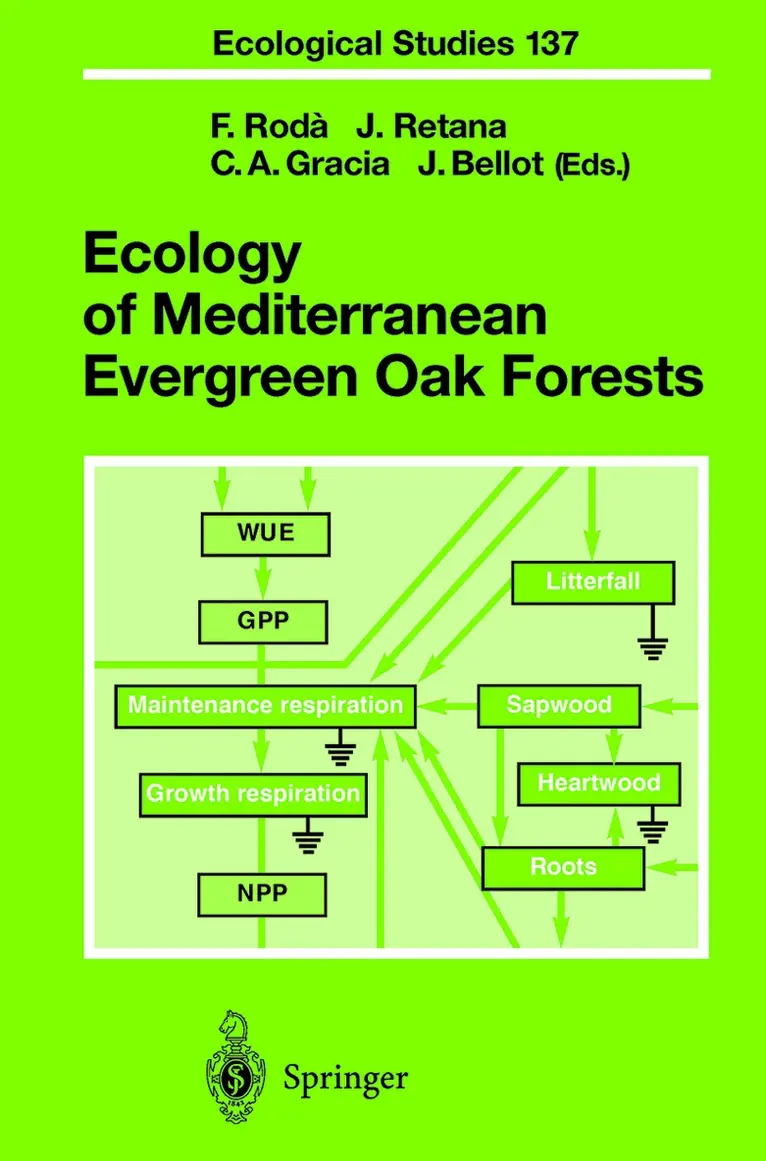
Ecology of Mediterranean Evergreen Oak Forests
Av Ferran Roda, Javier Retana, Carlos A. Gracia, Juan Bellot
552 kr
Beställningsvara. Skickas inom 10-15 vardagar. Fri frakt över 249 kr.
Beskrivning
Broadleaved evergreen forests where holm oak (Quercus ilex 1.) is almost the only canopy tree are a distinctive ecosystem of the Mediterranean Basin. Biogeographically, these forests lie between cool-temperate deciduous forests to the north and drier shrublands to the south. In a more general view, they are ecologically intermediate between these deciduous forests and humid warm-temperate evergreen forests, such as the laurisilva of the Macarone- sian islands or the broadleaved evergreen forests of eastern Asia. Holm oak forests are characterized by small-stature trees (usually 5 to 12 m tall), which are slow growing, cast a deep shade, and have small, evergreen, sclerophyl- lous leaves. Summer drought is the major environmental constraint. Mediterranean broadleaved evergreen forests have been underrepre- sented in the open literature. For example, The Woodlands Data Set of the International Biological Program (IBP) contained data from just one holm oak forest plot, Le Rouquet in southern France (Reichle 1981).Also, some models of European forests consider just two major forest types, broad- leaved deciduous and evergreen conifers, forgeting the extensive forests and woodlands of holm oak and cork oak (Quercus suber 1.), which are the ma- jor evergreen oak tree species in the Mediterranean Basin. The extensive lit- erature on Mediterranean-type ecosystems has also largely neglected these forests, being centred mostly on Mediterranean-type shrublands.
Produktinformation
- Utgivningsdatum: 2012-11-01
- Mått: 155 x 235 x 22 mm
- Vikt: 610 g
- Format: Häftad
- Språk: Engelska
- Serie: Ecological Studies
- Antal sidor: 377
- Förlag: Springer-Verlag Berlin and Heidelberg GmbH & Co. KG
- ISBN: 9783642636684
Utforska kategorier
Betyg & recensioner
0 recensioner
Inga recensioner tillgängliga.