• Fri frakt över 249 kr
  • •
  • Snabba leveranser
  • •
  • Billiga böcker
Kundservice

Du är på sajten för privatpersoner.

Företag, bibliotek eller offentlig verksamhet?

Du handlar på classic.bokus.com, där alla dina funktioner finns intakta.
Till classic.bokus.com
Bokus logotyp. Gå till startsidan.
  • Erbjudanden
  • Nyheter
  • Student
  • Topplistor
  • Barn & ungdom
  • Bokus Play
  • E-böcker
  • Pocketböcker
  • Spel & pussel

10% rabatt på allt med kod: NYSTART10 →

Sidfot

Mina sidor

    Hjälp

    • Kundservice
    • Vanliga frågor och svar
    • Frakt och leverans
    • Retur vid ångerrätt
    • Reklamera vara
    • Betalning
    • Köpvillkor
    • Allmänna villkor
    • Information om webbplatsens tillgänglighet

    Om Bokus

    • Om oss
    • Pressrum
    • För studenter
    • För företag
    • För bibliotek och offentlig verksamhet
    • För leverantörer
    • Hållbarhet

    Populärt

    • Aktuella erbjudanden
    • Presentkort
    • Studentlitteratur
    • Nya böcker
    • Topplistor
    • Signerade böcker
    • Engelska böcker

    Inspiration

    • Boktips
    • BookTok
    • Populära bokserier
    • Barnbokskaraktärer
    • Populära författare
    Logotyp för Bokus
    Följ oss på Facebook (extern länk)Följ oss på Instagram (extern länk)Följ oss på YouTube (extern länk)Följ oss på TikTok (extern länk)
    bokus @ CookiesAnpassa cookiesIntegritetspolicyKöpvillkor
    Till Citymail hemsida (extern länk)Till Budbee hemsida (extern länk)Till Postnord hemsida (extern länk)Till Schenker hemsida (extern länk)Till Early Bird hemsida (extern länk)Till Walleys hemsida (extern länk)
    1. Naturvetenskap och teknik
    2. Matematik och naturvetenskap
    3. Matematik
    4. Matematisk statistik

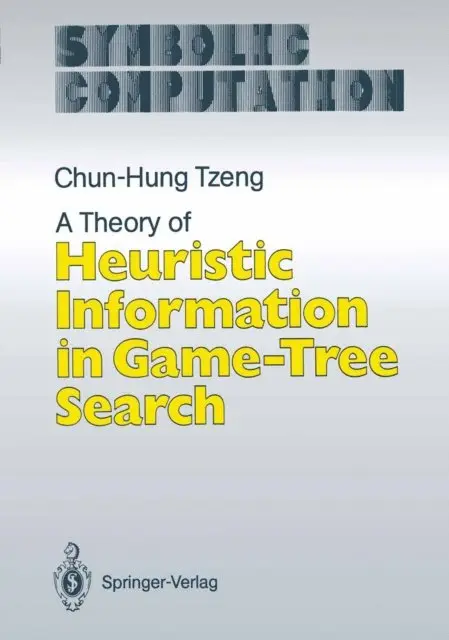
    Theory of Heuristic Information in Game-Tree Search

    AvChun-Hung Tzeng

    Häftad, Engelska, 2011

    Del i serien Symbolic Computation

    547 kr

    Beställningsvara. Skickas inom 10-15 vardagar. Fri frakt över 249 kr.

    Fler format och utgåvor

    E-bok

    710 kr

    Beskrivning

    Searching is an important process in most AI systems, especially in those AI production systems consisting of a global database, a set of production rules, and a control system. Because of the intractability of uninformed search procedures, the use of heuristic information is necessary in most searching processes of AI systems. This important concept of heuristic informatioD is the central topic of this book. We first use the 8-puzzle and the game tic-tac-toe (noughts and crosses) as examples to help our discussion. The 8-puzzle consists of eight numbered movable tiles set in a 3 x 3 frame. One cell of the frame is empty so that it is possible to move an adjacent numbered tile into the empty cell. Given two tile configurations, initial and goal, an 8-puzzle problem consists of changing the initial configuration into the goal configuration, as illustrated in Fig. 1.1. A solution to this problem is a sequence of moves leading from the initial configuration to the goal configuration, and an optimal solution is a solution having the smallest number of moves. Not all problems have solutions; for example, in Fig. 1.1, Problem 1 has many solutions while Problem 2 has no solution at all.

    Produktinformation

    • Utgivningsdatum:2011-10-08
    • Mått:170 x 244 x 7 mm
    • Vikt:222 g
    • Format:Häftad
    • Språk:Engelska
    • Serie:Symbolic Computation
    • Antal sidor:107
    • Förlag:Springer-Verlag Berlin and Heidelberg GmbH & Co. KG
    • ISBN:9783642648120

    Utforska kategorier

    • Matematisk statistik inom Naturvetenskap och teknik
    • Tillämpad matematik inom Naturvetenskap och teknik
    • Artificiell intelligens inom Data och IT

    Innehållsförteckning

    • 1 Introduction.- 2 Games and Minimax Values.- 2.1 Finite Perfect Information Games and Game Trees.- 2.2 Zero-Sum Two-Person Perfect Information Games.- 2.3 Subgames and Game Graphs.- 2.4 Example 1: G1-Games.- 2.5 Example 2: P2-Games.- 2.6 Minimax Values, the Minimax Procedure and the Alpha-Beta.- Procedure.- 3 Heuristic Game-Tree Searches.- 3.1 The Conventional Heuristic Game-Tree Search.- 3.1.1 Static Evaluation Functions.- 3.1.2 The Back-Up Process.- 3.2 Heuristic Arguments and the Pathological Phenomenon.- 3.3 New Back-Up Processes.- 3.3.1 The Product-Propagation Procedure.- 3.3.2 The M & N Procedure.- 3.3.3 The *-MIN Procedure.- 3.3.4 Average Propagation.- 4 Probability Spaces and Martingales.- 4.1 Borel Fields and Partitions.- 4.2 Probability Spaces.- 4.3 Random Variables.- 4.4 Product Spaces.- 4.5 Conditional Probabilities and Martingales.- 5 Probabilistic Game Models and Games Values.- 5.1 Probabilistic Game Models.- 5.2 Strategies and Game Values.- 5.2.1 Non-randomized Strategies.- 5.2.2 Randomized Strategies.- 5.2.3 Minimax Values.- 5.3 Pb-Game Models.- 5.4 Gd-Game Models.- 6 Heuristic Information.- 6.1 Examples: P2- and G1-Game Models.- 6.1.1 P2-Game Models.- 6.1.2 G1-GameModels.- 6.2 Formulation of Heuristic Information.- 6.3 Heuristic Search.- 6.4 Improved Visibility of a Heuristic Search.- 7 Estimation and Decision Making.- 7.1 Random Variable Estimators.- 7.2 Comparison of Estimators.- 7.3 Decision Making.- 7.3.1 Decision Models.- 7.3.2 Decision Qualities.- 8 Independence and Product-Propagation Rules.- 8.1 Product Models.- 8.2 Product Heuristic Information and Product Heuristic Searches.- 8.3 Product-Propagation Rules.- 9 Estimation of Minimax Values in Pb-Game Models.- 9.1 More About Probabilities on Pb-Game Trees.- 9.2 The Conditional Probability of a Forced Win, p(h,l).- 9.3 An Approximation of p(h,l).- 10 Estimation of Minimax Values in Gd-Game Models.- 10.1 Estimation in G1-Game Models.- 10.2 Estimation in Gd-Game Models.- 11 Conclusions.- References.