• Fri frakt över 249 kr
  • •
  • Snabba leveranser
  • •
  • Billiga böcker
Kundservice

Du är på sajten för privatpersoner.

Företag, bibliotek eller offentlig verksamhet?

Du handlar på classic.bokus.com, där alla dina funktioner finns intakta.
Till classic.bokus.com
Bokus logotyp. Gå till startsidan.
  • Erbjudanden
  • Nyheter
  • Student
  • Topplistor
  • Barn & ungdom
  • Bokus Play
  • E-böcker
  • Pocketböcker
  • Spel & pussel

10% rabatt på allt med kod: NYSTART10 →

Sidfot

Mina sidor

    Hjälp

    • Kundservice
    • Vanliga frågor och svar
    • Frakt och leverans
    • Retur vid ångerrätt
    • Reklamera vara
    • Betalning
    • Köpvillkor
    • Allmänna villkor
    • Information om webbplatsens tillgänglighet

    Om Bokus

    • Om oss
    • Pressrum
    • För studenter
    • För företag
    • För bibliotek och offentlig verksamhet
    • För leverantörer
    • Hållbarhet

    Populärt

    • Aktuella erbjudanden
    • Presentkort
    • Studentlitteratur
    • Nya böcker
    • Topplistor
    • Signerade böcker
    • Engelska böcker

    Inspiration

    • Boktips
    • BookTok
    • Populära bokserier
    • Barnbokskaraktärer
    • Populära författare
    Logotyp för Bokus
    Följ oss på Facebook (extern länk)Följ oss på Instagram (extern länk)Följ oss på YouTube (extern länk)Följ oss på TikTok (extern länk)
    bokus @ CookiesAnpassa cookiesIntegritetspolicyKöpvillkor
    Till Citymail hemsida (extern länk)Till Budbee hemsida (extern länk)Till Postnord hemsida (extern länk)Till Schenker hemsida (extern länk)Till Early Bird hemsida (extern länk)Till Walleys hemsida (extern länk)
    1. Medicin
    2. Andra medicinska specialiteter
    3. Farmakologi

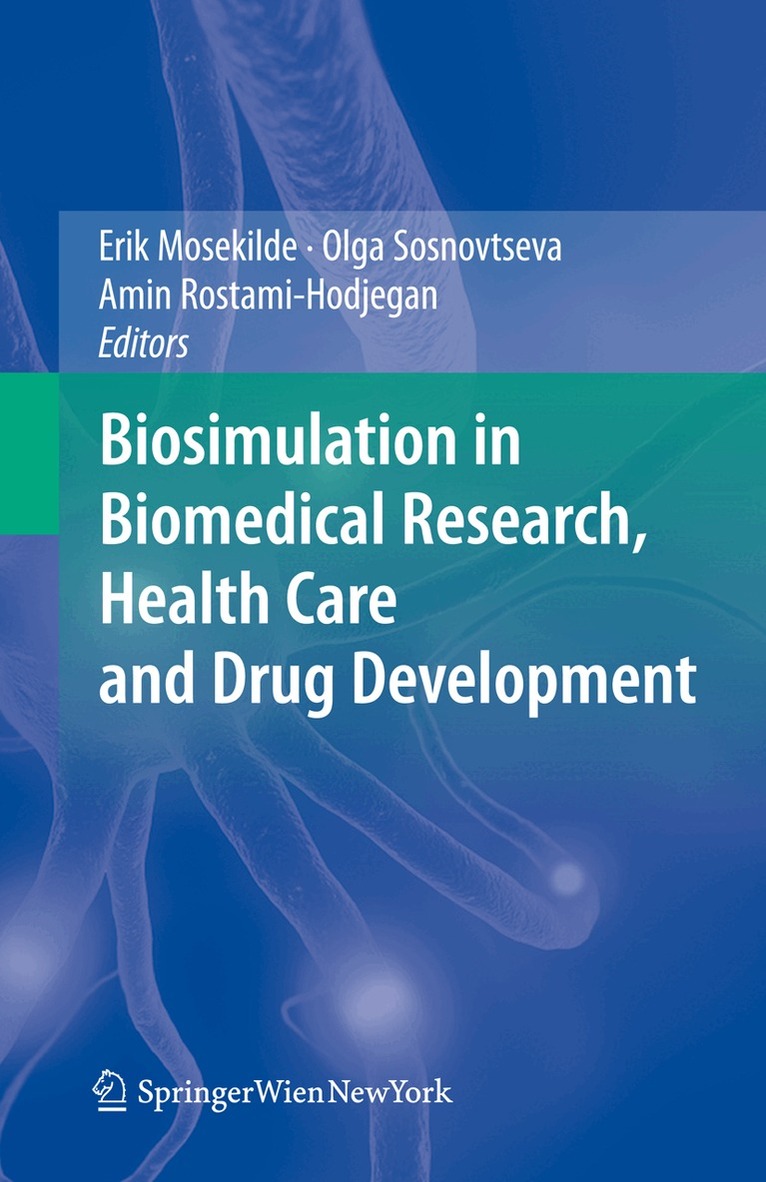
    Biosimulation in Biomedical Research, Health Care and Drug Development

    AvErik Mosekilde,Erik Mosekilde

    Inbunden, Engelska, 2011

    1 674 kr

    Beställningsvara. Skickas inom 10-15 vardagar. Fri frakt över 249 kr.

    Beskrivning

    Biosimulation is an approach to biomedical research and the treatment of patients in which computer modeling goes hand in hand with experimental and clinical work. Constructed models are used to interpret experimental results and to accumulate information from experiment to experiment.This book explains the concepts used in the modeling of biological phenomena and goes on to present a series of well-documented models of the regulation of various genetic, cellular and physiological processes. The way how the use of computer models allows optimization of cancer treatment for individual patients is discussed and models of interacting nerve cells that can be used to design new treatments for patients with Parkinson's disease are explained. Furthermore this volume provides an overview on the use of models in industry, and presents the view of regulatory agencies on the topic.

    Produktinformation

    • Utgivningsdatum:2011-11-02
    • Mått:155 x 235 x 27 mm
    • Vikt:781 g
    • Format:Inbunden
    • Språk:Engelska
    • Antal sidor:396
    • Upplaga:2012
    • Förlag:Springer Verlag GmbH
    • ISBN:9783709104170

    Utforska kategorier

    • Farmakologi inom Medicin
    • Medicinsk utrustning och medicinska tekniker inom Medicin
    • Biomedicinsk teknik inom Medicin

    Mer om författaren

    Erik Mosekilde was born in Århus, Denmark on May 26, 1941. In March 1966 he graduated (summa cum laude) from The Technical University of Denmark as an electrical engineer specialized in solid state physics, and in September 1968 he completed his Ph.D. studies at Physics Laboratory III with a thesis on acoustoelectric effects in piezoelectric semiconductors. Having performed his military service Erik Mosekilde was offered a postdoctoral position at Physics Laboratory III and shortly after received a postdoctoral fellowship from IBM, which allowed him to spend 9 months at Thomas J. Watson Research Center, Yorktown Heights, New York. In July 1972 Erik Mosekilde was appointed associate professor in modern physics, and in August 1977 he defended a dissertation on "Linear and Nonlinear Acoustoelectric Effects in Heavily Doped GaAs Epitaxial Single Crystals" for the Danish Doctor's degree at The University of Copenhagen. In September 2000 he was appointed Professor in Biological Applications of Nonlinear Dynamics at The Technical University of Denmark. Erik Mosekilde has been a member of various educational boards (1977-1982) and for six years (1982-1988) he was a member of Konsistorium, the governing body of The Technical University of Denmark. He has also served and as Vice President and member of the Policy Council for The System Dynamics Society (1984-1993), as member of the steering committee and chairman of the Scandinavian Simulation Society (1986-1992), as member of the Academic Advisory Group for the ERASMUS programme (1988-1990), as member of the J.W. Forrester Award Committee (1987-1997), as statistical consultant in medicine (1986-1998), as member of the steering committee for the Center for Chaos and Turbulence Studies, CATS (1992-2002), as chairman for the Center for Modeling, Nonlinear Dynamics and Irreversible Thermodynamics (1992-2006), as member of the steering committee for an EU COST-program on nonlinear dynamics in mechanical processing(1997-2001), as member of the steering committee for the Danish Graduate School in Nonlinear Science (1997-2002), as member of the steering committee for an INTAS program on coupled biological oscillators (2002-2005), as head of the Department of Physics (1996-2005), and as evaluator for a variety of national and international science foundations.

    Innehållsförteckning

    • 1. Modeling in Biomedical Research and Health Care (Steen G. Dawids, Jakob L. Laugesen and Erik Mosekilde) 2. Concepts in Mechanism Based Modeling (Ole Lund, Jakob L. Laugesen and Erik Mosekilde) 3. The Approach to Model Building (Jeppe Sturis, Jakob L. Laugesen and Erik Mosekilde) 4. Emergence of oscillatory dynamics (Jakob L. Laugesen and Erik Mosekilde) 5. Conductance-Based Models for the Evaluation of Brain Functions, Disorders, and Drug Effects (Svetlana Postnova, Christian Finke, Martin T. Huber, Karl Voigt and Hans A. Braun) 6. Functional modeling of neural-glial interaction (Dmitry E. Postnov, Nadezda A. Brazhe and Olga V. Sosnovtseva) 7. Activity-related structural changes in the myelinated nerve fiber (Alexey R. Brazhe and Georgy V. Maksimov) 8. Closed-Loop Control of BrainRhythms (Anne Beuter and Julien Modolo) 9. Modeling Ca2+ microdomains (Jens C. Brasen, Jens C. B. Jacobsen and Niels-Henrik Holstein-Rathlou) 10. Synchronization of Cellular Contractions in the Arteriolar Wall (Jens C. B. Jacobsen, Bjørn O. Hald, Jens C. Brasen and Niels-Henrik Holstein-Rathlou) 11. Microvascular Plasticity (Jens C. B. Jacobsen, Niels E. Olesen and Niels-Henrik Holstein-Rathlou) 12. Bifurcations and Multistability in Periodically Stimulated Cardiac Cells (Elena Surovyatkina) 13. Synchronization: A case in biological studies (Olga V. Sosnovtseva, Dmitry E. Postnov, Natalia B. Janson and Alexander G. Balanov) 14. Multilevel-modeling, core predictions, and the concept of final conclusions (Elin Nyman, Peter Strålfors and Gunnar Cedersund) 15.Absorption Kinetics of Insulin Mixtures after Subcutaneous Administration (Christian H. Rasmussen, Tue Søeborg, Erik Mosekilde and Morten Colding-Jørgensen) 16. Physiologically-Based Pharmacokinetics (Masoud Jamei, Karen R. Yeo, Trevor Johnson, Cyrus Ghobadi, Manoranjenni Chetty, Khaled Abduljalil, Gaohua Lu, Farzaneh Salem, Adam Darwich and Amin Rostami-Hodjegan)