• Fri frakt över 249 kr
  • •
  • Snabba leveranser
  • •
  • Billiga böcker
Kundservice

Du är på sajten för privatpersoner.

Företag, bibliotek eller offentlig verksamhet?

Du handlar på classic.bokus.com, där alla dina funktioner finns intakta.
Till classic.bokus.com
Bokus logotyp. Gå till startsidan.
  • Erbjudanden
  • Nyheter
  • Student
  • Topplistor
  • Barn & ungdom
  • Bokus Play
  • E-böcker
  • Pocketböcker
  • Spel & pussel

10% rabatt på allt med kod NYSTART10 →

Sidfot

Mina sidor

    Hjälp

    • Kundservice
    • Vanliga frågor och svar
    • Frakt och leverans
    • Retur vid ångerrätt
    • Reklamera vara
    • Betalning
    • Köpvillkor
    • Allmänna villkor
    • Information om webbplatsens tillgänglighet

    Om Bokus

    • Om oss
    • Pressrum
    • För studenter
    • För företag
    • För bibliotek och offentlig verksamhet
    • För leverantörer
    • Hållbarhet

    Populärt

    • Aktuella erbjudanden
    • Presentkort
    • Studentlitteratur
    • Nya böcker
    • Topplistor
    • Signerade böcker
    • Engelska böcker

    Inspiration

    • Boktips
    • BookTok
    • Populära bokserier
    • Barnbokskaraktärer
    • Populära författare
    Logotyp för Bokus
    Följ oss på Facebook (extern länk)Följ oss på Instagram (extern länk)Följ oss på YouTube (extern länk)Följ oss på TikTok (extern länk)
    bokus @ CookiesAnpassa cookiesIntegritetspolicyKöpvillkor
    Till Citymail hemsida (extern länk)Till Budbee hemsida (extern länk)Till Postnord hemsida (extern länk)Till Schenker hemsida (extern länk)Till Early Bird hemsida (extern länk)Till Walleys hemsida (extern länk)
    1. Naturvetenskap och teknik
    2. Teknik och industri
    3. Elektronik och kommunikationer

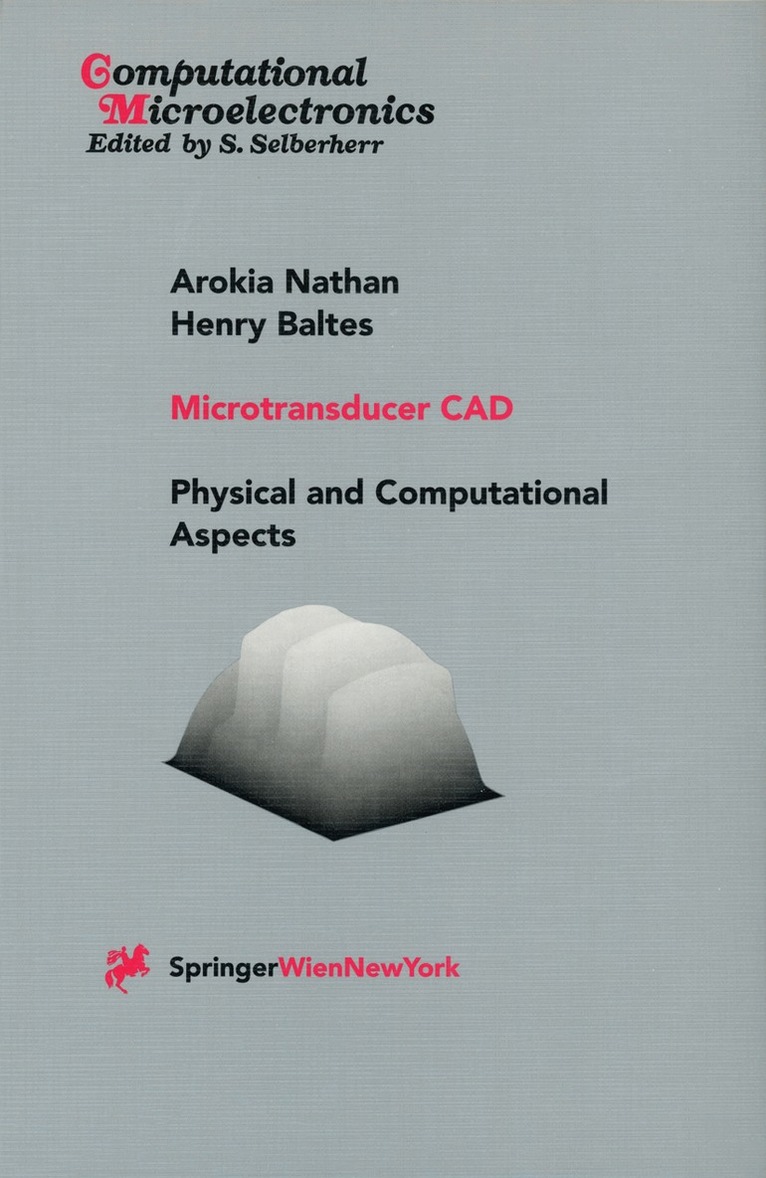
    Microtransducer CAD

    Physical and Computational Aspects

    AvArokia Nathan,Henry Baltes

    Häftad, Engelska, 2013

    Del i serien Computational Microelectronics

    546 kr

    Beställningsvara. Skickas inom 10-15 vardagar. Fri frakt över 249 kr.

    Beskrivning

    Computer-aided-design (CAD) of semiconductor microtransducers is relatively new in contrast to their counterparts in the integrated circuit world. Integrated silicon microtransducers are realized using microfabrication techniques similar to those for standard integrated circuits (ICs). Unlike IC devices, however, microtransducers must interact with their environment, so their numerical simulation is considerably more complex. While the design of ICs aims at suppressing "parasitic” effects, microtransducers thrive on optimizing the one or the other such effect. The challenging quest for physical models and simulation tools enabling microtransducer CAD is the topic of this book. The book is intended as a text for graduate students in Electrical Engineering and Physics and as a reference for CAD engineers in the microsystems industry.

    Produktinformation

    • Utgivningsdatum:2013-10-03
    • Mått:155 x 235 x 25 mm
    • Vikt:686 g
    • Format:Häftad
    • Språk:Engelska
    • Serie:Computational Microelectronics
    • Antal sidor:427
    • Förlag:Springer Verlag GmbH
    • ISBN:9783709173213

    Utforska kategorier

    • Elektronik och kommunikationer inom Naturvetenskap och teknik
    • Teknik: allmänt inom Naturvetenskap och teknik
    • 3D-grafik och modellering inom Data och IT

    Innehållsförteckning

    • 1. Introduction.- 1.1 Modeling and Simulation of Microtransducers.- 1.2 Illustrative Example.- 1.3 Progress in Microtransducer Modeling.- 1.4 References.- 2 Basic Electronic Transport.- 2.1 Poisson’s Equation.- 2.2 Continuity Equations.- 2.3 Carrier Transport in Crystalline Materials and Isothermal Behavior.- 2.4 Electrical Conductivity and Isothermal Behavior in Polycrystalline Materials.- 2.5 Electrical Conductivity and Isothermal Behavior in Metals.- 2.6 Boundary and Interface Conditions.- 2.7 The External Fields — What Do They Influence?.- 2.8 References.- 3 Radiation Effects on Carrier Transport.- 3.1 Reflection and Transmission of Optical Signals.- 3.2 Modeling Optical Absorption in Intrinsic Semiconductors.- 3.3 Absorption in Heavily-Doped Semiconductors.- 3.4 Optical Generation Rate and Quantum Efficiency.- 3.5 Low Energy Interactions with Insulators and Metals.- 3.6 High Energy Interactions and Monte Carlo Simulations.- 3.7 Model Equations for Radiant Sensor Simulation.- 3.8 Illustrative Simulation Example — Color Sensor.- 3.9 References.- 4 Magnetic Field Effects on Carrier Transport.- 4.1 Galvanomagnetic Transport Equation.- 4.2 Galvanomagnetic Transport Coefficients.- 4.3 Equations and Boundary Conditions for Magnetic Sensor Simulation.- 4.4 Illustrative Simulation Example — Micromachined Magnetic Vector Probe.- 4.5 References.- 5 Thermal Non-Uniformity Effects on Carrier Transport.- 5.1 Non-Isothermal Effects.- 5.2 Electrothermal Transport Model.- 5.3 Electrical and Thermal Transport Coefficients.- 5.4 Electro-Thermo-Magnetic Interactions.- 5.5 Heat Transfer in Thermal Microstructures.- 5.6 Summary of Equations and Computational Procedure.- 5.7 Illustrative Simulation Example — Micro Pirani Gauge.- 5.8 References.- 6 Mechanical Effects on CarrierTransport.- 6.1 Piezoresistive Effect.- 6.2 Strain and Electron Transport.- 6.3 Strain and Hole Transport.- 6.4 Piezojunction Effect.- 6.5 Effects of Stress Gradients.- 6.6 Galvano-Piezo-Magnetic Effects.- 6.7 The Piezo Drift-Diffusion Transport Model.- 6.8 Illustrative Simulation Example — Stress Effects on Hall Sensors.- 6.9 References.- 7 Mechanical and Fluidic Signals.- 7.1 Definitions.- 7.2 Model Equations for Mechanical Analysis.- 7.3 Model Equations for Analysis of Fluid Transport.- 7.4 Illustrative Simulation Example — Analysis of Flow Channels.- 7.5 References.- 8 Micro-Actuation.- 8.1 Transduction Principles.- 8.2 State-of-the-Art and Preview.- 8.3 Electrostatic Actuation.- 8.4 Thermal Actuation.- 8.5 Magnetic Actuation.- 8.6 Piezoelectric Actuation.- 8.7 Electroacoustic Transducers.- 8.8 Computational Procedure and Coupling.- 8.9 Illustrative Example — CMOS Micromirror.- 8.10 References.- 9 Microsystem Simulation.- 9.1 Electrical Analogues for Mixed-Signals and Historical Developments.- 9.2 Circuit Modeling and Implementation Considerations.- 9.3 Lumped Analysis: Illustrative Example — Electrostatic Micromirror.- 9.4 Distributed Analysis: Illustrative Example — Flow Microsensor.- 9.5 References.