• Fri frakt över 249 kr
  • •
  • Snabba leveranser
  • •
  • Billiga böcker
Kundservice

Du är på sajten för privatpersoner.

Företag, bibliotek eller offentlig verksamhet?

Du handlar på classic.bokus.com, där alla dina funktioner finns intakta.
Till classic.bokus.com
Bokus logotyp. Gå till startsidan.
  • Erbjudanden
  • Nyheter
  • Student
  • Topplistor
  • Barn & ungdom
  • Bokus Play
  • E-böcker
  • Pocketböcker
  • Spel & pussel

10% rabatt på allt med kod NYSTART10 →

Sidfot

Mina sidor

    Hjälp

    • Kundservice
    • Vanliga frågor och svar
    • Frakt och leverans
    • Retur vid ångerrätt
    • Reklamera vara
    • Betalning
    • Köpvillkor
    • Allmänna villkor
    • Information om webbplatsens tillgänglighet

    Om Bokus

    • Om oss
    • Pressrum
    • För studenter
    • För företag
    • För bibliotek och offentlig verksamhet
    • För leverantörer
    • Hållbarhet

    Populärt

    • Aktuella erbjudanden
    • Presentkort
    • Studentlitteratur
    • Nya böcker
    • Topplistor
    • Signerade böcker
    • Engelska böcker

    Inspiration

    • Boktips
    • BookTok
    • Populära bokserier
    • Barnbokskaraktärer
    • Populära författare
    Logotyp för Bokus
    Följ oss på Facebook (extern länk)Följ oss på Instagram (extern länk)Följ oss på YouTube (extern länk)Följ oss på TikTok (extern länk)
    bokus @ CookiesAnpassa cookiesIntegritetspolicyKöpvillkor
    Till Citymail hemsida (extern länk)Till Budbee hemsida (extern länk)Till Postnord hemsida (extern länk)Till Schenker hemsida (extern länk)Till Early Bird hemsida (extern länk)Till Walleys hemsida (extern länk)
    1. Samhälle och politik
    2. Samhälle och kultur
    3. Sociala grupper och identitet
    4. Etnicitet

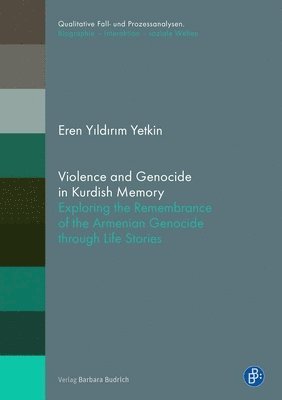
    Violence and Genocide in Kurdish Memory

    Exploring the Remembrance on the Armenian Genocide through Life Stories

    AvEren Yıldırım Yetkin

    Häftad, Engelska, 2022

    Del i serien Qualitative Fall- und Prozessanalysen. Biographie – Interaktion – soziale Welten

    668 kr

    Beställningsvara. Skickas inom 3-6 vardagar. Fri frakt över 249 kr.

    Beskrivning

    Kurdish memories of the Armenian Genocide challenge the systematic denialism established by the Turkish state structures and foster new possibilities of coming to terms with the past. This book examines Kurdish biographies, especially from Van, Turkey, and explores the dynamics of intertwined remembrance regimes concerning the political violence on Armenians and Syriac Christians of Ottoman imperial subjects and on Kurdish citizens of Turkey. These life stories shed light on the complexity of remembering, including collective and individual memory notions on violence, perpetratorship and victimhood from past and present.The author focuses on the Kurdish collective and individual memories through reconstructing biographical narrative interviews and ethnographic data. Based on such empirical inquiry, Yetkin argues that the genocide memory helps the Kurdish society articulate, describe, and discuss its own experiences with the state and political violence. Thus, denialism as a systematic notion by the Turkish state apparatus appears to be read accurately when the ongoing state violence on Kurds is problematised parallelly. Alternative younger voices questioning the forefathers’ involvement in the persecution have repeatedly confronted Kurdish positions in politics and civil society fostering critical discussions on the past – underscoring reconciliation with Armenians yet employing anachronistic patterns of storytelling. They have opened up new trajectories based on their experiences.Hence, the author understands the situation as a multi-faceted and multi-layered memory complexity that contains interwoven narratives starting the Kurdish social time with the genocidal violence on Armenians and Syriac Christians of the region and pointing out continuous oppression. In short, a sphere of contested and multidirectional memories challenging foundations of denialism and settled stories emerges within this context and makes the Kurdish experiences discussable.

    Produktinformation

    • Utgivningsdatum:2022-03-14
    • Mått:148 x 210 x 19 mm
    • Vikt:384 g
    • Format:Häftad
    • Språk:Engelska
    • Serie:Qualitative Fall- und Prozessanalysen. Biographie – Interaktion – soziale Welten
    • Antal sidor:300
    • Förlag:Verlag Barbara Budrich
    • ISBN:9783847425847

    Utforska kategorier

    • Etnicitet inom Samhälle och politik
    • Sociologi inom Samhälle och politik

    Mer om författaren

    Eren Yıldırım Yetkin works at Koblenz University of Applied Sciences in Germany

    Recensioner i media

    “Violence and Genocide in Kurdish Memory provides insight into how visions of the past shift within a turbulent political climate and how these shifts impact ongoing struggles.” Middle East Journal, Volume 76, Number 4, Spring 2023“Regardless, allowing his interviewees to speak for themselves through frequent and often long quotations, Violence and Genocide in Kurdish Memory provides us with an understanding of the multi-layered meaning of the recognition of events in a society that has been subjected to various instances of sociocultural repression, political violence and injustice. Overall, Yetkin’s refreshingly candid model of oral history makes a valuable work in memory studies.”Kurdish Studies Journal, 2 (2024)

    Innehållsförteckning

    • From the Contents1. INTRODUCTION 1.1. ACCESS TO THE FIELD AND RESEARCH PROCESS 1.2. RESEARCH ETHICS1.3. OUTLINE OF THE STUDY2. RESEARCH DESIGN2.1. FOCUSED ETHNOGRAPHY2.2. BIOGRAPHICAL RESEARCH2.2.1. Biographical Narrative Interviews: Overview of some Terms2.2.2. Data Collection2.2.3. Analysis2.3. RESEARCH QUESTIONS3. STUDYING MEMORY: APPROACHES, CONCEPTS, AND COMPLEXITIES3.1. CONCEPTUALISING MEMORY3.1.1 Violence in Processing3.2. CONTESTED MEMORIES3.3. CONCLUDING REMARKS4. ARMENIAN GENOCIDE AND THE TALE OF VAN4.1. A BRIEF INTRODUCTION TO THE CONTEXT4.1.1. History of Histories4.2. VAN4.2.1. Towards the Van Resistance4.2.2. Resistance of Van and Mass Destruction of the City4.2.3. Post-1915 Van and Violence Afterwards4.3. NAMING THE CONTEXT IN (POST-)VIOLENCE AND STRUGGLE FOR THOSE LEFT BEHIND4.3.1 Subjectivities4.4. 1915 ALONGSIDE HISTORIOGRAPHY4.5. CONCLUDING REMARKS5. THE CONFLICT OF RECOGNITION AND DENIAL5.1. ON DENIALISM (OF THE ARMENIAN GENOCIDE)5.1.1. The brief chronology of the Armenian Genocide Denialism5.2. THE CONTEMPORARY SITUATION IN THE “WEST”5.2.1. Just Memory. A novel approach?5.2.2. On the field with events5.2.3. Brief Excursion to Social Media and Political Engagement5.2.4. The “Depo(t)” for counter memories5.3. CONTEMPORARY SITUATION IN VAN5.3.1. The War as the Context5.3.2. Denialism as the Context: Memorial Site of Zeve5.3.3. Collective Memory on the Armenian Past, Genocide and Violence in Van5.4. RECOGNITION DEBATE(S) AMONG KURDS IN TURKEY5.4.1. Actors and Political Positions5.4.2. Reflections in the Kurdish Society or Scholarship5.5. CONCLUDING REMARKS6. LIFE STORIES. RECONSTRUCTING BIOGRAPHICAL EXPERIENCES AND MEMORIES6.1. MEHMED6.1.1. Analytical Abstraction6.1.1.2. Biographical Synopsis6.1.1.2. Elements of Violence in Narration6.2. DELAL6.2.2. Analytical Abstraction6.2.2.1. Biographical Synopsis6.2.2.2. Elements of Violence in Narration6.3. ZAL6.3.1. Analytical Abstraction6.3.1.1. Biographical Synopsis6.3.1.2. Elements of Violence in Narration6.4. CONCLUDING REMARKS7. VIOLENCE AND GENOCIDE IN MEMORY. A COMPARATIVE DISCUSSION7.1. SEMANTICS OF VIOLENCE. HOW TO DESCRIBE, WHAT TO DISCUSS7.1.1. Mnemonics: Space and Material7.1.2. Protagonists7.1.3. Collective References: Outlines and Frames7.1.3.1. Idealising the Past and Victims7.1.3.2. Narrative of Instrumentalisation and Victimhood7.2. CONTINUITY OF VIOLENCE AND TEMPORAL QUESTIONS7.2.1. Anachronisms and Analogies7.2.2. Generational Questions7.2.3. Envisioned Futures7.3. THE CONTESTED AREA AND THE SELF7.3.1. Memory in Transition7.4. CONCLUDING REMARKS8. CONCLUSIONNOTESREFERENCES