• Fri frakt över 249 kr
  • •
  • Snabba leveranser
  • •
  • Billiga böcker
Kundservice

Du är på sajten för privatpersoner.

Företag, bibliotek eller offentlig verksamhet?

Du handlar på classic.bokus.com, där alla dina funktioner finns intakta.
Till classic.bokus.com
Bokus logotyp. Gå till startsidan.
  • Erbjudanden
  • Nyheter
  • Student
  • Topplistor
  • Barn & ungdom
  • Bokus Play
  • E-böcker
  • Pocketböcker
  • Spel & pussel

10% rabatt på allt med kod: NYSTART10 →

Sidfot

Mina sidor

    Hjälp

    • Kundservice
    • Vanliga frågor och svar
    • Frakt och leverans
    • Retur vid ångerrätt
    • Reklamera vara
    • Betalning
    • Köpvillkor
    • Allmänna villkor
    • Information om webbplatsens tillgänglighet

    Om Bokus

    • Om oss
    • Pressrum
    • För studenter
    • För företag
    • För bibliotek och offentlig verksamhet
    • För leverantörer
    • Hållbarhet

    Populärt

    • Aktuella erbjudanden
    • Presentkort
    • Studentlitteratur
    • Nya böcker
    • Topplistor
    • Signerade böcker
    • Engelska böcker

    Inspiration

    • Boktips
    • BookTok
    • Populära bokserier
    • Barnbokskaraktärer
    • Populära författare
    Logotyp för Bokus
    Följ oss på Facebook (extern länk)Följ oss på Instagram (extern länk)Följ oss på YouTube (extern länk)Följ oss på TikTok (extern länk)
    bokus @ CookiesAnpassa cookiesIntegritetspolicyKöpvillkor
    Till Citymail hemsida (extern länk)Till Budbee hemsida (extern länk)Till Postnord hemsida (extern länk)Till Schenker hemsida (extern länk)Till Early Bird hemsida (extern länk)Till Walleys hemsida (extern länk)
    1. Historia och arkeologi
    2. Historia
    3. Historia: särskilda händelser och ämnen
    4. Socialhistoria och kulturhistoria

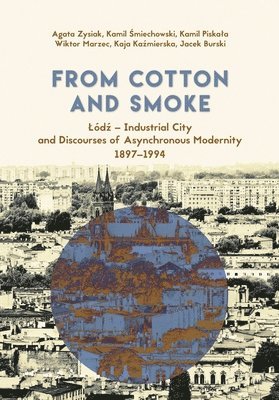
    From Cotton and Smoke

    Łódź – Industrial City and Discourses of Asynchronous Modernity, 1897–1994

    AvAgata Zysiak,Kamil Śmiechowski

    Häftad, Engelska, 2019

    512 kr

    Beställningsvara. Skickas inom 5-8 vardagar. Fri frakt över 249 kr.

    Beskrivning

    This book considers Łódź as the capital of the Polish nineteenth century, and the history of this former textile hub, which now finds itself in central Poland, as one of struggle with modern change in Eastern Europe. The authors boldly challenge the romantic and noble-based Polish cultural imaginary, offering instead a revolutionary path to understanding confrontation with modernity in the region. The book examines local press debates during four pivotal periods, each of which stimulated self-reflection on the idea of the modern city: Rapid industrial growth in the tsarist borderlands; State crafting after WWI; Socialist restructuring after 1945; Transition and deindustrialization after 1989. Together these insights constitute a multifaceted portrait of twentieth-century urban experience beyond the metropolis, in different historical contexts. This innovative, interdisciplinary work deftly integrates urban and cultural history, historical sociology and discourse research. It will be of great value to Polish and Jewish studies specialists, as well as those in the field of Eastern European and Slavic studies. The book also addresses core intellectual debates within urban studies, modernity studies, and historical discourse analysis worldwide.

    Produktinformation

    • Utgivningsdatum:2019-06-07
    • Mått:163 x 239 x 19 mm
    • Vikt:522 g
    • Format:Häftad
    • Språk:Engelska
    • Antal sidor:318
    • Förlag:Uniwersytet Jagiellonski, Wydawnictwo
    • ISBN:9788323344889

    Utforska kategorier

    • Socialhistoria och kulturhistoria inom Historia och arkeologi
    • Europas historia inom Historia och arkeologi
    • Sociala grupper och identitet inom Samhälle och politik

    Mer om författaren

    JACEK BURSKI, sociologist, is a research assistant at the Department of Sociology of Culture at the University of Łódź; he is preparing a PhD thesis about the social world of football fans in Poland.KAJA KAŹMIERSKA is a sociologist. An associate professor, she is the director of the Institute of Sociology and head of the Department of the Sociology of Culture at the University of Łódź. Her research interests include: biographical analysis, collective/national identity and memory, migration, borderland identity formation, European identity formation, the sociological analysis of civil society organization activities, and studies on Jewish identity.WIKTOR MARZEC holds a PhD in sociology and social anthropology from the Central European University in Budapest, an MA in sociology, and an MA in philosophy from the University of Łódź. His research interests concern historical sociology, labor history, and conceptual history.KAMIL PISKAŁA is a historian and holds a PhD in contemporary Polish history. He graduated from the University of Łódź in 2017. His research interests are focused on the history of labor movements and socialist ideology in the twentieth century, people’s history, and political ideas.KAMIL ŚMIECHOWSKI is a historian. He holds a PhD in the history of Poland, and graduated from the University of Łódź in 2013. He works as an associate professor at the Institute of History and is the secretary of the Interdisciplinary Urban Studies Center, the University of Łódź. His research interests are focused on urban theory, analyses of press discourse, processes of modernization in nineteenth- and twentieth-century Poland, and the history of Łódź. Currently, he is working on a post-doc research project about the discourse of the urban in the Kingdom of Poland at the turn of the twentieth century.AGATA ZYSIAK is a historical sociologist. She is an assistant professor at the University of Łódź, working on postwar Poland, modernization, and industrial cities. She is a member of the Institute for Advanced Study, Princeton 2017-2018. She also works at the University of Warsaw comparing urban decline in Detroit and Łódź.

    Recensioner i media

    This book moves the capital of the nineteenth century. Paralleling the switch of focus from Baudelairian Paris to industrial Manchester, it places the capital of the Polish nineteenth century in the textile industrial hub—Łódź. This is still a revolutionary gesture within Polish studies. The authors have aptly located their particular case study within a broader framework of modernity studies. Deftly integrating broad historical queries of the daily press and theoretical reasoning, they have succeeded in relating the imaginaries and normative orders present among journalists to the expert discourses and agendas of institutional actors.