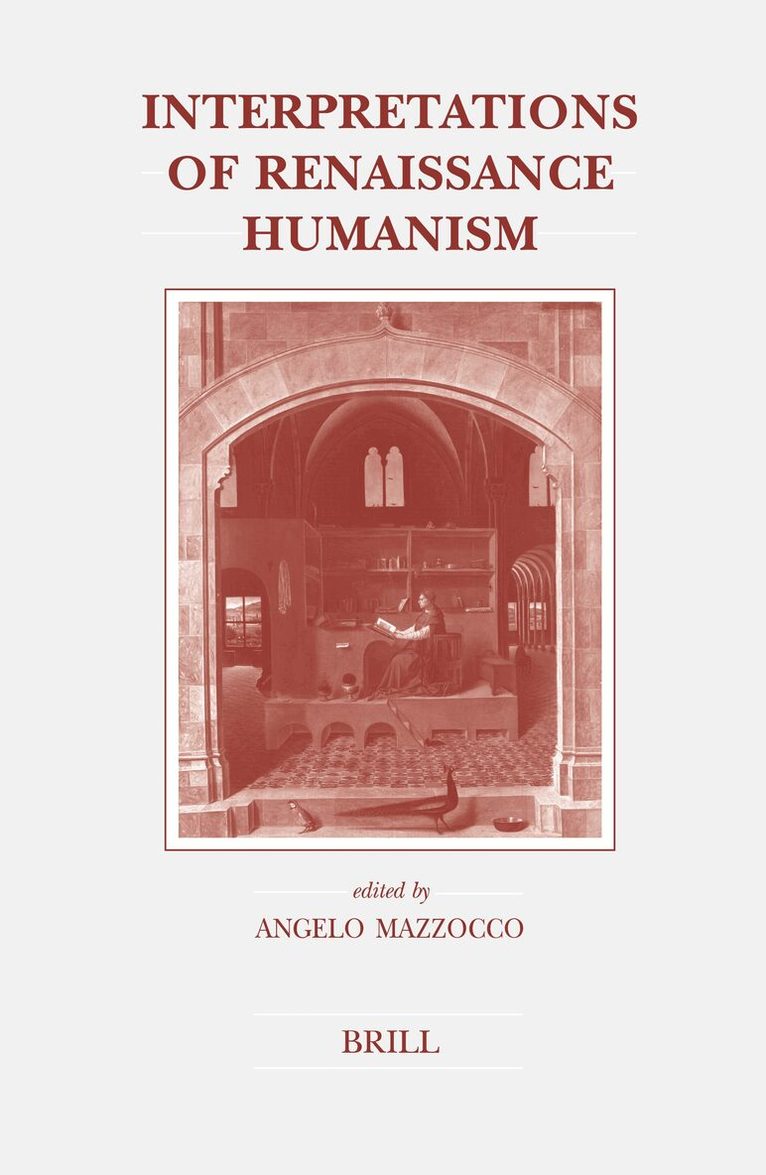
Inbunden, Engelska, 2006
Interpretations of Renaissance Humanism
Del 143 i serien Brill's Studies in Intellectual History
2351 kr
Beställningsvara. Skickas inom 5-8 vardagar. Fri frakt över 249 kr.
Beskrivning
Produktinformation
- Utgivningsdatum: 2006-07-01
- Mått: 155 x 235 x 25 mm
- Vikt: 662 g
- Format: Inbunden
- Språk: Engelska
- Serie: Brill's Studies in Intellectual History
- Antal sidor: 328
- Förlag: Brill
- ISBN: 9789004152441
Utforska kategorier
Mer om författaren
Angelo Mazzocco, Ph.D. (1973) in Romance Languages and Literatures, University of California, Berkeley is Professor emeritus of Italian and Spanish at Mount Holyoke College. He has published extensively on antiquarianism, historical linguistics, Dante, and Renaissance humanism including Linguistic Theories in Dante and the Humanists (Brill, 1993).
Recensioner i media
"In sum, this is an exaltation of essays by well-established scholars united by an important set of concerns. The essays could have appeared independently, of course: but thus assembled they react with each other in interesting and fruitful ways, even as they testify to the midlife vitality still of humanist studies."Michael J. B. Allen, University of California, Los Angeles, Renaissance Querterly"Thirteen distinguished senior scholars contribute an essay each to this exploratory volume on Renaissance humanism--mainly in Italy, but with attention to England, Germany, and France--from the 13th to the 16th century. These are neither experts for whom humanism has become a dirty word, nor followers of a party line of pietistic reverence. The essays vary in length, approach, and implication as they explore the nature, origins, and influence of the movement later ages would label humanism. One salutary common theme is the development of what Paul Grendler, writing on education, here calls "a culture of criticism." At the origins of humanism Robert Black identifies, in 13th-century Italy, "a return to classical authors ... connected with antipathy to contemporary aristocratic society dominated by ... hierarchical values." Alison Brown's excellent final piece shows how around 1500 the university lecturer Marcello Adriani employed texts by the dangerously impious Roman poet Lucretius to attack superstitious practice in contemporary Italy. The book both asserts in argument and demonstrates in practice the vigor of cultural critique as developed in the Renaissance.Summing Up: Highly recommended. Upper-division undergraduates through faculty."E. D. Hill, Mount Holyoke College, Choice
Betyg & recensioner
0 recensioner
Inga recensioner tillgängliga.