• Fri frakt över 249 kr
  • •
  • Snabba leveranser
  • •
  • Billiga böcker
Kundservice

Du är på sajten för privatpersoner.

Företag, bibliotek eller offentlig verksamhet?

Du handlar på classic.bokus.com, där alla dina funktioner finns intakta.
Till classic.bokus.com
Bokus logotyp. Gå till startsidan.
  • Erbjudanden
  • Nyheter
  • Student
  • Topplistor
  • Barn & ungdom
  • Bokus Play
  • E-böcker
  • Pocketböcker
  • Spel & pussel

10% rabatt på allt med kod: NYSTART10 →

Sidfot

Mina sidor

    Hjälp

    • Kundservice
    • Vanliga frågor och svar
    • Frakt och leverans
    • Retur vid ångerrätt
    • Reklamera vara
    • Betalning
    • Köpvillkor
    • Allmänna villkor
    • Information om webbplatsens tillgänglighet

    Om Bokus

    • Om oss
    • Pressrum
    • För studenter
    • För företag
    • För bibliotek och offentlig verksamhet
    • För leverantörer
    • Hållbarhet

    Populärt

    • Aktuella erbjudanden
    • Presentkort
    • Studentlitteratur
    • Nya böcker
    • Topplistor
    • Signerade böcker
    • Engelska böcker

    Inspiration

    • Boktips
    • BookTok
    • Populära bokserier
    • Barnbokskaraktärer
    • Populära författare
    Logotyp för Bokus
    Följ oss på Facebook (extern länk)Följ oss på Instagram (extern länk)Följ oss på YouTube (extern länk)Följ oss på TikTok (extern länk)
    bokus @ CookiesAnpassa cookiesIntegritetspolicyKöpvillkor
    Till Citymail hemsida (extern länk)Till Budbee hemsida (extern länk)Till Postnord hemsida (extern länk)Till Schenker hemsida (extern länk)Till Early Bird hemsida (extern länk)Till Walleys hemsida (extern länk)
    1. Historia och arkeologi
    2. Historia
    3. Asiens historia

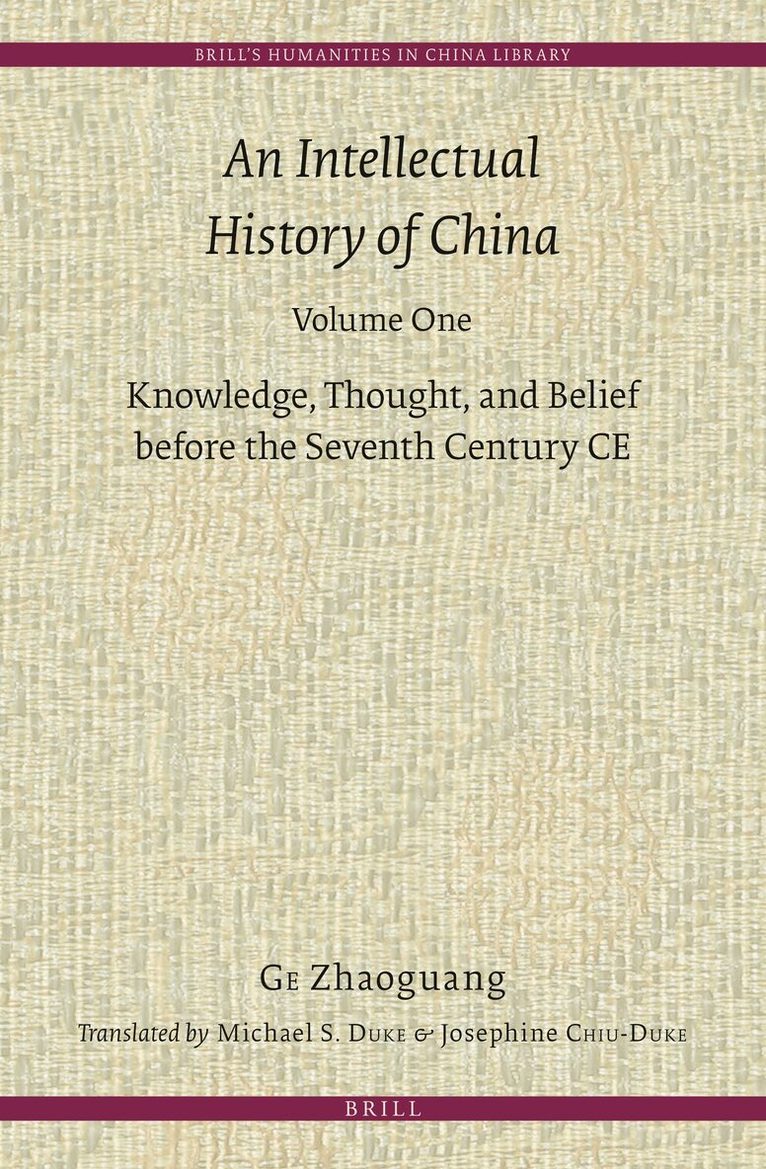
    Intellectual History of China, Volume One

    Knowledge, Thought, and Belief before the Seventh Century CE

    AvZhaoguang Ge

    Inbunden, Engelska, 2014

    Del 6 i serien Brill's Humanities in China Library

    3 170 kr

    Beställningsvara. Skickas inom 5-8 vardagar. Fri frakt över 249 kr.

    Beskrivning

    Winner of the 2014 Choice Outstanding Academic Title AwardIn An Intellectual History of China, Professor Ge Zhaoguang presents a history of traditional Chinese knowledge, thought and belief to the late six century CE with a new approach offering a new perspective. It appropriates a wide range of source materials and emphasizes the necessity of understanding ideas and thought in their proper historical contexts. Its analytical narrative focuses on the dialectical interaction between historical background and intellectual thought. While discussing the complex dynamics of interaction among the intellectual thought of elite Chinese scholars, their historical conditions, their canonical texts and the “worlds of general knowledge, thought and belief,” it also illuminates the significance of key issues such as the formation of the Chinese world order and its underlying value system, the origins of Chinese cultural identity and foreign influences.

    Produktinformation

    • Utgivningsdatum:2014-01-30
    • Mått:155 x 235 x 30 mm
    • Vikt:815 g
    • Format:Inbunden
    • Språk:Engelska
    • Serie:Brill's Humanities in China Library
    • Antal sidor:426
    • Förlag:Brill
    • ISBN:9789004171756
    • Översättare:Michael Duke, Josephine Chiu-Duke

    Utforska kategorier

    • Asiens historia inom Historia och arkeologi
    • Filosofiska discipliner inom Filosofi och religion

    Mer om författaren

    Ge Zhaoguang is a Professor of History at Fudan University, Shanghai. He was the founder of Fudan’s National Institute for Advanced Humanistic Studies and served as its Director for six years. He is well known for his studies of Chinese history and the religious and intellectual history of ancient China. He has been a visiting professor at Kyoto University in Japan, City University of Hong Kong, Katholieke Universiteit Leuven in Belgium and National Taiwan University. He was also appointed Princeton University Global Scholar for 2009-2010. Among his many Chinese publications are Zen Buddhism and Chinese Culture (1986), Taoism and Chinese Culture (1987), Ten Chinese Classic Canons (1993), Chinese Intellectual History, 2 volumes (1998 and 2000), Dwelling Here in China (2011).Michael S. Duke is Professor Emeritus of Chinese and Comparative Literature from the Asian Studies Department of the University of British Columbia. He is the author of several books including Blooming and Contending (1985). He has also translated many modern Chinese works of fiction such as Raise the Red Lantern (1993), The Fat Years (2011) and most recently co-translated, with Timothy D. Baker, Cho-yun Hsu, China: A New Cultural History (2012).Josephine Chiu-Duke is an Associate Professor of Chinese Intellectual History in the Asian Studies Department of the University of British Columbia. She is the author of To Rebuild the Empire: Lu Chih’s Confucian Pragmatist Approach to the Mid-T'ang Predicament (2000) and the editor of a Chinese work entitled Liberalism and the Humanistic Tradition – Essays in Honor of Professor Lin Yü-sheng (2005). She has also published many articles in both English and Chinese on traditional Chinese women and contemporary Chinese thought.

    Recensioner i media

    "This is a coherent, erudite, undogmatic, thoughtful account of a vast and complex subject by a distinguished and widely read senior professor of history at Fudan, one of China's premier universities."– C. Schirokauer, Columbia University, in Choice (September 2014)."Professor Ge’s wide-ranging study is a rare effort, standing alongside earlier landmarks of Chinese intellectual history such as Fung Youlan 馮友蘭’s History of Chinese Philosophy and Kung-chuan Hsiao 蕭公權’s History of Chinese Political Thought... the book is an accomplished translation into English of Ge’s original Chinese text, with all its citations and complexities of language, among them the use of various philosophical and religious terms whose rendition into English has to be both consistent and readable."– Peter Harris, Victoria University of Wellington, in New Zealand Journal of Asian Studies (June 2017)."While discussing the complex dynamics of interaction among the intellectual thought of elite scholar... it also illuminates the significance of key issues such as the formation of the Chinese world order and its underlying value system, the origins of Chinese cultural identity and foreign influences."(worldtrade.com)

    Innehållsförteckning

    • Introduction: Chinese Intellectual History WritingBrief Prologue: The History of Chinese Intellectual History ItselfPart One: The History of General Knowledge, Thought and BeliefPart Two: Between the History of Knowledge and the History of ThoughtPart Three: the Foundational Presupposition of Chinese Thought: “Dao” or the “Way of Heaven”Part Four: The Continuity of Intellectual History EmergesPart Five: Historical Memory, Intellectual Resources and ReinterpretationPart Six: Pictures Where There Are No Pictures: How to Deal With Empty Spaces in Intellectual HistoryPart Seven: Addition and Subtraction Methods in Intellectual History ResearchPart Eight: What Can Be A Resource Material for Intellectual History?Chapter One: Tracing the Origins of Chinese Intellectual History in the Three Dynasties (Ancient Times to ca. 6th Century BCE)Brief Prologue: Remote AntiquityPart One: Reconstructing the World of Ancient Thought: Traditional Written Documents, Modern Theory, and Archeological DiscoveriesPart Two: The Shang Conceptual System as Recorded in the Oracle Bone InscriptionsPart Three: Evolution of Thought as Recorded in the Written Documents and Bronze Inscriptions of the Western ZhouPart Four: Chinese Script and Chinese Intellectual HistoryPart Five: Ceremonies, Symbols and A Numerological World Order as the Background of Later Intellectual HistoryChapter Two: Hundred Schools of the Spring and Autumn and Warring States Periods, I (ca. 6th to 3rd Century BCE)Brief Prologue: China’s “Axial Age”Part One: General Knowledge and Thought in the Spring and Autumn PeriodPart Two: Continuation and Renewal of the Intellectual Tradition I: Ru or the ConfuciansPart Three: Continuation and Renewal of the Intellectual Tradition II: Mo or the MoistsPart Four: Continuation and Renewal of the Intellectual Tradition III: Dao or the DaoistsPart Five: Elite Thought and General Knowledge: Implications of Mantic and Medical Arts in Intellectual History Chapter Three: Hundred Schools of the Spring and Autumn and Warring States Periods, II (ca. 6th to 3rd Century BCE)Part One: Warring States Hundred Schools Contend, I: Cosmic Space and TimePart Two: Warring States Hundred Schools Contend, II: Social OrderPart Three: Warring States Hundred Schools Contend, III: Life of the IndividualPart Four: Language and Reality: the Warring States Period Disputations on NamesChapter Four: Intellectual Convergence in the Qin and Han Dynasties, from ca. the 3rd Century BCE to ca. the Mid-2nd Century CEPrologue: Coda to the “Hundred Schools of Thought Contending”Part One: General Knowledge Background and Intellectual Achievement in the Qin and Han dynastiesPart Two: Toward A Synthesis of Knowledge and Philosophy: from the Luxuriant Dew of the Spring and Autumn Annals to the HuainanziPart Three: Establishment of A State Ideology: from the Luxuriant Dew of the Spring and Autumn Annals to the Discourses in the White Tiger HallPart Four: Classics and Apocrypha: the Consequences of Mutual Interaction between General Knowledge and Elite ThoughtChapter Five: Confucianism, Daoism and Buddhism from the End of the Eastern Han to the Early Tang Dynasty, I (ca. Mid-2nd to Mid-7th Centuries)Prologue: Foreign Influence Enters ChinaPart One: Evolution of Autochthonous Chinese Thought and Learning from Han to JinPart Two: The Mysterious and Profound: A Turning Point of Intellectual History in the Third Century CEPart Three: Purification of Daoist Teachings: the Religionization of Daoist Thought, Knowledge and TechniquesChapter Six: Confucianism, Daoism and Buddhism from the Eastern Han to the Tang Dynasty IIPart One: the Transmission of Buddhism to China and Its Significance in Intellectual History, IPart Two: the Transmission of Buddhism to China and Its Significance in Intellectual History, IIPart Three: Buddhist Conquest of China?Part Four: Basic Outline of the Mainstream World of Knowledge and Thought in the Seventh CenturyBibliography