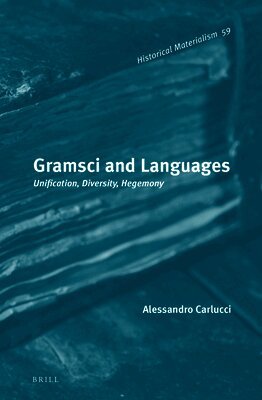
Gramsci and Languages
Unification, Diversity, Hegemony
2 625 kr
Beställningsvara. Skickas inom 3-6 vardagar. Fri frakt över 249 kr.
Beskrivning
Produktinformation
- Utgivningsdatum:2013-09-13
- Mått:155 x 235 x 20 mm
- Vikt:547 g
- Format:Inbunden
- Språk:Engelska
- Serie:Historical Materialism Book Series
- Antal sidor:256
- Förlag:Brill
- ISBN:9789004231115
Utforska kategorier
Mer om författaren
Alessandro Carlucci, Ph.D. (London, 2010), is Lector in Italian at the University of Oxford. He has published widely on Gramsci, and is the editor of New Approaches to Gramsci: Language, Philosophy and Politics, special issue of the Journal of Romance Studies (2012).
Recensioner i media
AWARDSGramsci and Languages by Alessandro Carlucci has been awarded the prestigious 'Giuseppe Sormani International Prize' for the best monograph on Antonio Gramsci (4th edition, 2012-2017). The book is one of the two 'ex aequo' winners.REVIEWS“Carlucci’s study is a meticulous and at times brilliant exploration of Gramsci’s relationship with the linguistic question […] a very enjoyable and informative read for anyone passionate about Gramscian matters, and about language in a social context more generally.”Neelam Srivastava, Senior Lecturer in Postcolonial Literature at Newcastle University, H-Italy (March 2016). "So much partial or misdirected work has recently appeared in English that appropriates Gramsci for its putative authority that Alessandro Carlucci (in Gramsci and Languages: Unification, Diversity, Hegemony) has done yeoman work providing new background and readings of the still untranslated parts of The Prison Notebooks (Lawrence & Wishart [1971]) to show about Gramsci’s lifelong interest in the interplay of culture, politics, and language. Carlucci places Gramsci’s university studies in linguistics under Matteo Bartoli as cementing Gramsci’s linkage of politics and language that came from his Sardinian origins. The nature of linguistic communication as a medium for controlling populations or possibility for contesting bourgeois hegemony remains an undertone to nearly all of Gramsci’s Prison Notebooks. Carlucci’s thorough review of linguistics in Gramsci has the benefit of knowing the entirety of the Prison Notebooks, which have unfortunately still remained largely untranslated. More importantly, Carlucci places these writings within the context of left debates of the time."Professor Stephen Shapiro, University of Warwick, The Year's Work in Critical and Cultural Theory, Oxford University Press, 2014.“The volume offers a comprehensive analysis of the interplay between political and linguistic reflections in the philosophy of Antonio Gramsci, during the diverse and very different periods of the life of this thinker and political leader. It begins in deepest Sardinia with a very young Gramsci, and passes through his experiences in Turin, Moscow and finally in prison. This comprehensive and meticulous close examination is claimed as the necessary methodology in the well-organised introduction (pp. 1-18) and, together with its ever compelling ideas, constitutes the volume’s main contribution […] The main merit of this volume is precisely that of bringing cohesion and unity to the study of a thinker who is first and foremost a political leader committed to action, but who in the end emerges as an important figure in the history of Italian linguistic thought.”Luciano Giannelli, Rivista Italiana di Dialettologia, 2014.“Gramsci and Languages is a very important addition to contemporary studies on Gramsci. It should be of interest also to philosophers (and philosophers of language in particular), and to scholars in social, cultural, and political studies.” Piotr Stalmaszczyk, Professor of English and General Linguistics at the University of Lodz, Marx and Philosophy Review of Books.“With this book, Carlucci makes a significant contribution to the growing international scholarship and debates on Gramsci. The originality of Gramsci and Languages lies mainly in its ability to recast three fundamental aspects of Gramsci’s political, intellectual and personal biography: the role of Sardinia, the influence of Italian and European historical linguistics on the development of Gramsci’s thought, as well as his encounter with Bolshevism and Lenin’s thought.”Giuseppe Vacca, President of the Fondazione Istituto Gramsci.“This is a fascinating study of how Gramsci’s interest in language shaped his politics and political theory. The reader will find important, newly discovered material on the influence of both Saussure and Soviet scholars of the 1920s. This book gives the clearest and most up to date account of Gramsci the philologist as well as the political activist, and adds to our knowledge of the Sardinian’s life in the Soviet Union in the early 1920s.” Carl Levy, Professor of Politics at Goldsmiths, University of London.
Innehållsförteckning
- PrefaceIntroductionLinguistic reflections as an integral part of Gramsci’s legacy Modern linguistics and the philosophy of praxisTowards a better understanding of Gramsci’s views1. The limited number of writings usually considered2. The risks involved in neglecting Gramsci’s biography3. Identifying sources and cultural links: a productive trend in recent research4. Linguistic themes and the debates on Gramsci’s LeninismDiversity and unification: a few considerations in conclusion1. Experiencing Linguistic Diversity and Cultural Unification1.1. Sardinian in Gramsci’s life1.2. Gramsci’s correspondence1.3. The Sardinian years1.4. Turin1.5. The Sassari Brigade in Turin, April-July 19191.5.1. The arrival of the Brigade1.5.2. The editorial board of L’Ordine Nuovo1.5.3. The successful campaign among Sardinian soldiers1.6. From Turin to the prison years1.7. Gramsci’s views on national linguistic unification1.7.1. ‘Every individual ... is a philosopher’1.7.2. The shortcomings of monolingualism1.7.3. Final remarks2. Influences and Differences: The Formation of Gramsci’s Views2.1. Gramsci’s direct and indirect sources in language studies2.2. Echoes of Saussure’s ideas2.2.1. Grammar2.2.2. Metaphors2.2.3. Language planning2.2.4. The penetration of Saussurean concepts into Italian intellectual culture2.2.5. A possible channel of transmission: the Cours in Russia, 1917-19252.2.6. Final remarks2.3. Language and social classes2.3.1. Sociological linguistics and the Marxist critique of language2.3.2. Bukharin2.3.3. Sociolinguistic variation and the national question in the USSR2.3.4. Grammar and language education for the popular masses2.3.5. Final remarks2.4. Glottopolitical aspects of Lenin’s influence2.4.1. Early Marxist approaches to language policies: Marx and Engels2.4.2. The Second International2.4.3. Lenin2.4.4. Did Gramsci know Lenin’s ideas on language?2.4.5. Affinities2.4.6. Jewish autonomy: a case of partial divergence2.4.7. Final remarks2.5. Rationalising and unifying linguistic communication2.5.1. Soviet Esperantism2.5.2. Proletarian culture2.5.3. Sources and periodisation2.5.4. Continuity and consistency of Gramsci’s glottopolitical views2.5.5. Final remarks: Soviet inputs and the development of Gramsci’s views3. Political Implications3.1. Gramsci and the linguistics of his time3.2. Language and politics in Gramsci’s writings3.3. The role of linguistic themes in shaping Gramsci’s politics3.3.1. Necessary conditions3.3.2. Centres of irradiation3.3.3. The Jacobins3.3.4. Language and hegemony3.4. Gramsci’s specificity3.4.1. A man ‘in flesh and blood’3.4.2. Gramsci’s Marxism3.4.3. Final remarksConclusions: Gramscian Links between Language and PoliticsGramsci in linguistics......and linguistics in GramsciAppendix: Gramsci’s Legacy, 1937–20074.1. The reception of Gramsci’s writings: the letters4.2. Lost, unpublished and recently published material4.2.1. Matteo Bartoli’s glottology course of 1912–134.2.2. Gramsci’s translation of Finck’s work4.2.3. Gramsci’s comments on Panzini’s Italian grammar4.2.4. Early work on Manzoni4.3. Pre-prison writings and prison notes4.4. Gramsci’s writings on language4.5. Gramsci and linguistic disciplines4.5.1. Early research4.5.2. Exploring Gramsci’s ideas on language4.5.3. Using Gramsci’s ideas on language4.5.4. Gramsci’s influence and its limits: some examples4.5.5. Final remarksReferencesIndex
Mer från samma författare
New worlds for old words / Mundos nuevos para viejas palabras
Gloria Clavería Nadal, Santiago Del Rey Quesada, Isabel García Ortiz, Susana Guerrero Salazar, Carmen Varo Varo, María del Carmen Rodríguez Caballero, Bozena Wislocka Breit, Steven N. Dworkin, Inmaculada González Sopeña, Christopher Pountain, Alessandro Carlucci, Rocío Díaz-Bravo, Gael Vaamonde, Ingmar Söhrman, Christopher Pountain, Bozena Wislocka Breit
Inbunden, 2021
885 kr
New worlds for old words / Mundos nuevos para viejas palabras
Isabel García Ortiz, Christopher Pountain, Bozena Wislocka Breit, Gloria Clavería Nadal, Santiago Del Rey Quesada, Susana Guerrero Salazar, Carmen Varo Varo, María del Carmen Rodríguez Caballero, Steven N. Dworkin, Inmaculada González Sopeña, Alessandro Carlucci, Rocío Díaz-Bravo, Gael Vaamonde, Ingmar Söhrman, Christopher Pountain, Bozena Wislocka Breit
Häftad, 2022
653 kr
Mer från samma serie
Du kanske också är intresserad av
The Cambridge Handbook of the Law of the Sharing Economy
Nestor M. Davidson, Michèle Finck, John J. Infranca
Inbunden, 2018
2 625 kr
Integration of Biomaterials for Gene Therapy
Neelam Jain, Sonali Sundram, Rishabha Malviya
2 625 kr
Zweites Buch . §§ 105-237
Birgit Weitemeyer, Rainer Walz, Andreas Schluter, Jurgen Sonnenschein, Jorn Rohrmann, Harro Otto, Stefan Kroll, Willi Joachim, Norbert Horn, Jochen Hoffmann, Harald Herrmann, Martin Henssler, Volker Emmerich, Klaus P. Berger, Peter Balzer
2 625 kr
Integration of Biomaterials for Gene Therapy
Neelam Jain, Sonali Sundram, Rishabha Malviya
2 625 kr
Phenotype & Genotype Characterization of V.cholera
Jawad K. Kreef, Adnan H . Hamad, Thuraya Aameer
Häftad, 2012
2 625 kr