• Fri frakt över 249 kr
  • •
  • Snabba leveranser
  • •
  • Billiga böcker
Kundservice

Du är på sajten för privatpersoner.

Företag, bibliotek eller offentlig verksamhet?

Du handlar på classic.bokus.com, där alla dina funktioner finns intakta.
Till classic.bokus.com
Bokus logotyp. Gå till startsidan.
  • Erbjudanden
  • Nyheter
  • Student
  • Topplistor
  • Barn & ungdom
  • Bokus Play
  • E-böcker
  • Pocketböcker
  • Spel & pussel

Må bättre, för mindre! Upp till 50% rabatt på hälsoböcker

Sidfot

Mina sidor

    Hjälp

    • Kundservice
    • Vanliga frågor och svar
    • Frakt och leverans
    • Retur vid ångerrätt
    • Reklamera vara
    • Betalning
    • Köpvillkor
    • Allmänna villkor
    • Information om webbplatsens tillgänglighet

    Om Bokus

    • Om oss
    • Pressrum
    • För studenter
    • För företag
    • För bibliotek och offentlig verksamhet
    • För leverantörer
    • Hållbarhet

    Populärt

    • Aktuella erbjudanden
    • Presentkort
    • Studentlitteratur
    • Nya böcker
    • Topplistor
    • Signerade böcker
    • Engelska böcker

    Inspiration

    • Boktips
    • BookTok
    • Populära bokserier
    • Barnbokskaraktärer
    • Populära författare
    Logotyp för Bokus
    Följ oss på Facebook (extern länk)Följ oss på Instagram (extern länk)Följ oss på YouTube (extern länk)Följ oss på TikTok (extern länk)
    bokus @ CookiesAnpassa cookiesIntegritetspolicyKöpvillkor
    Till Citymail hemsida (extern länk)Till Budbee hemsida (extern länk)Till Postnord hemsida (extern länk)Till Schenker hemsida (extern länk)Till Early Bird hemsida (extern länk)Till Walleys hemsida (extern länk)
    1. Samhälle och politik
    2. Politik och statsskick
    3. Politiska ideologier och rörelser
    4. Marxism och kommunism

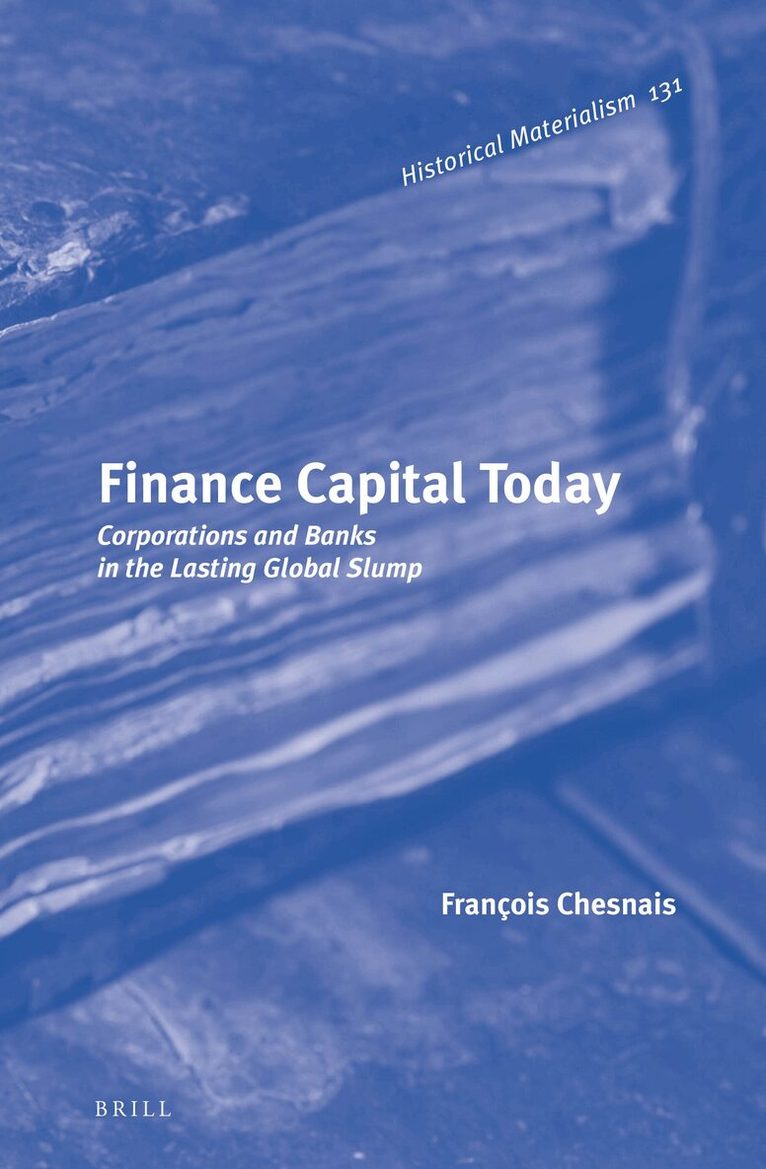
    Finance Capital Today

    Corporations and Banks in the Lasting Global Slump

    AvFrançois Chesnais

    Inbunden, Engelska, 2016

    Del 131 i serien Historical Materialism Book Series

    2 451 kr

    Beställningsvara. Skickas inom 5-8 vardagar. Fri frakt över 249 kr.

    Fler format och utgåvor

    Häftad

    352 kr

    Beskrivning

    Finance Capital Today is shortlisted for the The Isaac and Tamara Deutscher Memorial Prize 2017.Finance Capital Today presents a rich new analysis of the specific features of contemporary capitalism, notably its truly global nature and its financialisation, calling on Marxist analyses of the concentration, centralisation and globalisation of capital and Marx’s theory of interest-bearing and fictitious capital. Chesnais shows how financial globalisation and the exponential growth of financial assets have developed alongside the globalisation of productive capital, paying special attention to the contemporary operations of transnational corporations and global oligopoly. He argues that the macroeconomic perspective is one in which large amounts of capital are looking for profitable investment in a setting of underlying overproduction and low profits. The outcome will be low global growth, repeated financial shocks and the growing interconnection between the environmental and economic crises.

    Produktinformation

    • Utgivningsdatum:2016-09-15
    • Mått:155 x 235 x 24 mm
    • Vikt:621 g
    • Format:Inbunden
    • Språk:Engelska
    • Serie:Historical Materialism Book Series
    • Antal sidor:312
    • Förlag:Brill
    • ISBN:9789004255470

    Utforska kategorier

    • Marxism och kommunism inom Samhälle och politik
    • Nationalekonomi inom Ekonomi och Ledarskap
    • Finansiering inom Ekonomi och Ledarskap

    Mer om författaren

    François Chesnais is Emeritus Professor at Université-Paris Nord. From La mondialisation du capital (1994) to Les dettes illégitimes (2011), he has written and edited numerous books on financial globalisation, many of which have also been published in Portuguese, Spanish and Italian.

    Innehållsförteckning

    • AcknowledgementsIntroductionNo end to crisis in viewFinance capital and financial capitalThe world economy as an analytical aimFrom the theory of the internationalisation of industrial capital to the theory of financial globalisationFinancialisation as discussed in this bookNo ‘diversion of profits’ but the accumulation of fictitious capital The ‘crisis in the sphere of credit and money’ in 20081. The Historical Setting of the Crisis and Its Original Traits1. The Crisis in a Long-Term Trajectory1.1 In the advanced capitalist countries, slowing accumulation before the deep break in 20081.2 The bourgeoisie’s fight against the immanent barriers of capitalist production1.3 The fall in the rate of profit and the play of the counteracting factors 2. A Crisis Which Has Not Been Allowed to Run Its Course2.1 A mountain of fictitious capital alongside over-accumulation and overproduction2.2 Global over-accumulation and overproduction with China as a central locus2.3 The globalisation of the labour force, the cornerstone of capital’s strength2. Financial Liberalisation and Globalisation from the 1960s onwards and the Return of Financial Crises 1. Industrial Profits and the Eurodollar Market in the Resurgence of Concentrated Interest-bearing Capital2. The End of the Bretton Woods Monetary System and the Advent of Floating Exchange Rates3. The Recycling of Petrodollars and the Third World Debt Trap4. The Growth of Government Debt at the Heart of the System5. The Political Implications of Market-Based Retirement Schemes6. World Money Since the Demise of Bretton Woods 7. The ‘Semi-Completion’ of Financial Globalisation and the Financial Crises of the 1990sAppendix 2: The ‘Club of Paris’ and Brady bonds3. The Notion of Interest-Bearing Capital in the Setting of Present Centralisation and Concentration of Capital1. Steps in Approaching the Analysis of Financial Profits1.1 ‘Money-dealing’ capital, interest-bearing capital and ‘financial accumulation’1.2 Credit and debt as creating different relationships1.3 The nature of financial profits2. Interest-bearing Capital: Exteriority to Production and the Blurring of Lines between Profit and Interest2.1 ‘Capital-as-property’ and ‘capital-as-function’ 2.2 The blurring of lines between profit and interest 3. The Theory of Fictitious Capital3.1 Fictitious capital: Bonds and shares 3.2. Bank created fictitious capital in its classical form3.3 The onset and hardening of money fetishism Appendix 3: The centralisation and concentration of capital in Marxist theory4. The Organisational Embodiments of Finance Capital and the Intra-Corporate Division of Surplus Value1 A Brief Historical Perspective on the Bank-Industry Relationship1.1 Germany: The ‘unification of capital’ and a strong bank influence in industry 1.2 Money trusts as the US form of finance capital1.3 The prevalence of imperial financing priorities in Britain1.4 France: State support to industry and large foreign government loans2 Contemporary Issues Regarding Corporate Governance and Interlocking Boards of Directors2.1 Control under contemporary US corporate governance 2.2 Cross-country interlocking boards of directors and ‘transnational capitalist class formation’ in Europe3 Banks as Merchants and TNCs as Money Capitalists3.1 The operations of financial conglomerates in commodities trading and production3.2 The financial operations of TNCs4 Concentrated Commodity or Merchant Capital and the Sharing Out of Total Surplus Value4.1 The notion of ‘profits in circulation’4.2 Large commodities traders4.3 Large retailers 5 Natural Resource-based Monopoly Profit and Oil RentAppendix 4.1: Control in the ETH Zurich studiesAppendix 4.2: The three major New York investment banks’ activities in commoditiesAppendix 4.3: Three examples of industrial corporation ownership of financial corporations5. The Internationalisation of Productive Capital and the Formation of Global Oligopolies 1 The Internationalisation of Productive Capital: Theory and History 1.1 Foreign production of surplus value in the classical theory of imperialism 1.2 The internationalisation of productive capital in contemporary theory1.3 Stages in the internationalisation of productive capital 1.4 From horizontal to vertical integration and the intra-corporate division of labour1.5 The ownership-location-internalisation theoretical paradigm2 The Collective Global Monopoly Power of Industrial Capital2.1 Mergers and acquisitions and the international concentration of capital 2.2 Scant data on domestic concentration and little to none on global concentration2.3 Non-price and price competition in global oligopolies3 The Place of Emerging Countries’ Corporations in the Global Oligopoly3.1 Sovereign wealth funds3.2 FDI by developing-country TNCs and modes of foreign entry by China, India and BrazilAppendix 5: Recent Developments Affecting the Statistical Data on FDI6. The Operational Modes of TNCs in the 2000s 1 Industrial Capital: From Internationalisation to Globalisation2 Value Chains in Business Management Theory 3 Buyer-Driven Global Commodity Chains4 Outsourcing and Offshoring and Global Value Chains in Manufacturing 5 ‘Non-Equity Modes Of International Production’ 6 TNCs and the Present Configuration of World Trade7 Overexploitation and the ‘Global Law of Value’ 7. The Accelerated Growth and Further Globalisation of Financial Assets and Markets1 Factors Underlying the Growth of Global Financial Transactions 1.1 On the driving forces of financial accumulation again 1.2 Capital flows in and out of the United States 1.3 Intra-Eurozone interbank lending1.4 The growth and present organisation of foreign exchange trading2 The Growth of Global Transactions in Derivatives2.1 A new form of fictitious capital2.3 The theory of derivatives as the ‘contemporary form of world money’3 Financial Globalisation and Developing Countries in the 2000s3.1 The diminution of external debt and the renewed attractiveness of developing countries3.2 The ‘internalisation’ of government debt: The case of Brazil3.3 The audit and cancellation of illegitimate debt by Ecuador3.4 The 2002 Argentinian default8. Financialisation and the Transformation of Banking and Credit1 The Transformation of Banking in the United States1.1 ‘Traditional’ banking and credit intermediation1.2 The start of deregulation and the transition to a market-intermediated credit system1.3 US bank concentration in the 1990s2 Financial Liberalisation in Europe and European ‘universal banks’2.1 The course of financial liberalisation in Continental Europe2.2 Three types of banks in the EU2.3 The full restoration of the European ‘universal bank’ 3 Securitisation, the Originate-to-distribute Model and the Shadow Banking System3.1 The ‘originate-to-distribute’ banking model3.2 The large-scale build-up of fictitious capital on household mortgage 3.3 The shadow banking system 3.4 Global Systemically Important Financial Institutions and the global banking oligopoly9. Global Contagion and Systemic Crisis in 20081 Investment Banks and Hedge Funds1.1 High-risk leverage driven by low profitability1.2 Investment banks 1.3 Hedge funds: The absence of regulation as a key enabling feature 1.4 Highly leveraged speculative investments alongside ‘vulture’ hedge fund operations1.5 Investment banks’ proprietary trading and prime brokerage for hedge funds2 The Channels of International Financial Contagion 2.1 The channels of international financial contagion in the 1990s2.2 Contagion through the transatlantic shadow banking system3 Specific Systemic Vulnerability in the European Banking System3.1 The Maastricht Treaty construction3.2 Asymmetric intra-European relationships and the effects of shadow banking 3.3 From imported to self-generated financial crisis in the EU3.4 Greece as an in vivo political and social experiment10. Global Endemic Financial Instability 1 The Effects and Potential Backlashes of Quantitative Easing2 The Very Long Continuous Fall in Interest Rates and the Growth of Debt3 Non-Bank Financial Corporations and Systemic Contagion Risks Today4 The Potential for Financial Turmoil in Emerging CountriesConclusionThe institutional difficulties of doing Marxist economic research Persistent very low global growth coupled with endemic financial instability How could slow growth be brought to an end and a new long upswing start?The convergence of global economic and ecological crisis Non-ecological approaches to the notion of capitalism’s possible absolute limits The advent of a new more formidable immanent barrier and its implications ReferencesGlossaryIndex