• Fri frakt över 249 kr
  • •
  • Snabba leveranser
  • •
  • Billiga böcker
Kundservice

Du är på sajten för privatpersoner.

Företag, bibliotek eller offentlig verksamhet?

Du handlar på classic.bokus.com, där alla dina funktioner finns intakta.
Till classic.bokus.com
Bokus logotyp. Gå till startsidan.
  • Erbjudanden
  • Nyheter
  • Student
  • Topplistor
  • Barn & ungdom
  • Bokus Play
  • E-böcker
  • Pocketböcker
  • Spel & pussel

10% rabatt på allt med kod: NYSTART10 →

Sidfot

Mina sidor

    Hjälp

    • Kundservice
    • Vanliga frågor och svar
    • Frakt och leverans
    • Retur vid ångerrätt
    • Reklamera vara
    • Betalning
    • Köpvillkor
    • Allmänna villkor
    • Information om webbplatsens tillgänglighet

    Om Bokus

    • Om oss
    • Pressrum
    • För studenter
    • För företag
    • För bibliotek och offentlig verksamhet
    • För leverantörer
    • Hållbarhet

    Populärt

    • Aktuella erbjudanden
    • Presentkort
    • Studentlitteratur
    • Nya böcker
    • Topplistor
    • Signerade böcker
    • Engelska böcker

    Inspiration

    • Boktips
    • BookTok
    • Populära bokserier
    • Barnbokskaraktärer
    • Populära författare
    Logotyp för Bokus
    Följ oss på Facebook (extern länk)Följ oss på Instagram (extern länk)Följ oss på YouTube (extern länk)Följ oss på TikTok (extern länk)
    bokus @ CookiesAnpassa cookiesIntegritetspolicyKöpvillkor
    Till Citymail hemsida (extern länk)Till Budbee hemsida (extern länk)Till Postnord hemsida (extern länk)Till Schenker hemsida (extern länk)Till Early Bird hemsida (extern länk)Till Walleys hemsida (extern länk)
    1. Samhälle och politik
    2. Samhälle och kultur
    3. Sociala och etiska frågor

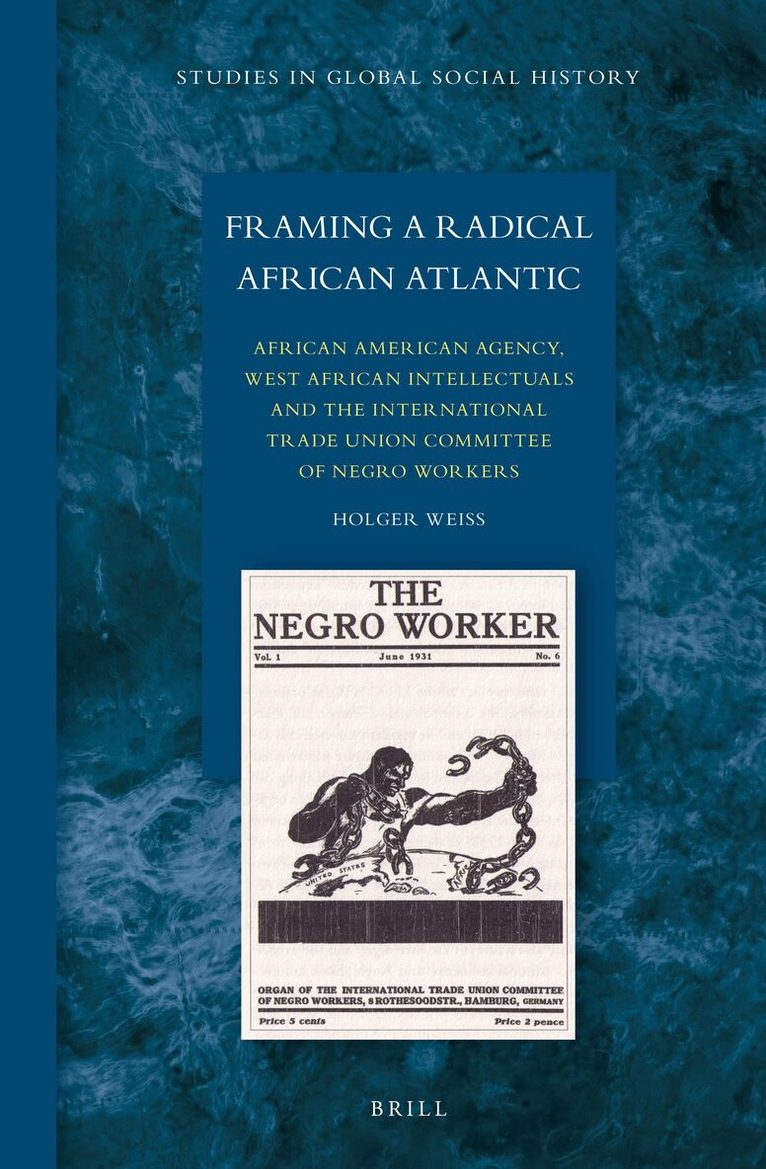
    Framing a Radical African Atlantic

    African American Agency, West African Intellectuals and the International Trade Union Committee of Negro Workers

    AvHolger Weiss

    Inbunden, Engelska, 2013

    Del 14 i serien Studies in Global Social History

    4 205 kr

    Beställningsvara. Skickas inom 5-8 vardagar. Fri frakt över 249 kr.

    Beskrivning

    In Framing a Radical African Atlantic Holger Weiss presents a critical outline and analysis of the International Trade Union Committee of Negro Workers (ITUCNW) and the attempts by the Communist International (Comintern) to establish an anticolonial political platform in the Caribbean and Sub-Saharan Africa during the interwar period. It is the first presentation about the organization and its activities, investigating the background and objectives, the establishment and expansion of a radical African (black) Atlantic network between 1930 and 1933, the crisis in 1933 when the organization was relocated from Hamburg to Paris, the attempt to reactivate the network in 1934 and 1935 and its final dissolution and liquidation in 1937-38.

    Produktinformation

    • Utgivningsdatum:2013-11-12
    • Mått:155 x 235 x 49 mm
    • Vikt:1 294 g
    • Format:Inbunden
    • Språk:Engelska
    • Serie:Studies in Global Social History
    • Antal sidor:752
    • Förlag:Brill
    • ISBN:9789004261631

    Utforska kategorier

    • Sociala och etiska frågor inom Samhälle och politik
    • Etnicitet inom Samhälle och politik
    • Sociologi inom Samhälle och politik

    Mer om författaren

    Holger Weiss, Ph.D. (1997, Helsinki University), is Professor of general history at Åbo Akademi University in Finland. He has published widely on African, global and Atlantic history, including Between Accommodation and Revivalism: Muslims, the State and Society in Ghana from the Precolonial to the Postcolonial Era (Finnish Oriental Society 2008).

    Innehållsförteckning

    • Prologue1. Outlining the plot: The Comintern and the African Atlantic2. Reconstructing the ITUCNW archives3. Categorization and assessment of the ITUCNW material4. Actors on Stage: Identifying Key Activists, their Networks and their WhereaboutsPART ONE: BANKOLEI. The Communist International and the ’Negro Question’1. The contours of a radical cosmopolitan African Atlantic world 2. The Comintern, anti-colonialism and the Negro ThesesII. A Communist Agitator in West Africa? 1. The Making of an African Bolshevik2. The Münzenberg Connection 2.1. Drafting a resolution on the Negro Question2.2. Approaching Casely Hayford and Kobina Sekyi2.3. Meeting Mr. Richards 3. Dreaming about a West African Workers Party and the realities of political activism 3.1. Aborted contacts: The WAFU and the LAI 3.2. Moscow and West Africa – Promises and pitfalls PART TWO: JAMESIII. The Sixth Comintern Congress and the Negro Question1. The establishment of the Negro Bureau2. The establishment of the ITUCNWIV. Moscow 1929-1930: The Negro Bureau, the (Provisional) ITUCNW and the World Negro Workers Conference1. Ford in Western Europe: Critical reflections and practical considerations2. The 1929 Manifesto of the Negro Bureau3. The Negro Bureau and the British Communist Party4. The Negro Bureau, the LAI and the Münzenberg-network5. Focus Africa: Prospects and difficulties6. Organising Africans in Berlin 7. Further criticism: the lack of emphasize in colonial workV. Towards a Global Agenda: The ITUCNW and the World Negro Workers Conference1. Moscow2. First contacts with Africans3. Bleak prospects in Berlin and London4. Caribbean and West African sojourns5. Meanwhile in the USA…6. Instructions and Plan B7. London – Paris – London8. Activating Plan B: Berlin to organize the conference9. Hamburg, eventually…VI. From Hamburg to Moscow and via Berlin back to Hamburg1. The political consequences of the Hamburg Conference2. The Fifth RILU Congress and a new focus for the ITUCNW3. Meetings in Berlin and the outlines of an African agenda4. Any hopes for African radical activism in Western Europe?5. Kouyaté, the LAI and the lack of support to the DSLVN6. The establishment of the RILU Negro Bureau and the Hamburg SecretariatPART THREE: GEORGEVII. The ITUCNW in the RILU- and CI-apparatus, 1930-19331. Visions about a ‘Black International’1.1.A truncated radical African Atlantic?1.2.The end of the Black International1.3.November 1931: Exit Ford, enter Padmore1.4. Frieda Schiff – more than Padmore’s secretary?2. The Hamburg Secretariat within the RILU-apparatus2.1. The RILU Negro Bureau2.2. The February and March 1931 RILU-Instructions to Ford 2.3. The June 1931 Reminder alias the 1931 July Resolution2.4. A new beginning: The October 1931 Resolution 2.5. Further corrections: The December 1932 Resolution2.6. Who pays who: The transfer of money from Moscow via Berlin to Hamburg2.7. Controlling propaganda3. The link between the ITUCNW and the ISH3.1. Two Black Comrades in Hamburg3.2. Working locally, acting globally3.3. The 1932 World Conference of the ISH in Altona 3.4. Comrade Jones: An agent provocateur of the ITUCNW - and the ISH?4. Black assistance to Red Aid 4.1. Connecting people: enlisting participants for IRH congresses4.2. Visions about IRH Sections in Africa4.3. The International Scottsboro Campaign5. Brothers in arms? The ITUCNW and the Münzenberg-network5.1. Wishful thinking: The LAI ‘Goes West Africa’? 5.2. Who represents whom? Ford in the orbit of the Münzenberg Platforms5.3. The Negro Number of the AIZ5.4. Towards a fruitful cooperation? Padmore, the “Münzenberg-Konzern” and the ISH5.5. Students from Africa5.6. Comrade Bilé and the fate of the DSLVN 6. Race or class: Criticizing international solidarity as racial lip-service VIII. The Radical African Atlantic, 1930-1933: Writing Class, Thinking Race1. The establishment of a radical African Atlantic network2. 5000 copies of the Proceedings…3. The Padmore-net, 1931-19333.1. “Our object is … to stimulate the revolutionary spirit of the masses”3.2. Impossible connections: the Belgian and Portuguese African colonies4. Reaching out to West Africa4.1. A revolutionary in Gambia?4.2. The problematic Sierra Leone Connection4.3. Setbacks and new contacts in the Gold Coast 4.4. “Yours sincerely R.B. Wuta-Ofei”4.5. The Nigeria–option: a promising start and disappointing end4.6. Our man in Lagos: I.T.A Wallace-Johnson 4.7. Establishing a radical cell in Liberia4.8. The rise and fall of the West African connection5. The global link: The Negro Worker5.1. From the Negro Worker to the International Negro Workers’ Review and back5.2. “The Negro Worker should be built into a popular mass journal”5.3. Global dissemination, African participation?5.4. The Negro Worker and the activities of the Hamburg Secretariat 6. “Thousands of new connections”: The radical African Atlantic in late 1932PART FOUR: OTTOIX. Mission Impossible? The collapse and rebirth of the radical Atlantic network1. The end of activities in Germany1.1. Escape and Reorganization: From Berlin and Hamburg to Copenhagen and Paris1.2. The yellow trunk1.3. The International Committee for Mutual Aid to Negro Workers2. Exit Padmore, enter Huiswoud 2.1. Still existing: The Negro Worker2.2. The critique2.3. The August 1933 meeting in Paris2.4. “Au revoir”3. The rebirth of the ITUCNW 3.1. The Reorganization of Negro Work: New structures and old tactics3.2. The Crusader News Office in Antwerp3.3. Yet another new beginning: semi-legal existence in Amsterdam3.4. Copenhagen – Harlem: The Negro Worker disguised4. Momentum lost? Renegades, radicals and the Abyssinian campaignX. Our comrades in West Africa1. The rise and fall of the Lagos connection2. The Liberian cell 3. Calling the Toilers in the Gold Coast4. Collaborating with Comrade Wallace-Johnson 5. Comrade Robert and the activities in the Gold Coast6. “Nevertheless, the high level of struggle developed in many recent strikes in the African colonies must be noted”XI. Moscow’s final call – and yet another new start? 1. The never-ending reorganization of Negro work2. Envisioning a radical African Atlantic International3. A redrafted manifesto and an aborted conference4. “Who and what is the ITUCNW remains for the Black colonies almost as much as a mystery as ever”Postscript Index