• Fri frakt över 249 kr
  • •
  • Snabba leveranser
  • •
  • Billiga böcker
Kundservice

Du är på sajten för privatpersoner.

Företag, bibliotek eller offentlig verksamhet?

Du handlar på classic.bokus.com, där alla dina funktioner finns intakta.
Till classic.bokus.com
Bokus logotyp. Gå till startsidan.
  • Erbjudanden
  • Nyheter
  • Student
  • Topplistor
  • Barn & ungdom
  • Bokus Play
  • E-böcker
  • Pocketböcker
  • Spel & pussel

Må bättre, för mindre! Upp till 50% rabatt på hälsoböcker

Sidfot

Mina sidor

    Hjälp

    • Kundservice
    • Vanliga frågor och svar
    • Frakt och leverans
    • Retur vid ångerrätt
    • Reklamera vara
    • Betalning
    • Köpvillkor
    • Allmänna villkor
    • Information om webbplatsens tillgänglighet

    Om Bokus

    • Om oss
    • Pressrum
    • För studenter
    • För företag
    • För bibliotek och offentlig verksamhet
    • För leverantörer
    • Hållbarhet

    Populärt

    • Aktuella erbjudanden
    • Presentkort
    • Studentlitteratur
    • Nya böcker
    • Topplistor
    • Signerade böcker
    • Engelska böcker

    Inspiration

    • Boktips
    • BookTok
    • Populära bokserier
    • Barnbokskaraktärer
    • Populära författare
    Logotyp för Bokus
    Följ oss på Facebook (extern länk)Följ oss på Instagram (extern länk)Följ oss på YouTube (extern länk)Följ oss på TikTok (extern länk)
    bokus @ CookiesAnpassa cookiesIntegritetspolicyKöpvillkor
    Till Citymail hemsida (extern länk)Till Budbee hemsida (extern länk)Till Postnord hemsida (extern länk)Till Schenker hemsida (extern länk)Till Early Bird hemsida (extern länk)Till Walleys hemsida (extern länk)
    1. Historia och arkeologi
    2. Historia
    3. Europas historia

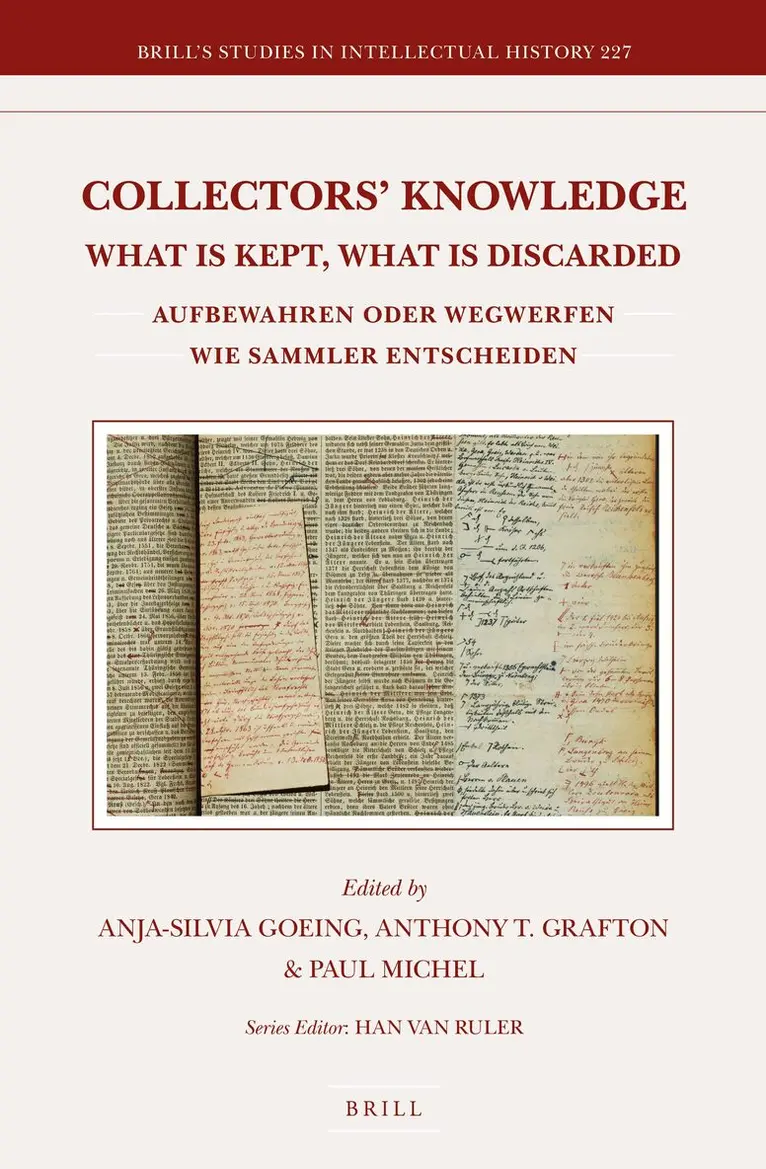
    Collectors’ Knowledge: What Is Kept, What Is Discarded / Aufbewahren oder wegwerfen: wie Sammler entscheiden

    AvAnja-Silvia Goeing

    Inbunden, Engelska, 2013

    Del 227 i serien Brill's Studies in Intellectual History

    2 810 kr

    Beställningsvara. Skickas inom 5-8 vardagar. Fri frakt över 249 kr.

    Beskrivning

    Drawing on case studies from the thirteenth to the twentieth centuries, covering Europe and beyond, Collectors’ Knowledge: What is Kept, What is Discarded investigates how knowledge was acquired, organized and sometimes lost. It examines collections of texts and objects—libraries, textbooks, miscellanies, commonplace books, data collections pertaining to historical events, encyclopedias, royal and ducal treasures, curiosity cabinets, galleries and museums—to uncover the processes of accumulation, organization, selection and rejection that have shaped learning. The essays emphasize the complex relationship between the intentions of collectors and the limitations they encountered—issues of format, presentation, display and storage—as well as outside forces that disrupted their aims, including pillage and natural disasters.Contributors include: Stephen Bann, Laurence Brockliss, François de Capitani, Livia Cárdenas, Steven Conn, Anja-Silvia Goeing, Anthony T. Grafton, Janet Grau, Jürgen Leonhardt, Ulrich Marzolph, Paul Michel, Jürgen Oelkers, Wilhelm Schmidt-Biggemann, Nicola Schneider, Gerald Schwedler, Iolanda Ventura, Monika Wicki, and Marc Winter.Achtzehn europäische und aussereuropäische Fallstudien vom dreizehnten bis zwanzigsten Jahrhundert fragen in “Collectors’ Knowledge: What Is Kept, What Is Discarded – Aufbewahren oder wegwerfen – wie Sammler entscheiden”, wie Wissen erworben und organisiert wurde und weshalb es verloren ging. Die Autoren untersuchen Sammlungen von Texten und Objekten – Bibliotheken, Lehrbücher, Sammelbände, Datensammlungen im Zusammenhang mit historischen Ereignissen, Enzyklopädien, herrschaftliche Schätze, Wunderkammern und Museen. Ihr Ziel ist es, Prozesse der Akkumulation, Organisation, Auswahl und Ablehnung aufzudecken, die unser Wissen über die Epochen geprägt haben. Die Aufsätze unterstreichen die komplexen Beziehungen zwischen den Absichten der Sammler und den Zwängen, mit denen sie konfrontiert waren – in Fragen des Formates, der Präsentation oder Speicherung –, sowie den Kräften, die Verluste bewirkten, beispielsweise Plünderung oder ideengeschichtliche Umwälzungen.

    Produktinformation

    • Utgivningsdatum:2013-10-17
    • Mått:155 x 235 x 32 mm
    • Vikt:874 g
    • Format:Inbunden
    • Språk:Engelska, Tyska
    • Serie:Brill's Studies in Intellectual History
    • Antal sidor:464
    • Förlag:Brill
    • ISBN:9789004262140

    Utforska kategorier

    • Europas historia inom Historia och arkeologi
    • Kulturvetenskap inom Samhälle och politik

    Mer om författaren

    Anja-Silvia Goeing is anniversary fellow at Northumbria University in Newcastle upon Tyne and Privatdozent at the University of Zurich. She is currently preparing a book on practices of knowledge transfer at the Zurich lectorium in the sixteenth century. Her work includes studies on fifteenth-century biographies written about the Italian Humanist Vittorino da Feltre (1999; 2013).Anthony T. Grafton is Henry Putnam University Professor of History at Princeton University. His interests comprise humanist scholarship and the writing of history in early modern times. Recent publications relating to this volume include a collaborative study of Isaac Casaubon as reader of Hebrew texts (2011) and a collection of early visualizations of timelines: Daniel Rosenberg and Anthony Grafton, Cartographies of Time (2012).Paul Michel is Professor Emeritus of German Literature to 1700 at the University of Zurich. His research focuses on the study of encyclopedias and the organization of knowledge. His latest monograph, Physikotheologie was published in 2008.

    Innehållsförteckning

    • Preface – VorwortAcknowledgements – DanksagungenINTRODUCTION – EINLEITUNGQuestions Framing the Research – Fragen an das Forschungsgebiet, Anja-Silvia Goeing, Anthony T. Grafton, Paul Michel PHENOMENOLOGY – PHÄNOMENOLOGIEErzählen und Sammeln: einige phänomenologische Erwägungen, Wilhelm Schmidt-Biggemann NON-WESTERN CONTEXTS – NICHTWESTLICHE KONTEXTECoining the Essentials: Arabic Encyclopaedias and Anthologies of the Pre-modern Period, Ulrich MarzolphDie Hoheit über die Erinnerung – Der Herrscher und das Erinnern in China, Marc Winter MIDDLE AGES AND TRANSITIONS TO EARLY MODERN TIMES – MITTELALTER UND ÜBERGÄNGE ZUR FRÜHEN NEUZEITLethe and ‘Delete’ – Discarding the Past in the Early Middle Ages: The case of Fredegar, Gerald SchwedlerChanging Representations of Botany in Encyclopaedias from the Middle Ages to the Renaissance, Iolanda Ventura‘I wasted time, and now doth time waste me’: Chronologers as Collectors, Anthony T. GraftonKollektionskataloge des Heiligen: Reliquiensammlungen im Bild, Livia CárdenasHumanistisches Weltwissen: Die Lectionum antiquarum libri des Caelius Rhodiginus, Jürgen LeonhardtEARLY MODERN TIMES – FRÜHE NEUZEITStoring to Know: Konrad Gessner’s De Anima and the Relationship between Textbooks and Citation Collections in Sixteenth-Century Europe, Anja-Silvia GoeingWissensdynamik an Hand von Lehrmitteln im katechetischen Unterricht, Jürgen OelkersGetilgtes Wissen: Gotthard Heideggers Über¬arbeitung der »Acerra philologica«, Paul MichelForming and Displaying a Collection in the Age of the Enlightenment: The Case of Esprit Calvet, Laurence Brockliss 19TH TO 21ST CENTURIES – 19.-21. JAHRHUNDERTFallstricke des Wissens: die Überlieferung der materiellen Kultur im Spiegel des Geschichtsbildes, François de Capitani (†)Museums by Commerce, Museums of Commerce, Museums for Commerce, Steven ConnKaum ein Wort: Tabuisierung von Inhalten und Fokussierung auf die Disziplin als Strategien der Wissensverarbeitung, Monika T. WickiThe Losses of the Music Collection of the Hessische Landesbibliothek in Darmstadt in 1944: A Case Study on the Failure to Safeguard Historical Library Holdings, Nicola SchneiderRESPONSEResponse, Stephen Bann EPILOGUE: THE PRESENCE OF MEMORY – EPILOG: DIE GEGENWART DER ERINNERUNGPublic Attic – ausgestellter speicher, Janet Grau Selected Bibliography – AuswahlbibliographiePicture and Table Index – Bild- und TabellennachweisNotes on Contributors – Über die BeiträgerName Index – Namensregister