• Fri frakt över 249 kr
  • •
  • Snabba leveranser
  • •
  • Billiga böcker
Kundservice

Du är på sajten för privatpersoner.

Företag, bibliotek eller offentlig verksamhet?

Du handlar på classic.bokus.com, där alla dina funktioner finns intakta.
Till classic.bokus.com
Bokus logotyp. Gå till startsidan.
  • Erbjudanden
  • Student
  • Topplistor
  • Barn & ungdom
  • Bokus Play
  • E-böcker
  • Ljudböcker
  • Pocketböcker
  • Spel & pussel

10% rabatt på allt med kod NYSTART10 →

Sidfot

Mina sidor

    Hjälp

    • Kundservice
    • Vanliga frågor och svar
    • Frakt och leverans
    • Retur vid ångerrätt
    • Reklamera vara
    • Betalning
    • Köpvillkor
    • Allmänna villkor
    • Information om webbplatsens tillgänglighet

    Om Bokus

    • Om oss
    • Pressrum
    • För studenter
    • För företag
    • För bibliotek och offentlig verksamhet
    • För leverantörer
    • Hållbarhet

    Populärt

    • Aktuella erbjudanden
    • Presentkort
    • Studentlitteratur
    • Nya böcker
    • Topplistor
    • Signerade böcker
    • Engelska böcker

    Inspiration

    • Boktips
    • BookTok
    • Populära bokserier
    • Barnbokskaraktärer
    • Populära författare
    Logotyp för Bokus
    Följ oss på Facebook (extern länk)Följ oss på Instagram (extern länk)Följ oss på YouTube (extern länk)Följ oss på TikTok (extern länk)
    bokus @ CookiesAnpassa cookiesIntegritetspolicyKöpvillkor
    Till Citymail hemsida (extern länk)Till Budbee hemsida (extern länk)Till Postnord hemsida (extern länk)Till Schenker hemsida (extern länk)Till Early Bird hemsida (extern länk)Till Walleys hemsida (extern länk)
    1. Ekonomi och Ledarskap
    2. Nationalekonomi
    3. Ekonomisk historia

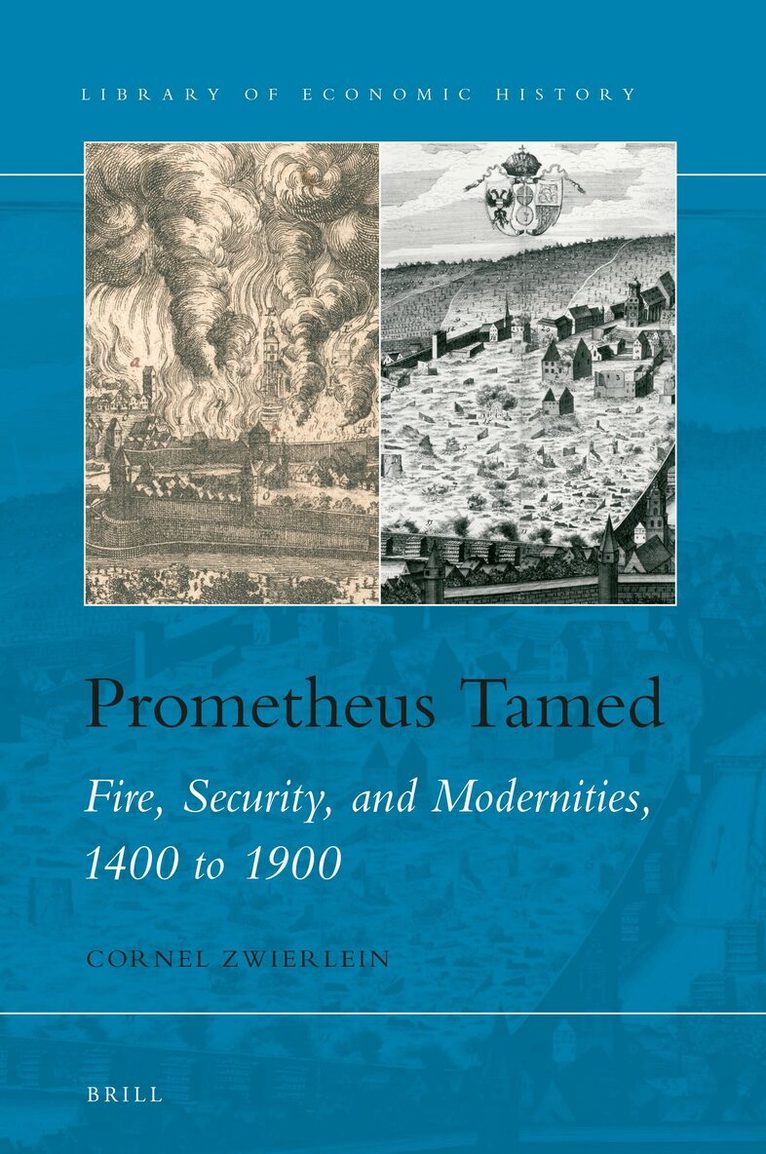
    Prometheus Tamed

    Fire, Security, and Modernities, 1400 to 1900

    AvCornel Zwierlein

    Inbunden, Engelska, 2021

    Del 13 i serien Library of Economic History

    2 489 kr

    Beställningsvara. Skickas inom 5-8 vardagar. Fri frakt över 249 kr.

    Beskrivning

    Over 8,200 large city fires broke out between 1000 and 1939 CE in Central Europe. Prometheus Tamed inquires into the long-term history of that fire ecology, its local and regional frequencies, its relationship to climate history. It asks for the visual and narrative representation of that threat in every-day life. Institutional forms of fire insurance emerged in the form of private joint stock companies (the British model, starting in 1681) or in the form of cameralist fire insurances (the German model, starting in 1676). They contributed to shape and change society, transforming old communities of charitable solidarity into risk communities, finally supplemented by networks of cosmopolite aid. After 1830, insurance agencies expanded tremendously quickly all over the globe: Cultural clashes of Western and native perceptions of fire risk and of what is insurance can be studied as part of a critical archaeology of world risk society and the plurality of modernities.

    Produktinformation

    • Utgivningsdatum:2021-01-07
    • Mått:155 x 235 x 33 mm
    • Vikt:1 163 g
    • Format:Inbunden
    • Språk:Engelska
    • Serie:Library of Economic History
    • Antal sidor:548
    • Förlag:Brill
    • ISBN:9789004424128

    Utforska kategorier

    • Ekonomisk historia inom Ekonomi och Ledarskap
    • Miljövetenskap och miljöpolitik inom Naturvetenskap och teknik
    • Regional planering inom Naturvetenskap och teknik

    Mer om författaren

    Cornel Zwierlein, Ph.D. (2003) University of Munich (LMU) and the CESR Tours is currently on a Heisenberg-Stelle at the Friedrich-Meinecke-Institut, FU Berlin. Before he was w1-Prof. 2008-2017. He holds the Habilitation (Privatdozent) at RUB Bochum (2011/3), was Fellow at the History Department, Harvard University 2013-2015, Associate there 2016, 2018, CRASSH Cambridge 2014, Max-Weber-Kolleg Erfurt 2017/18. His monographs include: Discorso and Lex Dei (French Wars of Religion, Vandenhoeck & Ruprecht: 2006), The Political Thought of the French League and Rome, 1585-1589 (Droz: 2016) and Imperial Unknowns. The French and the British in the Mediterranean, 1650-1750 (Cambridge UP, 2016/8).

    Innehållsförteckning

    • AcknowledgementsList of Figures and Tables1 Introduction2 Spaces, Value, Presentism: Premodern Insurance1 The Commercial Communication System around 14002 Insurance as an Accounting Trick between the World of Nature and the World of Values3 Premiums of Presentism: Hidden Forces within the History of Law4 International Trade Law and Insurance as an Achievement of the Moderni5 Summary3 The Danger between Nature and Culture: The Quotidian Threat of Urban Fires in the Premodern Era1 The “Reality” of the Danger: Fire Cycles, Fire Frequencies1.1 The “Fire Gap”1.2 8,200 Fires in Germany and Austria1.3 Trends in Fire Frequencies According to Fire Insurance Statistics1.4 War and Fire Trends1.5 Climate and Fire Trends1.6 The Fire Ecology of Hamburg1.7 Summary2 The Perception of Danger2.1 The Theology of Divine Punishment and the Fire Events of the Seventeenth and Eighteenth Centuries: Security Losses, Security Gains2.2 Visualization and Affect2.2.1 The Modernity of City Fire Images and Their Dutch Provenance2.2.2 A Discrepancy: Mythological/Biblical City Fire Paintings vs. the Low Number/Quality of Paintings of “Real” City Fires2.2.3 Early Modern Image Theory and Disaster Images2.2.4 Temporalization, Eventfulness and Affect Control2.2.5 Threat Perception, Security Requirements, and Emotionalization2.3 Ground Zeros: Visualization and Time Horizons3 Developmental Trends of “Real-Assecuration”: Fire Policey, Construction3.1 The Security Regimes between the Late Middle Ages and the Enlightenment and between the City and the Territories3.1.1 Cologne: An Important Medieval Imperial City3.1.2 The German Center of Security Innovations: Hamburg3.1.3 The State’s “Images” of the City Collective: An Approach to Disaster Memory and to Learning from Disaster (e.g., Prussia)3.2 Panaceas: from “Local Knowledge” to Science and Back Again to Popular Enlightenment4 Summary4 The Epochal Threshold of the Security Regimes 1680–17001 Laboratories of Innovation: Hamburg and Berlin---1680–17001.1 London: Nicholas Barbon1.1.1 Protostatistics, Protoprobabilistic Reasoning, and the Conflict between State and Private Economies1.1.2 Nicholas Barbon: Building Speculator and Growth Theorist1.1.3 Insurance Innovation and the “Financial Revolution”1.2 Hamburg and Leibniz1.2.1 The Hamburg General Fire Fund: Innovation without an Inventor1.2.2 Transformation into an Element of Economic Provisioning: Leibniz1.2.2.1 Before Leibniz: The Rulership Contract and Disaster Insurance around 16001.2.2.2 Leibniz and the Territorial Institutionalization of Insurance1.2.2.3 “Real-Assecuration”: The Founding of the Berlin Academy and Fire Association1.3 Summary: The Power of Analogies2 Religious Culture and “Insurance”2.1 Max Weber, the Protestant Ethic, Calvin(ism), and Economics2.2 A Historiographical Gap: Insuring and Religious Denominations2.3 Insurance History and Protestantism: The Search for Evidence5 The Emergence of the Normal Secure Society1 Insurance and Social Structures1.1 Collective Solidarity: from Risk Communities to Cosmopolitical Aid in the Eighteenth and Nineteenth Centuries1.2 Insurance as Emerging from Notions of Social Contract and Moral Duty2 State and Society in the Code of Numbers3 Time Instead of Space: Sustainability and Insurance6 The Globalization of Safety Regimes: The Return of Space1 Hamburg2 Istanbul3 Bombay/Calcutta4 China5 USA/New York6 Comparative Analysis7 ConclusionAppendix 1 Academic Legal Treatises and Dissertations on the Assecuratio (in Chronological Order)Appendix 2 Chronological List of Cameralist Fire Insurance Foundations in GermanyAppendix 3 Cameralist Treatises of Brandkassen and InsurancesSources and LiteratureIndex LocorumIndex NominumIndex Rerum