• Fri frakt över 249 kr
  • •
  • Snabba leveranser
  • •
  • Billiga böcker
Kundservice

Du är på sajten för privatpersoner.

Företag, bibliotek eller offentlig verksamhet?

Du handlar på classic.bokus.com, där alla dina funktioner finns intakta.
Till classic.bokus.com
Bokus logotyp. Gå till startsidan.
  • Erbjudanden
  • Nyheter
  • Student
  • Topplistor
  • Barn & ungdom
  • Bokus Play
  • E-böcker
  • Pocketböcker
  • Spel & pussel

10% rabatt på allt med kod: NYSTART10 →

Sidfot

Mina sidor

    Hjälp

    • Kundservice
    • Vanliga frågor och svar
    • Frakt och leverans
    • Retur vid ångerrätt
    • Reklamera vara
    • Betalning
    • Köpvillkor
    • Allmänna villkor
    • Information om webbplatsens tillgänglighet

    Om Bokus

    • Om oss
    • Pressrum
    • För studenter
    • För företag
    • För bibliotek och offentlig verksamhet
    • För leverantörer
    • Hållbarhet

    Populärt

    • Aktuella erbjudanden
    • Presentkort
    • Studentlitteratur
    • Nya böcker
    • Topplistor
    • Signerade böcker
    • Engelska böcker

    Inspiration

    • Boktips
    • BookTok
    • Populära bokserier
    • Barnbokskaraktärer
    • Populära författare
    Logotyp för Bokus
    Följ oss på Facebook (extern länk)Följ oss på Instagram (extern länk)Följ oss på YouTube (extern länk)Följ oss på TikTok (extern länk)
    bokus @ CookiesAnpassa cookiesIntegritetspolicyKöpvillkor
    Till Citymail hemsida (extern länk)Till Budbee hemsida (extern länk)Till Postnord hemsida (extern länk)Till Schenker hemsida (extern länk)Till Early Bird hemsida (extern länk)Till Walleys hemsida (extern länk)
    1. Naturvetenskap och teknik
    2. Matematik och naturvetenskap
    3. Naturvetenskap:allmänt
    4. Naturvetenskapens historia

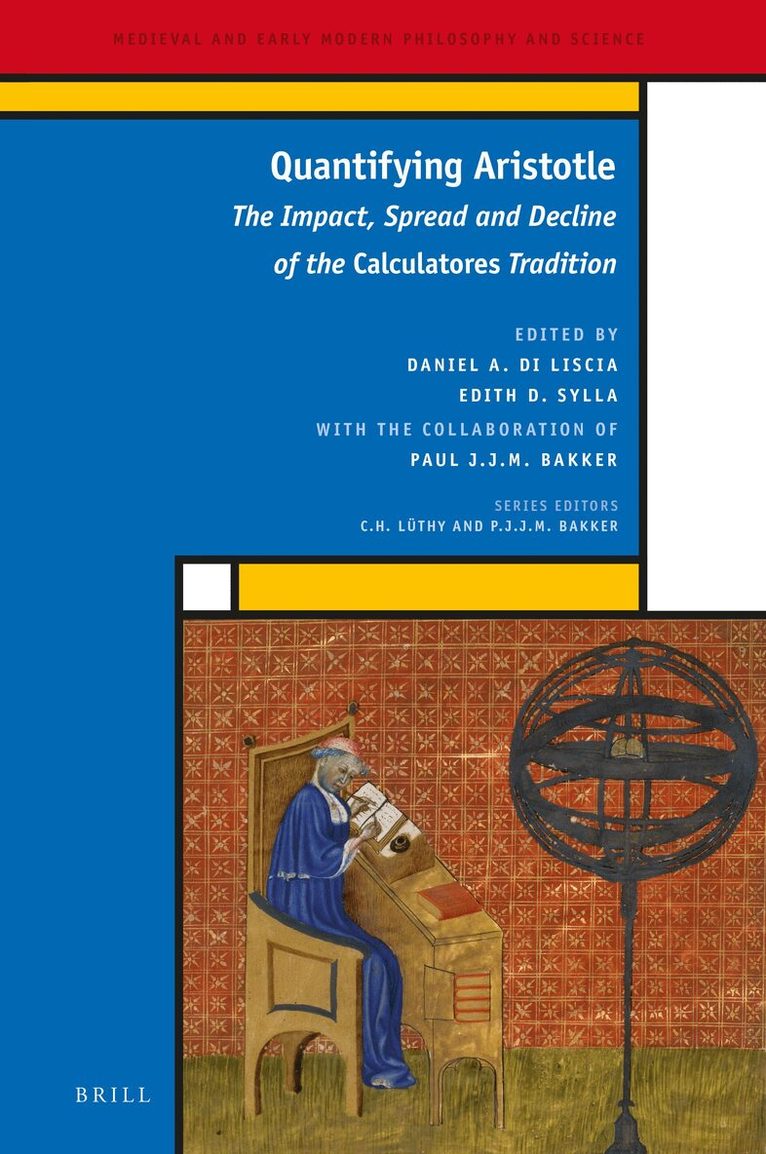
    Quantifying Aristotle

    The Impact, Spread and Decline of the Calculatores Tradition

    AvDaniel A. Di Liscia

    Inbunden, Engelska, 2022

    Del 34 i serien Medieval and Early Modern Philosophy and Science

    2 678 kr

    Beställningsvara. Skickas inom 5-8 vardagar. Fri frakt över 249 kr.

    Beskrivning

    Aristotelian philosophy is generally regarded as incompatible with the mathematical methods and principles that form the basis of modern science. This book offers an entirely new perspective on this presumed incompatibility. It surveys the tradition of the Oxford Calculators from its beginnings in the fourteenth century until Leibniz and the philosophy of the seventeenth century and explores how the Calculators' techniques of quantification expanded the conceptual and methodological limits of Aristotelianism. In the process, it examines a large number of authors, some of them never studied in this context. Exploring the relationship between various late medieval disciplines, the book sheds new light on the problem of continuity vs. discontinuity between scholasticism and modern science. Beyond its historiographical purpose, this book also hopes to be a source of inspiration for present-day philosophers of science.

    Produktinformation

    • Utgivningsdatum:2022-06-02
    • Mått:155 x 235 x 37 mm
    • Vikt:943 g
    • Format:Inbunden
    • Språk:Engelska
    • Serie:Medieval and Early Modern Philosophy and Science
    • Antal sidor:480
    • Förlag:Brill
    • ISBN:9789004499829

    Utforska kategorier

    • Naturvetenskapens historia inom Naturvetenskap och teknik
    • Filosofi inom Filosofi och religion

    Mer om författaren

    Daniel A. Di Liscia (Ph.D. 2003), is Lecturer at the Ludwig-Maximilians-Universität München (Germany), at the Munich Center for Mathematical Philosophy. He worked on the edition of Copernicus and Kepler, and published several papers on the Oxford Calculators, in particular on the latitude of forms. Edith D. Sylla (Ph.D. 1971) is Professor Emerita at North Carolina State University (Raleigh, North Carolina). She works on the history of mathematics, physics, and their interrelations from the late Middle Ages to the early eighteenth century.

    Innehållsförteckning

    • AcknowledgementsList of FiguresNotes on ContributorsIntroductionDaniel A. Di Liscia1 Thomas Wylton on the Ceasing of an Instant of TimeCecilia Trifogli2 The New Interpretation of Aristotle: Richard Kilvington, Thomas Bradwardine, and the New Rule of MotionElżbieta Jung3 The Opuscula de motu Ascribed to Richard Swineshead: The Testimony of the Ongoing Development of the Oxford Calculators’ Science of MotionRobert Podkoński4 Calculations in Thomas Bradwardine’s De causa dei, Book IEdit Anna Lukács5 The Calculators on the Insolubles: Bradwardine, Kilvington, Heytesbury, Swyneshed, and DumbletonStephen Read6 The Influence of the Oxford Calculatores on the Understanding of Local Motion: The Example of the Tractatus de sex inconvenientibusSabine Rommevaux-Tani7 Wyclif, the Black Sheep of the Oxford CalculatorsMark Thakkar8 On the Reception of English Logic at Universities of Central Europe: Helmoldus de Zoltwedel (Prague, Leipzig) on the Liar-ParadoxHarald Berger9 Blasius of Parma on the Calculation of the Variation of Qualities and Aristotelian PhysicsJoël Biard10 The Calculators Tradition in Oresme’s De visione stellarumAníbal Szapiro11 Perfections and Latitudes: The Development of the Calculators’ Tradition and the Geometrisation of Metaphysics and TheologyDaniel A. Di Liscia12 Decline of the Calculators in Paris c. 1500: Humanism and PrintRichard Oosterhoff13 Some Aspects of the ‘Rules’ of motus difformis in Angelo da Fossambruno’s Commentary on Heytesbury’s De tribus praedicamentisFabio Seller14 Leibniz and the CalculatorsEdith Dudley SyllaManuscriptsBibliographyIndex Nominum