• Fri frakt över 249 kr
  • •
  • Snabba leveranser
  • •
  • Billiga böcker
Kundservice

Du är på sajten för privatpersoner.

Företag, bibliotek eller offentlig verksamhet?

Du handlar på classic.bokus.com, där alla dina funktioner finns intakta.
Till classic.bokus.com
Bokus logotyp. Gå till startsidan.
  • Erbjudanden
  • Nyheter
  • Student
  • Topplistor
  • Barn & ungdom
  • Bokus Play
  • E-böcker
  • Pocketböcker
  • Spel & pussel

10% rabatt på allt med kod: NYSTART10 →

Sidfot

Mina sidor

    Hjälp

    • Kundservice
    • Vanliga frågor och svar
    • Frakt och leverans
    • Retur vid ångerrätt
    • Reklamera vara
    • Betalning
    • Köpvillkor
    • Allmänna villkor
    • Information om webbplatsens tillgänglighet

    Om Bokus

    • Om oss
    • Pressrum
    • För studenter
    • För företag
    • För bibliotek och offentlig verksamhet
    • För leverantörer
    • Hållbarhet

    Populärt

    • Aktuella erbjudanden
    • Presentkort
    • Studentlitteratur
    • Nya böcker
    • Topplistor
    • Signerade böcker
    • Engelska böcker

    Inspiration

    • Boktips
    • BookTok
    • Populära bokserier
    • Barnbokskaraktärer
    • Populära författare
    Logotyp för Bokus
    Följ oss på Facebook (extern länk)Följ oss på Instagram (extern länk)Följ oss på YouTube (extern länk)Följ oss på TikTok (extern länk)
    bokus @ CookiesAnpassa cookiesIntegritetspolicyKöpvillkor
    Till Citymail hemsida (extern länk)Till Budbee hemsida (extern länk)Till Postnord hemsida (extern länk)Till Schenker hemsida (extern länk)Till Early Bird hemsida (extern länk)Till Walleys hemsida (extern länk)
    1. Språk och ordböcker
    2. Språk: referensverk och allmänt
    3. Skrivande och redigering

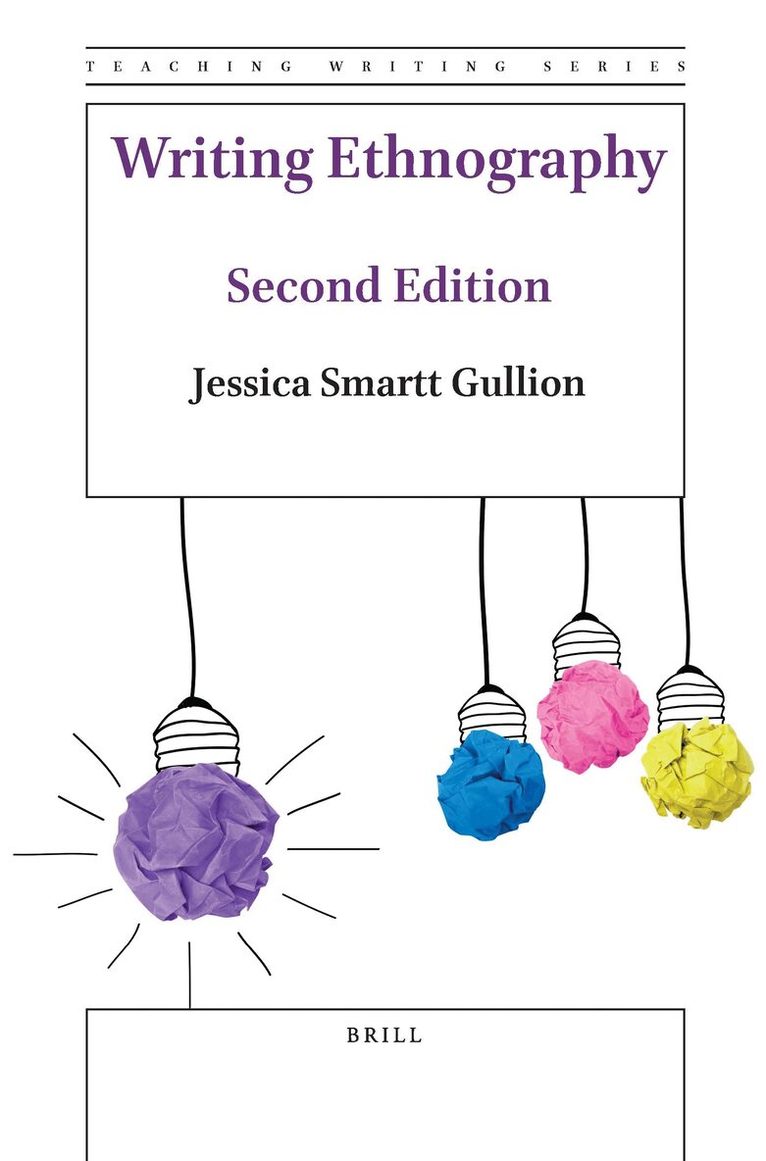
    Writing Ethnography (Second Edition)

    AvJessica Smartt Gullion

    Inbunden, Engelska, 2021

    Del 9 i serien Teaching Writing

    1 302 kr

    Beställningsvara. Skickas inom 5-8 vardagar. Fri frakt över 249 kr.

    Fler format och utgåvor

    Häftad

    445 kr

    Beskrivning

    Ethnographers spend a tremendous amount of time in the field, collecting all sorts of empirical material—but how do they turn their work into books or articles that people actually want to read? This concise, engaging guide will help academic writers at all levels to write better. Manyethnography textbooks focus more on the ‘ethno’ portion of our craft, and less on developing our ‘graph’ skills. Gullion fills that gap, helping ethnographers write compelling, authentic stories about their fieldwork. From putting the first few words on the page, to developing a plot line, to publishing, Writing Ethnography offers guidance for all stages of the writing process.

    Produktinformation

    • Utgivningsdatum:2021-11-25
    • Mått:155 x 235 x 10 mm
    • Vikt:366 g
    • Format:Inbunden
    • Språk:Engelska
    • Serie:Teaching Writing
    • Antal sidor:128
    • Upplaga:2
    • Förlag:Brill
    • ISBN:9789004508088

    Utforska kategorier

    • Skrivande och redigering inom Språk och ordböcker
    • Sociologi inom Samhälle och politik
    • Antropologi inom Samhälle och politik

    Mer om författaren

    Jessica Smartt Gullion, PhD (2002), Texas Woman’s University, is the Associate Dean of Research for the College of Arts and Sciences at that university. She has written extensively on ethnography, including Diffractive Ethnography (Routledge, 2018), and the forthcoming Doing Ethnography (Guilford).

    Recensioner i media

    "Jessica Smartt Gullion writes with conversational, reader-friendly prose about the craft and art of scholarly storytelling. She expertly demonstrates how to follow the essential rules of academic writing and how and when to break them. Dr. Gullion titles her work with 'ethnography,' but the pragmatic guidance in this book also applies to other genres of qualitative inquiry such as phenomenology, case study, grounded theory, and autoethnography. This is an essential resource for novice and veteran researchers to enhance their written documentation of fieldwork, and an ideal textbook for courses and workshops in scholarly composition." – Johnny Saldaña, Professor Emeritus, Arizona State University, author of The Coding Manual for Qualitative Researchers (now in its fourth edition) and co-author of Qualitative Research: Analyzing Life (second edition)"Ethnographic fields are contested territories and terrains because even as we ethnographers work and live in our fields, we carry them with us wherever we go—in our notes, memories, dreams, reveries, and bodies. We shuttle between here and there and here. We try to translate between the ethnographic moments when and where we saw, heard, felt and the ethnographic presents, when and where we are seeing, hearing, and feeling, presently. Many things are lost, but much newness is found in these temporal and geographical crossings. Ethnographic writing is nothing if not an unruly dance, an orchestral attempt to write in-between these crossings, an attempt to untangle, in text or performance, what was experienced, what is remembered, and what is to be written, in the ‘now.’ It is a kind of writing that is always answering what I believe are two questions that ethnographers like Jessica Smartt Gullion are committed to—how to tell this story? And how to tell it well? In Writing Ethnography, Gullion takes on the daunting task of how such a dance can be led and be led with care and rigor. I highly recommend this book to any student and practitioner of the ethnographic method. It is much needed and essential." – Devika Chawla, Professor of Communication Studies, Ohio University and editor-in-chief of Departures in Critical Qualitative Research"Writing Ethnography is engaging and accessible, yet still grounded in solid scholarship—the essence of good public scholarship. Gullion makes the mysterious process of writing a lot less mysterious, and actually quite straightforward. She does this, in part, by sharing her own relationship with writing, including the banes of every writer—panic, writer’s block, and the academic’s desire to sound smart which often obscures the whole point of sharing the research. She also fills the book with concrete examples, suggested approaches, and practical advice. The new edition includes an expanded and extremely useful section on editing (the most disregarded phase of writing). A particular strength of the book is that Gullion speaks to the reader directly, creating a connection that functions much like a trusted friend. Her generous spirit spills off the page. She includes writing prompts that help the reader to make concrete connections to the points she is making. Finally, and perhaps most importantly, Gullion emphasizes that all research, especially ethnography, is basically about telling stories that matter. After all, as Thomas King reminds us, the truth about stories is that’s all we are." – Rosemary C. Reilly, PhD, Full Professor in the Department of Applied Human Sciences, Concordia University, Montreal"Jessica Smartt Gullion’s Writing Ethnography is a valuable resource not only in my dance ethnography classes, but also in my work with MA and PhD students at the thesis and dissertation writing stage. The book provides pithy guidance for graduate students and emerging scholars for transforming their data into prose that transports readers into the field sites, bringing research participants to life on the page. Writing Ethnography is a beautiful and accessible primer on how to ‘show, don’t tell,’ and produce polished, publishable work." – Rosemary Candelario, PhD, Associate Professor of Dance, Texas Woman’s University and co-editor of the forthcoming book Dance Research

    Innehållsförteckning

    • AcknowledgmentsList of FiguresAbout the AuthorIntroduction1 Changes from the First Edition1 On Ethnography1 A (Very) Brief History of Ethnography2 Why Ethnography?3 Ethical Issues in Ethnographic Writing4 Fieldnotes2 On Storytelling1 Types of Tales2 Creative Nonfijiction in Ethnography3 What Makes a Story Great?4 Story Arcs5 Vignettes6 Evocative Storytelling7 Vulnerability in Writing8 Reflexivity and Difffraction3 On Technical Considerations1 Writing Rituals2 Academic Fanfijiction3 The Art of the Sentence4 First, Second, or Third Person5 Active/Passive6 The Trouble with Adverbs7 Audience8 Show, Don’t Tell9 Voice10 Writing the Voices of Our Participants11 Characters12 Conversations13 Metaphorically Speaking14 Integrating the Literature4 On Refinement1 Editing2 On Sounding Smart3 What to Call This Thing?5 On Writing as Process1 Getting Started2 Writing as Process3 Writing as Inquiry4 Doing the Unstuck5 The Panic Attack6 Framing and Publishing7 Revise and Resubmit8 Writing to Connect, Writing for Social ChangeAppendix: Writing PromptsReferencesIndex