• Fri frakt över 249 kr
  • •
  • Snabba leveranser
  • •
  • Billiga böcker
Kundservice

Du är på sajten för privatpersoner.

Företag, bibliotek eller offentlig verksamhet?

Du handlar på classic.bokus.com, där alla dina funktioner finns intakta.
Till classic.bokus.com
Bokus logotyp. Gå till startsidan.
  • Erbjudanden
  • Nyheter
  • Student
  • Topplistor
  • Barn & ungdom
  • Bokus Play
  • E-böcker
  • Pocketböcker
  • Spel & pussel

10% rabatt på allt med kod: NYSTART10 →

Sidfot

Mina sidor

    Hjälp

    • Kundservice
    • Vanliga frågor och svar
    • Frakt och leverans
    • Retur vid ångerrätt
    • Reklamera vara
    • Betalning
    • Köpvillkor
    • Allmänna villkor
    • Information om webbplatsens tillgänglighet

    Om Bokus

    • Om oss
    • Pressrum
    • För studenter
    • För företag
    • För bibliotek och offentlig verksamhet
    • För leverantörer
    • Hållbarhet

    Populärt

    • Aktuella erbjudanden
    • Presentkort
    • Studentlitteratur
    • Nya böcker
    • Topplistor
    • Signerade böcker
    • Engelska böcker

    Inspiration

    • Boktips
    • BookTok
    • Populära bokserier
    • Barnbokskaraktärer
    • Populära författare
    Logotyp för Bokus
    Följ oss på Facebook (extern länk)Följ oss på Instagram (extern länk)Följ oss på YouTube (extern länk)Följ oss på TikTok (extern länk)
    bokus @ CookiesAnpassa cookiesIntegritetspolicyKöpvillkor
    Till Citymail hemsida (extern länk)Till Budbee hemsida (extern länk)Till Postnord hemsida (extern länk)Till Schenker hemsida (extern länk)Till Early Bird hemsida (extern länk)Till Walleys hemsida (extern länk)
    1. Historia och arkeologi
    2. Historia
    3. Militärhistoria
    4. Tidigmodern militärhistoria

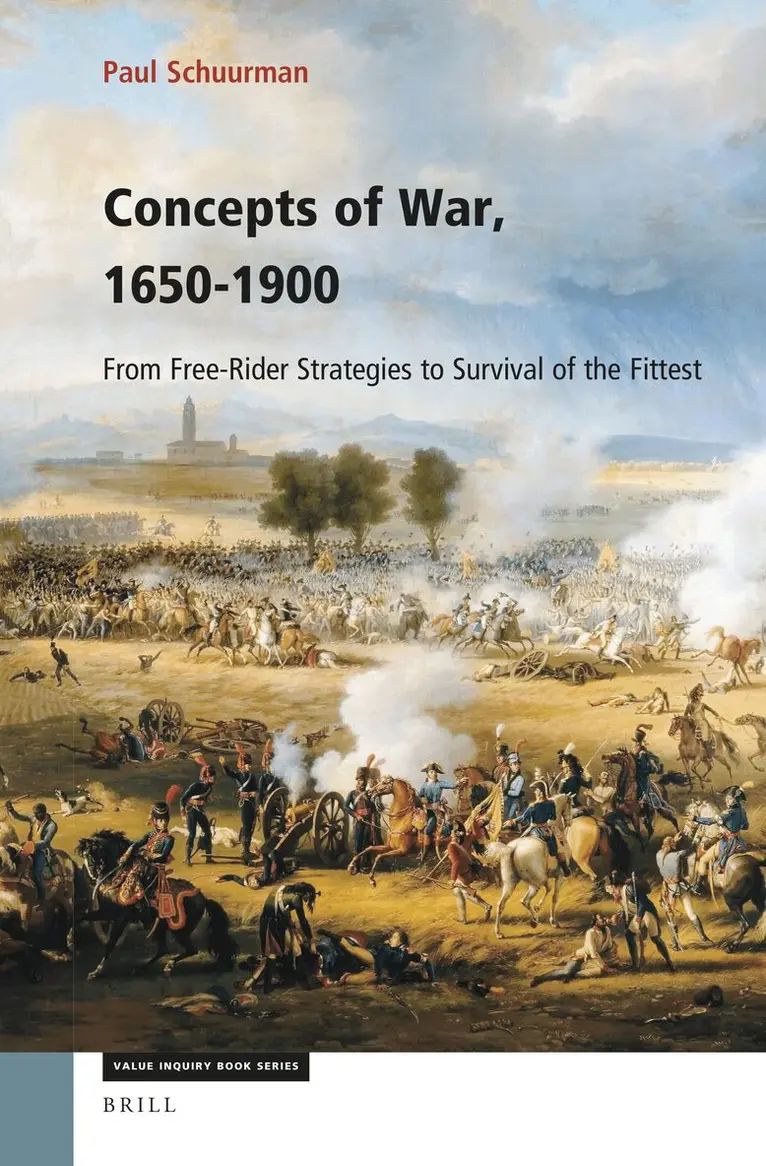
    Concepts of War, 1650-1900

    From Free-Rider Strategies to Survival of the Fittest

    AvPaul Schuurman

    Inbunden, Engelska, 2023

    Del 383 i serien Studies in the History of Western Philosophy

    2 501 kr

    Beställningsvara. Skickas inom 5-8 vardagar. Fri frakt över 249 kr.

    Beskrivning

    Why do people wage war? How can wars be won? How has warfare been an engine of change for human civilization—for better and for worse? In this book Paul Schuurman shows how some of the best Western minds between 1650 and 1900 tried to answer these questions in an epoch when European developments became a matter of global concern. In eight wide-ranging chapters he discusses the key concepts that philosophers and generals of this era developed to grasp and influence the dramatic phenomenon of war. Their concepts remain fresh and relevant down to the present day.

    Produktinformation

    • Utgivningsdatum:2023-02-24
    • Mått:155 x 235 x 20 mm
    • Vikt:524 g
    • Format:Inbunden
    • Språk:Engelska
    • Serie:Studies in the History of Western Philosophy
    • Antal sidor:228
    • Förlag:Brill
    • ISBN:9789004536661

    Utforska kategorier

    • Tidigmodern militärhistoria inom Historia och arkeologi
    • Särskilda krig och fälttåg inom Historia och arkeologi
    • Filosofiska discipliner inom Filosofi och religion

    Mer om författaren

    Paul Schuurman was associate professor at the philosophy department of Erasmus University Rotterdam until his retirement. He has published articles on war in the history of ideas and on early modern philosophy. His books include Ideas, Mental Faculties and Method: The New Logic of René Descartes and John Locke and Its Reception in the Dutch Republic, 1630-1750 (Brill, 2004) and (co-edited with Sami-Juhani Savonius-Wroth and Jonathan Walmsley) The Bloomsbury Companion to Locke (Bloomsbury, 2014).

    Innehållsförteckning

    • PrefaceList of Figures and TablesIntroduction1 The Cat’s Grand Strategy Pieter de la Court on Holland and the Challenges and Prospects of Free-Riding Behaviour during the General Crisis of the Seventeenth Century1 Introduction2 Commerce and Compromise3 Historical Context: Change and Crisis4 Game Theory5 Holland and Europe: the Opportunities of Free-Riding6 Holland and the Other United Provinces: the Challenges of Free-Riding7 Philosophical Context: Hobbes and Spinoza8 Conclusion2 François Fénelon on Luxury, War, and Trade in the Telemachus1 Introduction2 Telemachus3 Boetica4 Salentum: Luxury and War5 Salentum: Commerce6 Mercantilism7 Quietism8 Self-interest9 Evaluation3 ‘The Effect in Turn Became the Cause’ Determinism and Causal Feedback Loops in Montesquieu’s Explanations for the Military Rise and Fall of Rome1 Introduction2 Determinism and Contingency at the Meso-Level3 Process Explanations4 Military and Political Context5 Philosophical and Historiographical Context4 Carl von Clausewitz on Limited War: a Three-Stage Interpretation1 Introduction2 Interaction and Holism3 Friction4 Suspension5 Politics6 Discussion5 What-If at Waterloo: Clausewitz’s Use of Historical Counterfactuals in his History of the Campaign of 18151 Introduction2 Description: the Waterloo Campaign in 25 Counterfactuals3 Analysis of the Function of Counterfactuals in the ‘Campaign of 1815’4 Context: On War5 Context: Military History in General6 Models of War 1770–1830: the Birth of Wargames and the Trade-Off between Realism and Simplicity1 Introduction2 Wargames 1770–1830: Types and Functions3 Historical Background: Peace and War and Peace4 Trade-Off between Realism and Simplicity5 The Realism-Simplicity Trade-Off and Chance6 Discussion: Empire of Chance?7 Conclusion7 Preparing for War: Prussian–German Professional Wargames and the Leadership Concept of Mission Tactics 1870–18801 Introduction2 Prussian–German Wargames 1870–18803 Wargames and Mission Tactics4 Wargames and Mission Tactics: Incubation, Rifles, and Railways5 Conclusion8 Herbert Spencer and the Paradox of War1 Introduction2 The Function of War: before Spencer3 Spencer on the Function of War4 Biological Evolution: Two Mechanisms5 Evolution of the Militant and the Industrial Type: the Same Two Mechanisms6 The Function of the Militant/Industrial Typology7 EvaluationBibliographyIndex