• Fri frakt över 249 kr
  • •
  • Snabba leveranser
  • •
  • Billiga böcker
Kundservice

Du är på sajten för privatpersoner.

Företag, bibliotek eller offentlig verksamhet?

Du handlar på classic.bokus.com, där alla dina funktioner finns intakta.
Till classic.bokus.com
Bokus logotyp. Gå till startsidan.
  • Erbjudanden
  • Nyheter
  • Student
  • Topplistor
  • Barn & ungdom
  • Bokus Play
  • E-böcker
  • Pocketböcker
  • Spel & pussel

Må bättre, för mindre! Upp till 50% rabatt på hälsoböcker

Sidfot

Mina sidor

    Hjälp

    • Kundservice
    • Vanliga frågor och svar
    • Frakt och leverans
    • Retur vid ångerrätt
    • Reklamera vara
    • Betalning
    • Köpvillkor
    • Allmänna villkor
    • Information om webbplatsens tillgänglighet

    Om Bokus

    • Om oss
    • Pressrum
    • För studenter
    • För företag
    • För bibliotek och offentlig verksamhet
    • För leverantörer
    • Hållbarhet

    Populärt

    • Aktuella erbjudanden
    • Presentkort
    • Studentlitteratur
    • Nya böcker
    • Topplistor
    • Signerade böcker
    • Engelska böcker

    Inspiration

    • Boktips
    • BookTok
    • Populära bokserier
    • Barnbokskaraktärer
    • Populära författare
    Logotyp för Bokus
    Följ oss på Facebook (extern länk)Följ oss på Instagram (extern länk)Följ oss på YouTube (extern länk)Följ oss på TikTok (extern länk)
    bokus @ CookiesAnpassa cookiesIntegritetspolicyKöpvillkor
    Till Citymail hemsida (extern länk)Till Budbee hemsida (extern länk)Till Postnord hemsida (extern länk)Till Schenker hemsida (extern länk)Till Early Bird hemsida (extern länk)Till Walleys hemsida (extern länk)
    1. Samhälle och politik
    2. Sociologi och antropologi
    3. Sociologi

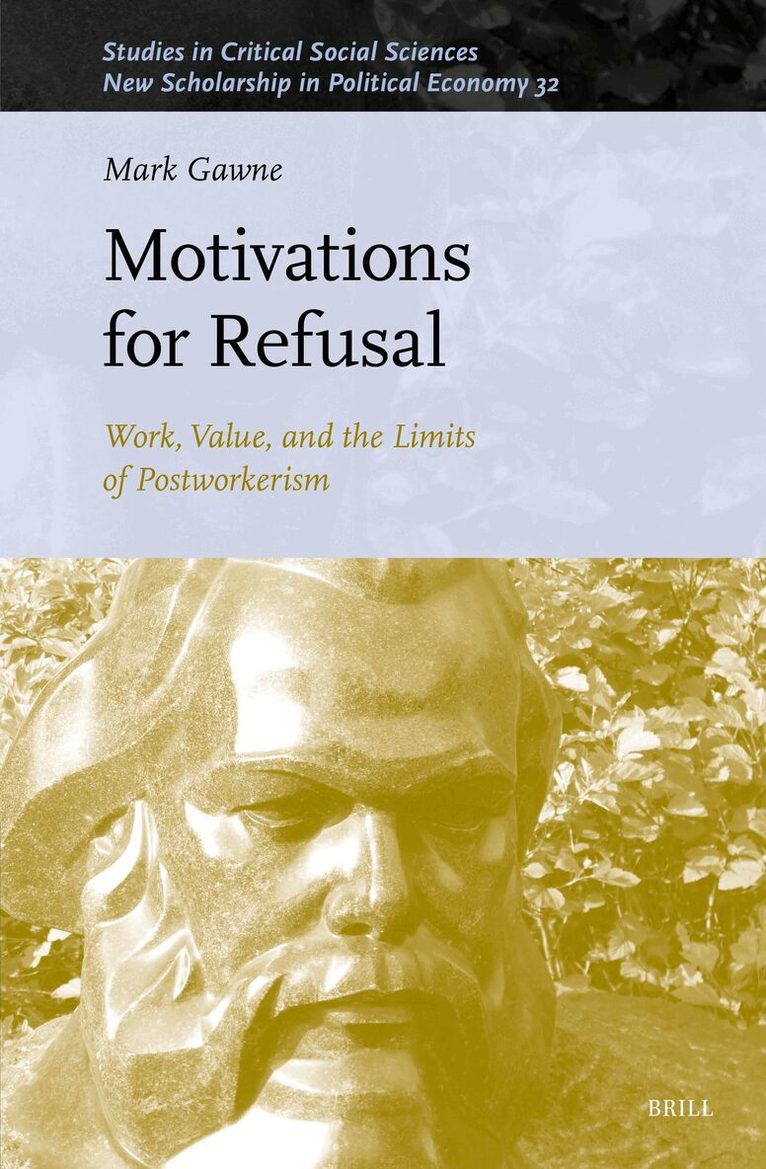
    Motivations for Refusal

    Work, Value, and the Limits of Postworkerism

    AvMark Gawne

    Inbunden, Engelska, 2025

    Del i serien New Scholarship in Political Economy

    1 895 kr

    Beställningsvara. Skickas inom 3-6 vardagar. Fri frakt över 249 kr.

    Fler format och utgåvor

    Häftad

    303 kr

    Beskrivning

    In Motivations for Refusal: Work, Value, and the Limits of Postworkerism, Mark Gawne develops a critical account of how the affective politics of capital and class are formed and contested in contemporary arrangements of work, and offers a comprehensive critique of the postworkerist school of autonomist Marxism. Drawing on value critique and class composition analysis, the book challenges core assumptions of postworkerism and related theories of affective labour, while retaining their core insights. Moving beyond the limits of postworkerism, Gawne analyses how the integration of the affective sciences into management and workplace technologies constitutes a terrain of contestation in conditions of immaterial production. Motivations for Refusal explores how affective politics emerge in the contestation between labour and capital in their affective modes.

    Produktinformation

    • Utgivningsdatum:2025-04-24
    • Mått:155 x 235 x 21 mm
    • Vikt:567 g
    • Format:Inbunden
    • Språk:Engelska
    • Serie:New Scholarship in Political Economy
    • Antal sidor:254
    • Förlag:Brill
    • ISBN:9789004678934

    Utforska kategorier

    • Sociologi inom Samhälle och politik
    • Ekonomisk politik inom Ekonomi och Ledarskap
    • Sociala grupper och identitet inom Samhälle och politik

    Mer om författaren

    Mark Gawne, Ph.D. (2015), University of Sydney, is Lecturer in Social and Political Sciences at the University of Technology Sydney. He has taught widely in critical sociologies of labour and political economy, and writes on themes of work, class composition, and deindustrialisation, including “Love Is a Battlefield: on the Affective Politics of Crisis”, in The Love Collective (eds.), Love: Art, Ideas, Music, Politics (Kembla Books, 2020).

    Innehållsförteckning

    • ContentsAcknowledgements1 Introduction1 Crisis, Work, Motivation2 Why Work? What Life?3 Preliminary Comments on Postworkerism, Affective Labour, and Immaterial Production4 Motivation, Refusal, and the Affective Compositions of Capital and ClassPart 1: Labour, Value, Affect2 Lineages of Value, Theories of Labour1 Introduction2 Marx on Value: Variations and Ambivalences3 Value-Form4 Tracing the Lineages of Theories of Value5 Foundations of a New Substantialism: the Trinity of Labour-Value-Affect6 Notation: against a Productivist Foundation of Politics7 Conclusion3 Class Composition and the Prehistory of Immaterial Production1 Introduction2 Value and Antagonism3 Class Composition Analysis as Method and Perspective4 Workerist-Feminist Critiques, Wages for and against Housework5 The Emergence of Postworkerism and the Composition of Class6 Conclusion4 Affective Ontology, Cooperation, and the Crisis of Value1 Introduction2 The Crisis of Value3 Cooperation, Autonomous Production, and Measure4 From Class Composition to the Foundational Threshold of Political Ontology5 The Character of Labour in the Becoming-Rent of Profit6 Fragmentation and the Persistence of Mediation7 ConclusionPart 2: Contested Terrains of Affect5 The Affective Sciences and Managerial Practice1 Introduction2 Critical Management Studies and the Problem of Affect3 Affective Capitalism and the Theorisation of Labour and Capital4 The Affective Sciences and Management5 Affect as Material of Service Labour and Management6 Conclusion: Affective Management and the Technical Composition of Class6 Affective Capital, Labour, and Emotion Recognition Technology in the Workplace1 Introduction2 Affect and Emotion3 Affective Machines and Problems of Composition4 Human-Computer Interaction and Affective Capital5 Technologically Fixed Affects, or the ReInversion of the General Intellect6 Affective Augmentation, Productivity, and Surplus Value7 Conclusion: Technological Determinism or Technical Ambivalence?7 Ambivalence and the Affective Compositions of Capital and Class1 Introduction2 Class Compositions: Technical, Political, Social, Affective3 Affective Politics and the Affective Composition of Labour: Motivation and Refusal4 Affective Sciences and the Technical Composition of Class5 On Ambivalence6 Ambivalent Affects7 Conclusion8 ConclusionBibliographyIndex