• Fri frakt över 249 kr
  • •
  • Snabba leveranser
  • •
  • Billiga böcker
Kundservice

Du är på sajten för privatpersoner.

Företag, bibliotek eller offentlig verksamhet?

Du handlar på classic.bokus.com, där alla dina funktioner finns intakta.
Till classic.bokus.com
Bokus logotyp. Gå till startsidan.
  • Erbjudanden
  • Nyheter
  • Student
  • Topplistor
  • Barn & ungdom
  • Bokus Play
  • E-böcker
  • Pocketböcker
  • Spel & pussel

10% rabatt på allt med kod NYSTART10 →

Sidfot

Mina sidor

    Hjälp

    • Kundservice
    • Vanliga frågor och svar
    • Frakt och leverans
    • Retur vid ångerrätt
    • Reklamera vara
    • Betalning
    • Köpvillkor
    • Allmänna villkor
    • Information om webbplatsens tillgänglighet

    Om Bokus

    • Om oss
    • Pressrum
    • För studenter
    • För företag
    • För bibliotek och offentlig verksamhet
    • För leverantörer
    • Hållbarhet

    Populärt

    • Aktuella erbjudanden
    • Presentkort
    • Studentlitteratur
    • Nya böcker
    • Topplistor
    • Signerade böcker
    • Engelska böcker

    Inspiration

    • Boktips
    • BookTok
    • Populära bokserier
    • Barnbokskaraktärer
    • Populära författare
    Logotyp för Bokus
    Följ oss på Facebook (extern länk)Följ oss på Instagram (extern länk)Följ oss på YouTube (extern länk)Följ oss på TikTok (extern länk)
    bokus @ CookiesAnpassa cookiesIntegritetspolicyKöpvillkor
    Till Citymail hemsida (extern länk)Till Budbee hemsida (extern länk)Till Postnord hemsida (extern länk)Till Schenker hemsida (extern länk)Till Early Bird hemsida (extern länk)Till Walleys hemsida (extern länk)
    1. Naturvetenskap och teknik
    2. Matematik och naturvetenskap
    3. Matematik

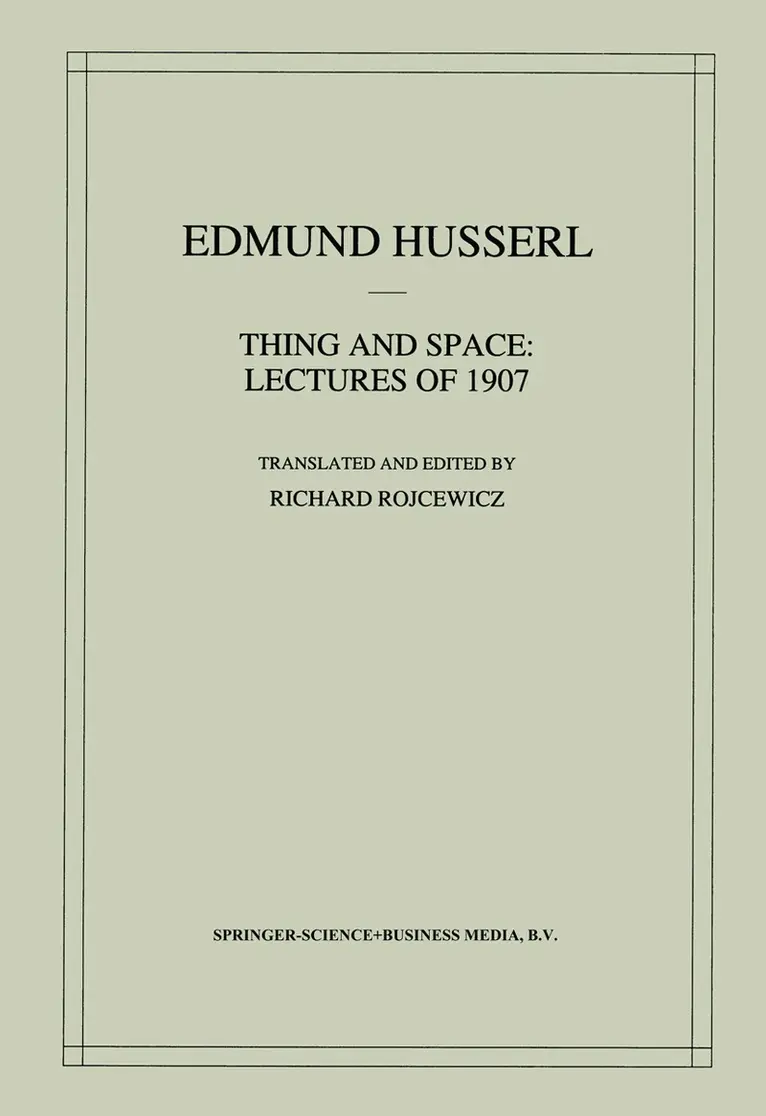
    Thing and Space

    Lectures of 1907

    AvEdmund Husserl

    Häftad, Engelska, 2010

    Del 7 i serien Husserliana: Edmund Husserl – Collected Works

    546 kr

    Beställningsvara. Skickas inom 10-15 vardagar. Fri frakt över 249 kr.

    Fler format och utgåvor

    Inbunden

    546 kr

    Beskrivning

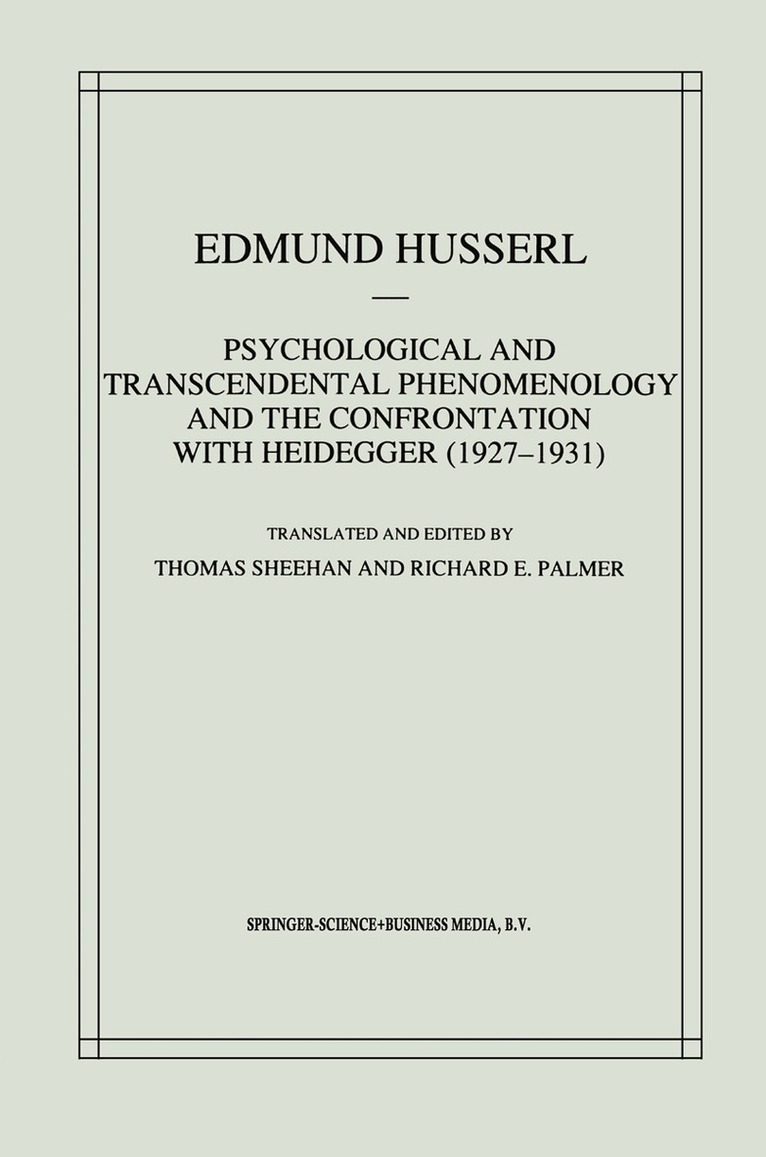
    This is a translation of Edmund HusserI's lecture course from the Summer semester 1907 at the University of Gottingen. The German original was pub­ lished posthumously in 1973 as Volume XVI of Husserliana, Husserl's opera omnia. The translation is complete, including both the main text and the supplementary texts (as Husserliana volumes are usually organized), except for the critical apparatus which provides variant readings. The announced title of the lecture course was "Main parts of the phenome­ nology and critique of reason." The course began with five, relatively inde­ pendent, introductory lectures. These were published on their own in 1947, bearing the title The idea ojphenomenology.l The "Five Lectures" comprise a general orientation by proposing the method to be employed in the subsequent working out of the actual problems (viz., the method of "phenomenological reduction") and by clarifying, at least provisionally, some technical terms that will be used in the labor the subsequent lectures will carry out. The present volume, then, presents that labor, i.e., the method in action and the results attained. As such, this text dispels the abstract impression which could not help but cling to the first five lectures taken in isolation. Accord­ ingly, we are here given genuine "introductory lectures," i.e., an introduction to phenomenology in the genuine phenomenological sense of engaging in the work of phenomenology, going to the "matters at issue themselves," rather than remaining aloof from them in abstract considerations of standpoint and approach.

    Produktinformation

    • Utgivningsdatum:2010-10-28
    • Mått:170 x 244 x 21 mm
    • Vikt:661 g
    • Format:Häftad
    • Språk:Engelska
    • Serie:Husserliana: Edmund Husserl – Collected Works
    • Antal sidor:350
    • Förlag:Springer
    • ISBN:9789048149131
    • Översättare:R. Rojcewicz

    Utforska kategorier

    • Matematik inom Naturvetenskap och teknik
    • Filosofiska discipliner inom Filosofi och religion

    Innehållsförteckning

    • Thing and Space. Lectures of 1907.- Section I The Foundations of a Phenomenological Theory of Perception.- 1. Fundamental Determinations of Outer Perception.- 2. The Methodological Possibility of the Analysis of Perception.- Section II Analysis of Unchanged Outer Perception.- 3. The Elements of Perceptual Correlation.- 4. The Constitution of the Temporal and Spatial Extension of the Appearance.- Section III Analysis of the Kinetic Synthesis of Perception. Changes in Perception and Changes in Appearance.- 5. The Givenness of the Thing at Rest in Continuous Courses of Perception.- 6. The Possibility and Sense of an Adequate Perception of Spatial Things.- 7. Recapitulation. the Analyses of Perception in The Framework of the Phenomenological Reduction.- Section IV The Significance of the Kinaesthetic Systems for the Constitution of the Perceived Object.- 8. The Phenomenological Concept of Kinaesthesis.- 9. The Correlation Between the Visual Field and the Kinaesthetic Sequences.- 10. The Thing as Unity in the Kinaesthetically Motivated Manifold of Appearances.- Section V The Transition from the Oculomotor Field TO Objective Space. the Constitution of Three-Dimensional, Spatial Corporeality.- 11. Amplifications of the Oculomotor field.- 12. The Typicality of the Modifications of Appearances in the Oculomotor Field.- 13. The Constitution of Space Through the Conversion of the Oculomotor Field Into an Expansional and Turning Manifold.- 14. Supplementary Considerations.- Section VI The Constitution of Objective Change.- 15. Qualitative Changes of the Perceptual Object.- 16. The Constitution of Mere Movement.- Final Consideration.- Supplementary Texts.- A. Essays.- I. Systematic Constitution of Space. Husserl’s Draft.- A. Sense-fields and kinaesthetic systems.- B. Levels of theconstitution of space.- II. Systematic Constitution of Space. Edith Stein’s Elaboration.- §1. Necessity of a location for each body.- §2. Sense-fields and kinaesthetic field.- §3. The significance of the various kinaesthetic systems for the constitution of space.- §4. Significance of kinaesthetic sequences for the constitution of Objective rest and movement.- §4a. I am moved; my body.- §5. Null-orientation of the kinaesthetic systems.- §6. Basic distinction within the kinaesthetic systems and within the constitution of space. Closed visual space and infinite Objective space.- §7. Further distinctions in the kinaesthetic systems and in the constitutive levels.- §8. The pre-eminence of the null-position. The optimum of the visual field.- §9. Interrelations among the kinaesthetic systems in question.- B. Appendices.- Appendix I: Husserl’s Critical Remarks on the Course of Thought and the Progression of the Lectures, Compiled by the Editor.- Appendix II (to §1): On the Doctrine of the Levels of Givenness of Things.- Appendix III (to §§20FF.); The Special Position of the Spatial Feature (Determination of Space).- Appendix IV (to §§49FF.): The Kinaesthetic Systems of Monocularity and Binocularity.- Appendix V (to §54): Strata in the Constitution of the Thing.- Appendix VI (to §54): Motivational Nexuses and Apperception.- Appendix VII (to §76): Empty Space.- Appendix VIII (to §78): Problem of the Quality That Fills Space.- Appendix IX (to §§82F.): On the Constitution of Movement and Rest.- Appendix X (to §83): Subjective Self-Movement AND Objective Corporeal Movement.- Appendix XI (to §83): Visual Space and Objective Space.- Appendix XII (to Essay I): On the Constitution of Riemannian Things.- Appendix XIII (to Essay II, §4A): Active and PassiveLocomotion.