• Fri frakt över 249 kr
  • •
  • Snabba leveranser
  • •
  • Billiga böcker
Kundservice

Du är på sajten för privatpersoner.

Företag, bibliotek eller offentlig verksamhet?

Du handlar på classic.bokus.com, där alla dina funktioner finns intakta.
Till classic.bokus.com
Bokus logotyp. Gå till startsidan.
  • Erbjudanden
  • Nyheter
  • Student
  • Topplistor
  • Barn & ungdom
  • Bokus Play
  • E-böcker
  • Pocketböcker
  • Spel & pussel

10% rabatt på allt med kod NYSTART10 →

Sidfot

Mina sidor

    Hjälp

    • Kundservice
    • Vanliga frågor och svar
    • Frakt och leverans
    • Retur vid ångerrätt
    • Reklamera vara
    • Betalning
    • Köpvillkor
    • Allmänna villkor
    • Information om webbplatsens tillgänglighet

    Om Bokus

    • Om oss
    • Pressrum
    • För studenter
    • För företag
    • För bibliotek och offentlig verksamhet
    • För leverantörer
    • Hållbarhet

    Populärt

    • Aktuella erbjudanden
    • Presentkort
    • Studentlitteratur
    • Nya böcker
    • Topplistor
    • Signerade böcker
    • Engelska böcker

    Inspiration

    • Boktips
    • BookTok
    • Populära bokserier
    • Barnbokskaraktärer
    • Populära författare
    Logotyp för Bokus
    Följ oss på Facebook (extern länk)Följ oss på Instagram (extern länk)Följ oss på YouTube (extern länk)Följ oss på TikTok (extern länk)
    bokus @ CookiesAnpassa cookiesIntegritetspolicyKöpvillkor
    Till Citymail hemsida (extern länk)Till Budbee hemsida (extern länk)Till Postnord hemsida (extern länk)Till Schenker hemsida (extern länk)Till Early Bird hemsida (extern länk)Till Walleys hemsida (extern länk)
    1. Ekonomi och Ledarskap
    2. Nationalekonomi
    3. Mikroekonomi

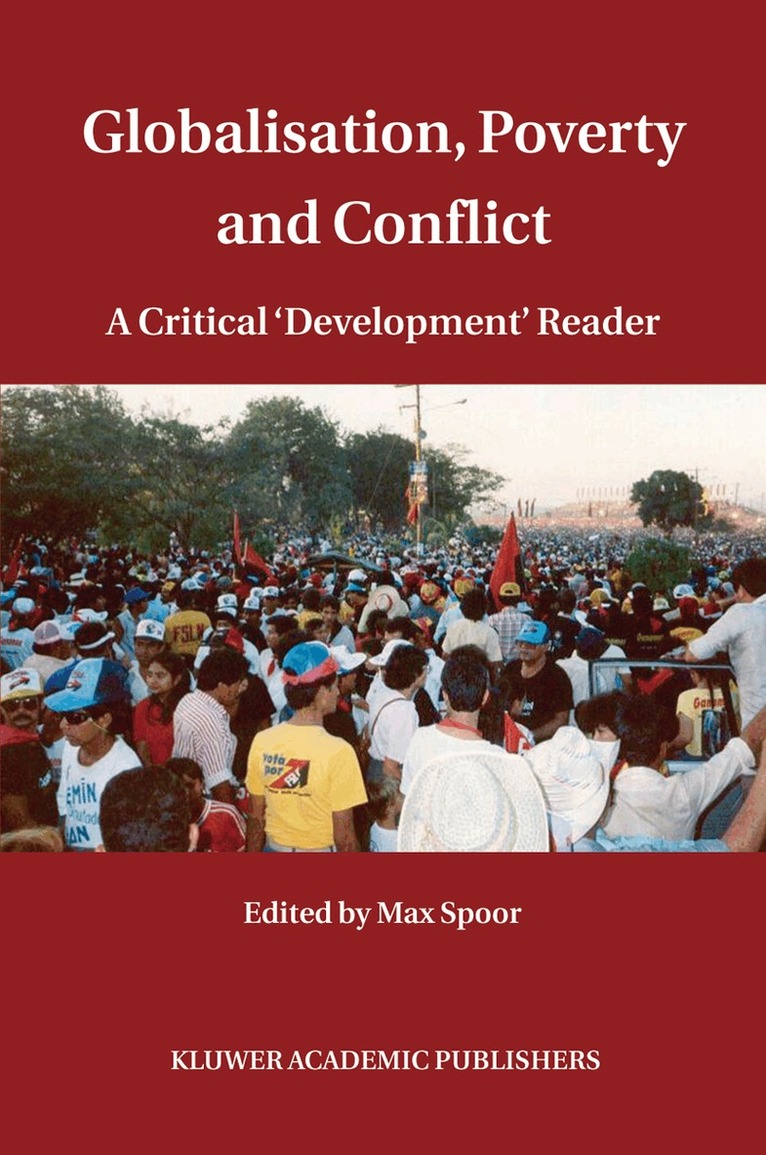
    Globalisation, Poverty and Conflict

    A Critical 'Development' Reader

    AvMax Spoor

    Häftad, Engelska, 2010

    1 623 kr

    Beställningsvara. Skickas inom 10-15 vardagar. Fri frakt över 249 kr.

    Beskrivning

    Is ‘development’ passé? Is it merely a by-product or a ‘trickle down’ effect of economic growth, spurred by globalisation? Will poverty simply diminish with increased global markets? This state-of-the-art critical ‘development’ reader deals with these and related questions. Globalisation, Poverty and Conflict examines the inter-relationships between globalisation, poverty and conflict. It complements current debates in the field of development studies and, in an era in which development fatigue seems to have become more profound than ever before, it brings the importance of development once again to the forefront. Achieving the Millennium Development Goals by 2015 is a concrete target which many governments have agreed to work towards.Whether these goals can be realised is another issue. Nonetheless, the Millennium Development Goals have brought more focused attention to development in the past few years and renewed debate about the relationships between the process of globalisation and widespread poverty and the emergence of violent conflicts. The authors in this edited volume discuss these inter-related and highly controversial topical elements of development in a number of chapters organised around three sets of issues: (1) globalisation, inequality and poverty; (2) governance, civil society and poverty; and (3) resource degradation, institutions and conflict. The contributions represent current thinking on (and practice of) development policy, poverty reduction, the need for multi-level democratic institutions, and the containing and prevention of conflicts. The authors confront the predominant mainstream ideas on ‘development’ and propose alternatives. The chapters, written by a select group of scholars and development practitioners, will be of direct interest to those involved in this field of social sciences and in ‘development practice’, but they are composed in such a way as to remain accessible for the generallyinterested reader.

    Produktinformation

    • Utgivningsdatum:2010-10-19
    • Mått:160 x 240 x 20 mm
    • Vikt:588 g
    • Format:Häftad
    • Språk:Engelska
    • Antal sidor:340
    • Upplaga:2004
    • Förlag:Springer
    • ISBN:9789048167333

    Utforska kategorier

    • Mikroekonomi inom Ekonomi och Ledarskap
    • Internationell ekonomi inom Ekonomi och Ledarskap
    • Miljövetenskap och miljöpolitik inom Naturvetenskap och teknik

    Mer om författaren

    Max Spoor is Associate Professor and Coordinator of the Centre for the Study of Transition and Development (CESTRAD), Institute of Social Studies, The Hague, The Netherlands, and Extraordinary Professor, Centre of International Relations and International Cooperation (CIDOB), Barcelona, Spain.

    Recensioner i media

    From the reviews: "The book, a collection of 16 chapters grouped into three parts, gives a thorough and interesting review and discussion of contemporary development issues from a global perspective. ... Although the book is targeted at readers in the field of social sciences, it is well written in a clear and simple manner so that it can find appeal to a wide audience, ranging from policy makers, academics to students and development practitioners." (Shephard Siziba, Quarterly Journal of International Agriculture, Vol. 45 (4), 2006)

    Innehållsförteckning

    • Globalisation, Inequality and Poverty.- From Exclusive to Inclusive Development.- Collateral Damage or Calculated Default? The Millennium Development Goals and the Politics of Globalisation.- Can Improved Human Development Policies Break the Cycle of Poverty?.- Inequality, Poverty and Conflict in Transition Economies.- Globalisation, Marginalisation and Conflict.- The Slow Progress of International Financial Reform.- The Debt Crisis and the South in an Era of Globalisation.- Resource Degradation, Institutions and Conflict.- Multi-Level Governance and Resilience of Social-Ecological Systems.- In Conclusion.- Knowledge Sharing in Support of Human Development.- Disempowering new Democracies and the Persistence of Poverty.- Local Governance and Rural Poverty in Africa.- Local Governance Hybrids: Enabling Policies and Citizen Approaches to Poverty Reduction.- Civic Engagement, Social Accountability and The Governance Crisis.- Blurring The State-Private Divide: Flex Organisations and The Decline of Accountability.- The Limits of Institutions: Environmental Degradation and Knowledge Framing.- Beyond State-Community Polarisations and Bogus “Joint”Ness: Crafting Institutional Solutions for Resource Management.