• Fri frakt över 249 kr
  • •
  • Snabba leveranser
  • •
  • Billiga böcker
Kundservice

Du är på sajten för privatpersoner.

Företag, bibliotek eller offentlig verksamhet?

Du handlar på classic.bokus.com, där alla dina funktioner finns intakta.
Till classic.bokus.com
Bokus logotyp. Gå till startsidan.
  • Erbjudanden
  • Nyheter
  • Student
  • Topplistor
  • Barn & ungdom
  • Bokus Play
  • E-böcker
  • Pocketböcker
  • Spel & pussel

10% rabatt på allt med kod: NYSTART10 →

Sidfot

Mina sidor

    Hjälp

    • Kundservice
    • Vanliga frågor och svar
    • Frakt och leverans
    • Retur vid ångerrätt
    • Reklamera vara
    • Betalning
    • Köpvillkor
    • Allmänna villkor
    • Information om webbplatsens tillgänglighet

    Om Bokus

    • Om oss
    • Pressrum
    • För studenter
    • För företag
    • För bibliotek och offentlig verksamhet
    • För leverantörer
    • Hållbarhet

    Populärt

    • Aktuella erbjudanden
    • Presentkort
    • Studentlitteratur
    • Nya böcker
    • Topplistor
    • Signerade böcker
    • Engelska böcker

    Inspiration

    • Boktips
    • BookTok
    • Populära bokserier
    • Barnbokskaraktärer
    • Populära författare
    Logotyp för Bokus
    Följ oss på Facebook (extern länk)Följ oss på Instagram (extern länk)Följ oss på YouTube (extern länk)Följ oss på TikTok (extern länk)
    bokus @ CookiesAnpassa cookiesIntegritetspolicyKöpvillkor
    Till Citymail hemsida (extern länk)Till Budbee hemsida (extern länk)Till Postnord hemsida (extern länk)Till Schenker hemsida (extern länk)Till Early Bird hemsida (extern länk)Till Walleys hemsida (extern länk)
    1. Ekonomi och Ledarskap
    2. Ledarskapsböcker
    3. Ledarskap och motivation

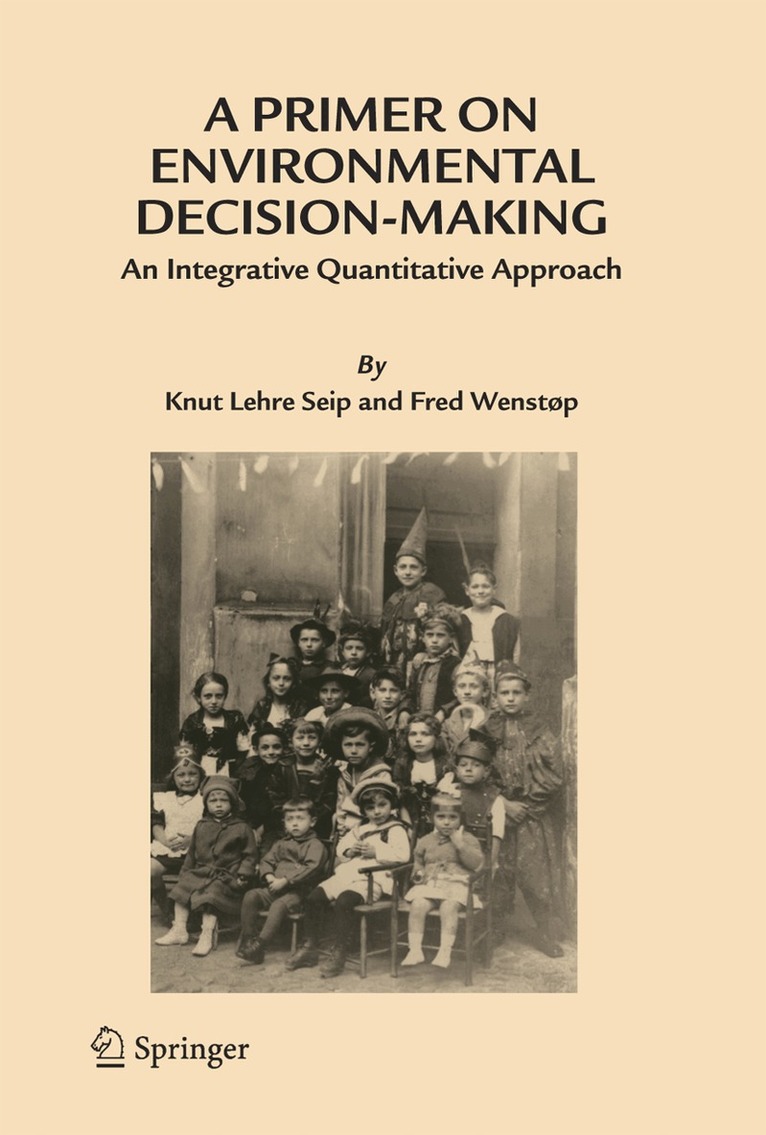
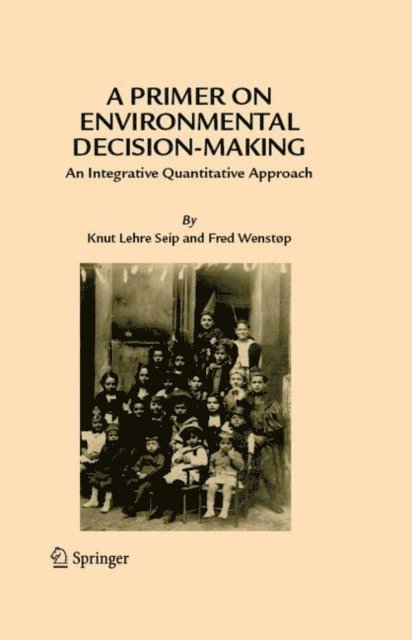
    Primer on Environmental Decision-Making

    An Integrative Quantitative Approach

    AvKnut Lehre Seip,Fred Wenstøp

    Häftad, Engelska, 2010

    1 247 kr

    Beställningsvara. Skickas inom 10-15 vardagar. Fri frakt över 249 kr.

    Fler format och utgåvor

    Inbunden

    1 733 kr

    Beskrivning

    This book integrates decision-making and environmental science. For ecologists it will bridge the gap to economics. For practitioners in environmental economics and management it will be a major reference book. It probably contains the largest collection available of expressions and basic equations that are used in environmental sciences. Applying these expressions as "rules-of-thumb" will give participants in a decision-making process a common platform for discussion and arbitration. To make the text comfortable to read, the book is organized in disciplines, but it also includes 13 applications that draw on all subjects in the book, and where cross-references are extensively used. The applications that range from siting of paper mills to wilderness management show how a range of topics in economics, social sciences and ecology are interrelated when decisions have to be made.The third chapter is called "Getting started". It shows how to carry out a complete environmental screening study in one day, much like the computer manuals that get you going from the first day. We believe that raising a platform for environmental decision-making puts issues into their right perspective, it is fun, and it lets an individual contribute to society’s understanding of the environment in a very short while.

    Produktinformation

    • Utgivningsdatum:2010-11-10
    • Mått:155 x 235 x 28 mm
    • Vikt:803 g
    • Format:Häftad
    • Språk:Engelska
    • Antal sidor:496
    • Förlag:Springer
    • ISBN:9789048170326

    Utforska kategorier

    • Ledarskap och motivation inom Ekonomi och Ledarskap
    • Miljövetenskap och miljöpolitik inom Naturvetenskap och teknik
    • Företagsekonomi inom Ekonomi och Ledarskap

    Recensioner i media

    The book would be valued by academics, bureaucrats and students. The coverage is broad and relevant to the topic it purports to encompass. It is far reaching and much of the theory it addresses is cutting edge. There are a number of emergent disciplines and ideas in this field, and the manner in which this book is structured and composed should enable penetration of al relevant and cognate disciplines. I believe the book is "State- of- the art". -- Professor Sarah Lumley; University of Western Australia. I had a pleasure to host Prof. Seip twice at the Institute of Environmental Sciences, Jagiellonian University in Krakow, Poland. Together with his colleague, Dr Reidar Kvadsheim, he provided us excellent courses in applied environmental decision making. The courses were well suited mostly for M.Sc. and Ph.D. students specializing in ecology and environmental sciences. Unfortunately, until now there was no single good source, such as a handbook, that might be used for developing similar courses independently. Thus, I was indeed happy to hear that a primer based on well-established courses in applied environmental decision making is going to be published by Springer. The one thing I noted after looking through the manuscript of the primer is that it is going to serve a really broad audience: starting from ecologists - with good background in biology and environmental sciences but usually purely prepared to undertake decisions considering also economic and social criteria - to decision-makers, whose education is just opposite - with relatively good insight into economic and social matters, they usually have no or pure education in biology and ecology. Applied environmental decision making is a difficult task, requiring balancing costs and benefits, and both these aspects should be well based on current knowledge. However, while knowledge suffice as the scientific criterion, environmental decision making has to consider also social costs and preferences. The combination of these both aspects is exactly what our students were taught during the courses provided at the Jagiellonian University, and what is the topic of the primer. What is very important in the case of this particular handbook is how the authors are able to introduce the two quite different groups of people - the decision-makers and the ecologists - to the areas they are not familiar with. In my opinion, the manuscript I had a pleasure to review for the authors, handles this difficult task exceptionally well. It is written with simple, easy to follow language, it is not overloaded with difficult equations (which would most probably discourage many students), and when these are crucial, some examples are given so that a student can easily follow all the calculations. The book is also rich in graphs and other figures that make the text even easier to understand. In conclusion, I will be indeed happy to see the book in bookstores and libraries, and I believe that it will enable dozens of lecturers to introduce the interesting field of environmental decision making into university curricula either as separate courses or, at least, as parts of other, more general ones. I am also pretty sure that a number of people working currently in the field of conservation biology, environmental protection, ecotoxicology, etc. will be happy to use this book in their daily professional work. --Ryszard Laskowski, Institute of Environmental Sciences, Jagiellonian University in Krakow, Poland

    Innehållsförteckning

    • From the contentsPreface.- Part 1 Environmental Decision-Making.- Part 2 The Subjective Experience.- Part 3 Ecological Principles and Processes.- Part 4 The Natural Environment.- Index.