• Fri frakt över 249 kr
  • •
  • Snabba leveranser
  • •
  • Billiga böcker
Kundservice

Du är på sajten för privatpersoner.

Företag, bibliotek eller offentlig verksamhet?

Du handlar på classic.bokus.com, där alla dina funktioner finns intakta.
Till classic.bokus.com
Bokus logotyp. Gå till startsidan.
  • Erbjudanden
  • Nyheter
  • Student
  • Topplistor
  • Barn & ungdom
  • Bokus Play
  • E-böcker
  • Pocketböcker
  • Spel & pussel

10% rabatt på allt med kod: NYSTART10 →

Sidfot

Mina sidor

    Hjälp

    • Kundservice
    • Vanliga frågor och svar
    • Frakt och leverans
    • Retur vid ångerrätt
    • Reklamera vara
    • Betalning
    • Köpvillkor
    • Allmänna villkor
    • Information om webbplatsens tillgänglighet

    Om Bokus

    • Om oss
    • Pressrum
    • För studenter
    • För företag
    • För bibliotek och offentlig verksamhet
    • För leverantörer
    • Hållbarhet

    Populärt

    • Aktuella erbjudanden
    • Presentkort
    • Studentlitteratur
    • Nya böcker
    • Topplistor
    • Signerade böcker
    • Engelska böcker

    Inspiration

    • Boktips
    • BookTok
    • Populära bokserier
    • Barnbokskaraktärer
    • Populära författare
    Logotyp för Bokus
    Följ oss på Facebook (extern länk)Följ oss på Instagram (extern länk)Följ oss på YouTube (extern länk)Följ oss på TikTok (extern länk)
    bokus @ CookiesAnpassa cookiesIntegritetspolicyKöpvillkor
    Till Citymail hemsida (extern länk)Till Budbee hemsida (extern länk)Till Postnord hemsida (extern länk)Till Schenker hemsida (extern länk)Till Early Bird hemsida (extern länk)Till Walleys hemsida (extern länk)
    1. Medicin
    2. Medicin: allmänt
    3. Medicinhistoria

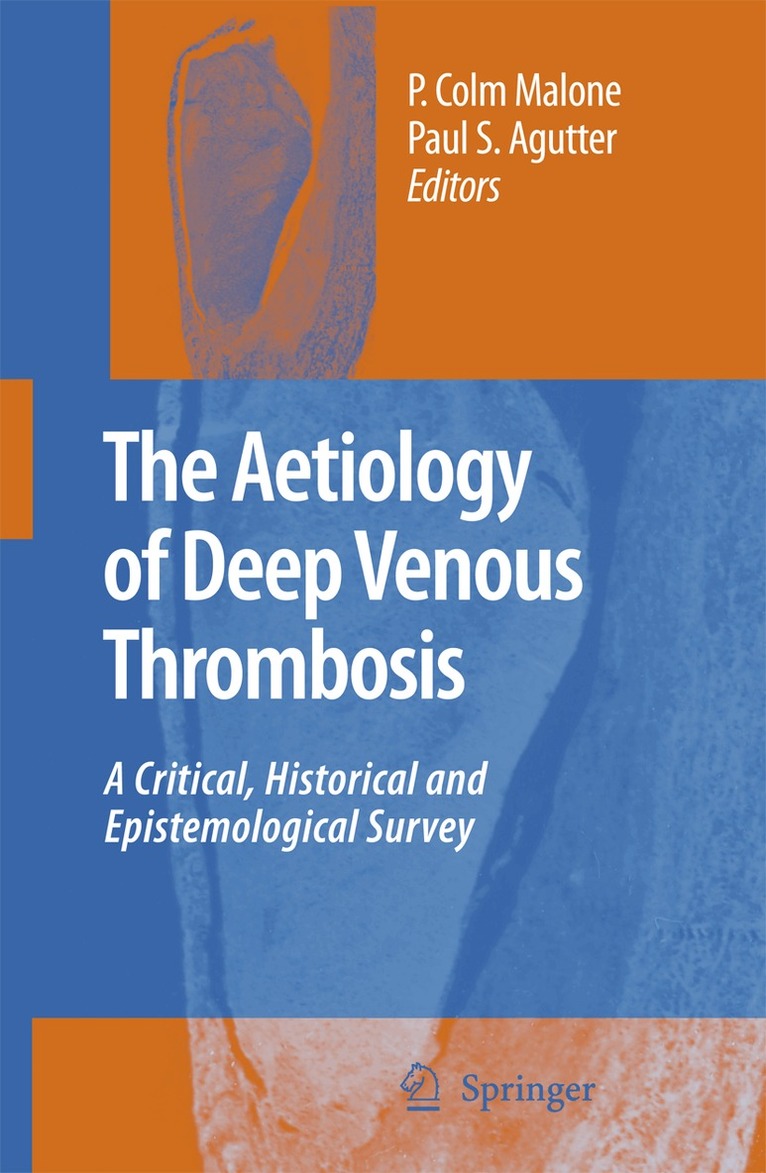
    Aetiology of Deep Venous Thrombosis

    A Critical, Historical and Epistemological Survey

    AvP. Colm Malone,Paul S. Agutter

    Häftad, Engelska, 2010

    1 119 kr

    Beställningsvara. Skickas inom 10-15 vardagar. Fri frakt över 249 kr.

    Fler format och utgåvor

    Inbunden

    1 119 kr

    Beskrivning

    What we now call ‘deep venous thrombosis’ (DVT) has been studied in diverse ways during the last 200–300 years. Each of these approaches contributes to a full modern understanding of aetiology. Therefore, much of this book is a historical survey of the field. However, our remit is broader than the title might suggest: the evolution of ideas about DVT is typical in many ways of medical biology as a whole. Thus, although the aetiology of DVT may seem a narrow topic for a monograph – it implicitly excludes arterial thrombosis and marginalises prophylaxis, therapy, and even such clinically significant sequelae as pulmonary embolism – we hope to engage the reader in a much more general inquiry. Our historical investigation reveals a 160-year-old schism between two contrasting philosophies of medical and biological research, a schism that is particularly – but by no means uniquely – relevant to the study of DVT. In principle, these philosophies should be complementary rather than competing. So while we wish to elucidate the aetiology of DVT per se, we are also concerned with a more abstract and wide-ranging issue: the future accommodation or rapprochement between two conceptual and methodological traditions.

    Produktinformation

    • Utgivningsdatum:2010-10-19
    • Mått:155 x 235 x 19 mm
    • Vikt:522 g
    • Format:Häftad
    • Språk:Engelska
    • Antal sidor:318
    • Förlag:Springer
    • ISBN:9789048176892

    Utforska kategorier

    • Medicinhistoria inom Medicin
    • Patologi inom Medicin
    • Hematologi inom Medicin

    Innehållsförteckning

    • to the Study of Deep Venous Thrombosis.- The Coagulation Cascade and the Consensus Model of DVT.- Hypercoagulability.- Historical Roots.- Coagulation and its Disorders: A History of Haematological Research.- Virchow and the Pathophysiological Tradition in the 19th Century.- The Pathophysiological Tradition after Virchow.- Interrupted Circulation: The ‘Stasis’ Hypothesis and the Significance of Venous Valves.- Underperfusion of Valve Pockets and the Initiation of DVT.- The Role of Endothelial Hypoxia in DVT.- The Valve Cusp Hypoxia Hypothesis.- Molecular Changes in the Hypoxic Endothelium.- Cadaver Clots or Agonal Thrombi?.