• Fri frakt över 249 kr
  • •
  • Snabba leveranser
  • •
  • Billiga böcker
Kundservice

Du är på sajten för privatpersoner.

Företag, bibliotek eller offentlig verksamhet?

Du handlar på classic.bokus.com, där alla dina funktioner finns intakta.
Till classic.bokus.com
Bokus logotyp. Gå till startsidan.
  • Erbjudanden
  • Student
  • Topplistor
  • Barn & ungdom
  • Bokus Play
  • E-böcker
  • Ljudböcker
  • Pocketböcker
  • Spel och pussel

Skapa nya rutiner – hälsoböcker upp till 50% →

Sidfot

Mina sidor

    Hjälp

    • Kundservice
    • Vanliga frågor och svar
    • Frakt och leverans
    • Retur vid ångerrätt
    • Reklamera vara
    • Betalning
    • Köpvillkor
    • Allmänna villkor
    • Information om webbplatsens tillgänglighet

    Om Bokus

    • Om oss
    • Pressrum
    • För studenter
    • För företag
    • För bibliotek och offentlig verksamhet
    • För leverantörer
    • Hållbarhet

    Populärt

    • Aktuella erbjudanden
    • Presentkort
    • Studentlitteratur
    • Nya böcker
    • Topplistor
    • Signerade böcker
    • Engelska böcker

    Inspiration

    • Boktips
    • BookTok
    • Barnbokskaraktärer
    • Populära författare
    Logotyp för Bokus
    Följ oss på Facebook (extern länk)Följ oss på Instagram (extern länk)Följ oss på YouTube (extern länk)Följ oss på TikTok (extern länk)
    bokus @ CookiesAnpassa cookiesIntegritetspolicyKöpvillkor
    Till Citymail hemsida (extern länk)Till Budbee hemsida (extern länk)Till Postnord hemsida (extern länk)Till Schenker hemsida (extern länk)Till Early Bird hemsida (extern länk)Till Walleys hemsida (extern länk)
    1. Naturvetenskap och teknik
    2. Geovetenskap
    3. Miljövetenskap och miljöpolitik

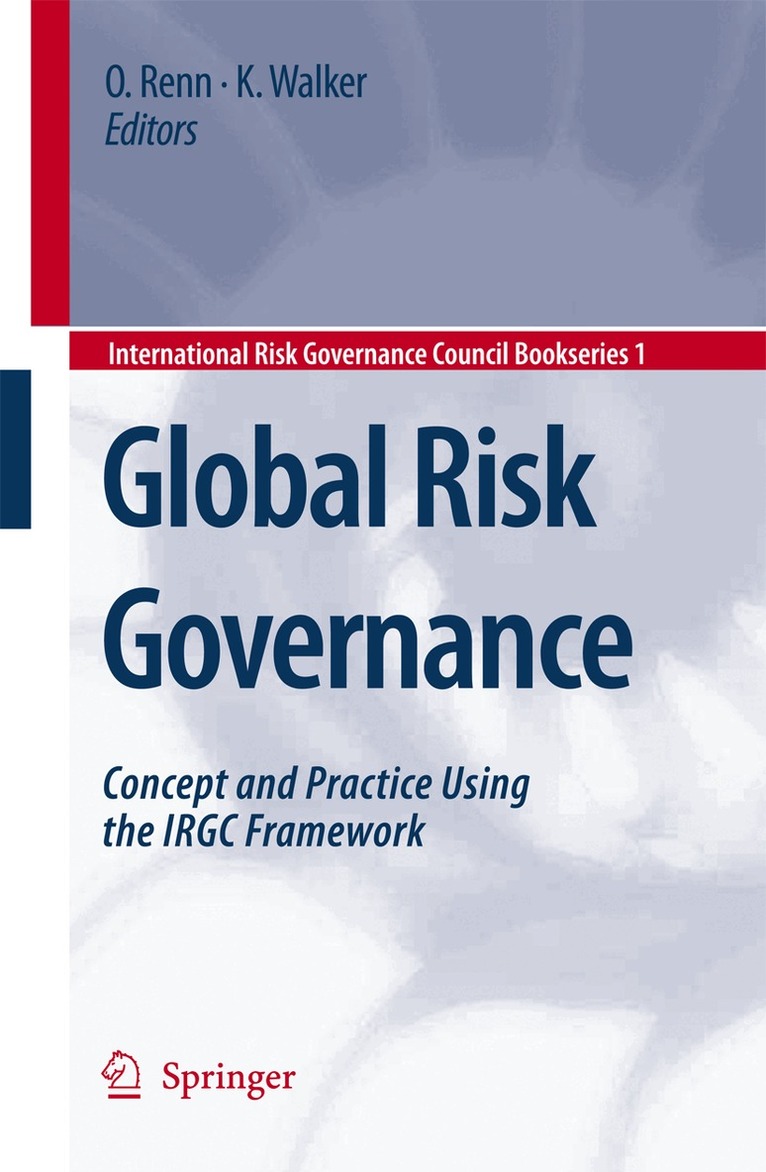
    Global Risk Governance

    Concept and Practice Using the IRGC Framework

    AvOrtwin Renn,Katherine D. Walker

    Häftad, Engelska, 2010

    Del 1 i serien International Risk Governance Council Bookseries

    1 662 kr

    Beställningsvara. Skickas inom 10-15 vardagar. Fri frakt över 249 kr.

    Beskrivning

    Japanese government planners set out in the 1960s to build a barrage on the Nagara River, one of the last major free?owing rivers in Japan. Conceived during a period of rapid growth in the Japanese economy, the barrage was part of a national effort to ensure adequate water supplies for future economic development as well as to reduce ?oodingrisks to downstream communities. A string of lawsuits brought by groups concerned about the impact of the dam on ecological and ?sheries - sourcesresulted incostlydelays:thedamwasnotcompletedformorethan25years. The 1990s witnessed the start of a kind of biotech gold rush toward the use of genetic modi?cation (GM) as tool to develop more productive crops through the introduction of herbicide, insect and disease resistance to feed a growing world. Opponents of the rapid deployment of GM crops have raised concerns about the safety of the technology and about its socio-economic, cultural, and ethical implications. The debate over this issue divided the world – for example, the US allowed the development of GM crops to move forward and now accounts for over half the GM crops grown worldwide whereas the European Union only recently lifted a de facto moratorium imposed in 1998 and now authorises products on a case by case basis. Worldwide, the development and use of GM crops is still barely covered by a patchwork of regulations and guidelines, ranging from strict prohibition to none at all, and creating its own sets of disparities and risks.

    Produktinformation

    • Utgivningsdatum:2010-11-23
    • Mått:155 x 235 x 22 mm
    • Vikt:604 g
    • Format:Häftad
    • Språk:Engelska
    • Serie:International Risk Governance Council Bookseries
    • Antal sidor:370
    • Förlag:Springer
    • ISBN:9789048177301

    Utforska kategorier

    • Miljövetenskap och miljöpolitik inom Naturvetenskap och teknik
    • Byggnadsteknik inom Naturvetenskap och teknik
    • Statsvetenskap och politisk teori inom Samhälle och politik

    Recensioner i media

    The International Risk Governance Council (IRGC) is an independent organization whose purpose is to help the understanding and management of emerging global risks that have impacts on human health and safety, the environment, the economy and society at large. IRGC focuses on emerging, systemic risks for which governance deficits exist and aims to provide recommendations for how policy makers can correct them. The IRGC takes a broad, interdisciplinary approach; it draws specialists from practice and academe, and from natural sciences as well as social sciences. In Global Risk Governance: Concept and Practice Using the IRGC Framework, Ortwin Renn presents a risk management framework that aims to provide a comprehensive and transparent approach to managing physical risks with global or ubiquitous consequences. This framework is the result of extensive international consultation with risk managers and the academic community. The framework has four stages beginning with pre-assessment where stakeholders and experts help decision makers frame risks. Here, managers increase institutional activity in risk by, for example, establishing agreed standards and early warning systems that identify questionable deviations from the norm. The second step is risk appraisal, which includes two phases: first, scientists estimate the consequences of a potential threat, and second, social scientists consider civil society's understanding of the risk. The third stage is tolerability and acceptability judgement where managers weigh the empirical evidence against different social values and perceptions. The final step is risk management. Typically, this step requires significant stakeholder involvement. The book notes that by including the public in the process, managers can increase transparency in decision-making and distribute the responsibility for risk reduction between governments and society. When risk managers are unable to reach a consensus, constant communication and transparent monitoring can often help stakeholders agree on provisional solutions. Given the nature of risk governance, the IRGC's framework is a recurring process as depicted in the accompanying figure. Renn suggests that one of the most important risk policy issues is the treatment of different actors' risk perceptions. Availability and assessment biases, over- and under-estimation of risks, and risks spread over time (even over generations) challenge the traditional, straightforward risk calculations and projections. Renn argues for better integration of lay views with those of experts. On the balance, he favours the latter; however, both have to be considered in order to generate stable risk-management solutions and a lasting sense of security. The framework also includes clear definitions of key terms, including the distinction of different types of risks. The framework distinguishes, for instance, between risks that are highly complex; uncertain; or ambiguous. Complex risks are those which are difficult to quantify, largely because of the multitude of potential causal agents at work. Uncertain risks refer to a state of knowledge in which the likelihood of any adverse effect or the effects themselves cannot be described precisely even though the factors influencing the issues are identified. Ambiguous risks-perhaps the most contentious aspect of the book-give rise to several meaningful and legitimate interpretations of accepted risk assessment results. Managers can rely on expert judgement when society agrees on the values underpinning a decision and the tolerability of the risk. When risk is considered complex, managers need an accepted method by which to compare available evidence. When risks are judged to be uncertain, Renn advocates a precautionary approach. When a risk is ambiguous, he suggests that a broad societal discourse will help overcome differences in values and perceptions. The book has limitations. First, it is relatively new. While several chapters include very interesting case studies from around the world, the authors of these chapters in most instances have applied the framework in an after-the-fact approach. It will be important to see the impact that the framework will have when it is applied in a detailed and systematic way to new and emerging risks. This will take time. Second, its somewhat academic tone and style make it a little less accessible to a broader audience. Third and perhaps most importantly, the framework's strength can also be its weakness. While consultation is an important part of the process in a democratic society seeking stable risk management solutions, as Lofstedt and van Asselt as well as North note in their respective chapters, it is often difficult to build consensus, and therefore consultation can also be expensive and time consuming. Indeed, conducting the appropriate amount of consultation might be a bit more art than science. This is a significant challenge for most risk management processes; again, more time and research will suggest the extent to which the framework can accommodate multiple and competing views, and do so in an acceptably efficient manner. For more information on the International Risk Governance Council's research on this and other policy files, please visit their website, www.irgc.org. Notably, the IRGC has recently published Managing and Reducing Social Vulnerabilities from Coupled Critical Infrastructures, a copy of which is available on their website. Craig O'Blenis is a recent graduate of Dalhousie University's Masters of Public Administration program. For more information on this article, please contact him at craig.oblenis@gmail.com

    Innehållsförteckning

    • A Framework For Risk Governance.- White Paper on Risk Governance: Toward an Integrative Framework.- A Framework For Risk Governance: Critical Reviews.- A Framework for Risk Governance Revisited.- Enterprise Risk Management Perspectives on Risk Governance.- Comments on the IRGC Framework for Risk Governance.- White, Black, and Gray: Critical Dialogue with the International Risk Governance Council's Framework for Risk Governance.- Synopsis of Critical Comments on the IRGC Risk Governance Framework.- A Framework For Risk Governance: Case Study Applications.- Risk Governance of Genetically Modified Crops – European and American Perspectives.- Nature-Based Tourism.- Listeria in Raw Milk Soft Cheese: A Case Study of Risk Governance in the United States Using the IRGC Framework.- Nagara River Estuary Barrage Conflict.- Acrylamide Risk Governance in Germany.- Energy Security for the Baltic Region.- Nanotechnology Risk Governance.- A Framework For Risk Governance: Lessons Learned.- Lessons Learned: A Re-Assessment of the IRGC Framework on Risk Governance.
    Hoppa över listan

    Du kanske också är intresserad av

    Ortwin Renn, Katherine D. Walker - Global Risk Governance, Inbunden
    Del 1

    Global Risk Governance

    Ortwin Renn, Katherine D. Walker

    Inbunden, 2007

    1 595 kr

    Katherine D. Walker, Ortwin Renn - Global Risk Governance, E-bok

    Global Risk Governance

    Katherine D. Walker, Ortwin Renn

    E-bok
    2008

    2 105 kr

    Katherine D. Walker - Seed of the Word, E-bok

    Seed of the Word

    Katherine D. Walker

    E-bok
    2024

    168 kr

    Katherine D Walker - Seed of the Word, Häftad

    Seed of the Word

    Katherine D Walker

    Häftad, 2024

    150 kr

    Marcus Frank - SIGNERAD - Mackans kost : Middagar och matlådor, Inbunden
    • Signerad!

    SIGNERAD - Mackans kost : Middagar och matlådor

    Marcus Frank

    Inbunden, 2026

    269 kr

    Joanna André - SIGNERAD - Ropet från rymden, Inbunden
    • Signerad!

    SIGNERAD - Ropet från rymden

    Joanna André

    Inbunden, 2026

    179 kr

    Mats Ahlstedt, Veronica Ahlstedt McCleave - Visselblåsaren, Pocket
    • -51%
    Del 1

    Visselblåsaren

    Mats Ahlstedt, Veronica Ahlstedt McCleave

    Pocket, 2025

    3,5 utav 5 stjärnor. Totalt antal röster:(2)

    49 kr99 kr

    Eva Mozes Kor, Lisa Rojany Buccieri - Tvillingarna i Auschwitz : den inspirerande och sanna historien om en liten flicka som överlever fasorna i doktor Mengeles helvete, Pocket
    • -45%

    Tvillingarna i Auschwitz : den inspirerande och sanna historien om en liten flicka som överlever fasorna i doktor Mengeles helvete

    Eva Mozes Kor, Lisa Rojany Buccieri

    Pocket, 2022

    4,0 utav 5 stjärnor. Totalt antal röster:(14)

    49 kr89 kr

    Veronica Henry - Puben vid floden, Pocket
    • -51%

    Puben vid floden

    Veronica Henry

    Pocket, 2023

    4,2 utav 5 stjärnor. Totalt antal röster:(18)

    49 kr99 kr

    Mats Ahlstedt, Veronica Ahlstedt McCleave - Svindlarna, Pocket
    • -51%
    Del 2

    Svindlarna

    Mats Ahlstedt, Veronica Ahlstedt McCleave

    Pocket, 2025

    3,0 utav 5 stjärnor. Totalt antal röster:(1)

    49 kr99 kr